In 2022, Malaysia's durian exports to China were valued at approximately RM 3.4 billion. A decade earlier, the durian trade between Malaysia and China was a fraction of that. What changed was not durian — it was logistics, trade policy, and the rise of a Chinese middle class with both the income to afford premium imported fruit and the cultural curiosity to try it.
This is the story of how Malaysia's most controversial fruit became one of its most valuable agricultural exports — and the supply chain, policy, and competitive pressures that come with it.
How the Export Trade Developed
The frozen pulp era (pre-2019): Before 2019, Malaysia could only send durian to China as frozen pulp and paste. Thailand, whose Monthong variety already had distribution networks in China, dominated the fresh durian market.
Frozen whole fruit (2019) and fresh fruit (2024): Under a protocol signed in 2018, Malaysia began shipping frozen whole durian to China in mid-2019 from registered farms and packing houses. Fresh whole durian came much later: China approved it in 2024, and the first fresh shipments went out that year. Together these opened the door for premium Musang King and Black Thorn to reach Chinese consumers as whole fruit — commanding far higher prices than frozen pulp.
Post-2019 growth: The combination of GACC access and rising Chinese consumer interest in premium imported fruit drove rapid export growth. By 2022, Malaysia's durian exports to China reached approximately RM 3.4 billion across all product forms — fresh, frozen, and processed. Musang King commanded RM 150–300/kg at Chinese retail, compared to RM 60–120/kg at Malaysian farm gate.
The Cold Chain Challenge
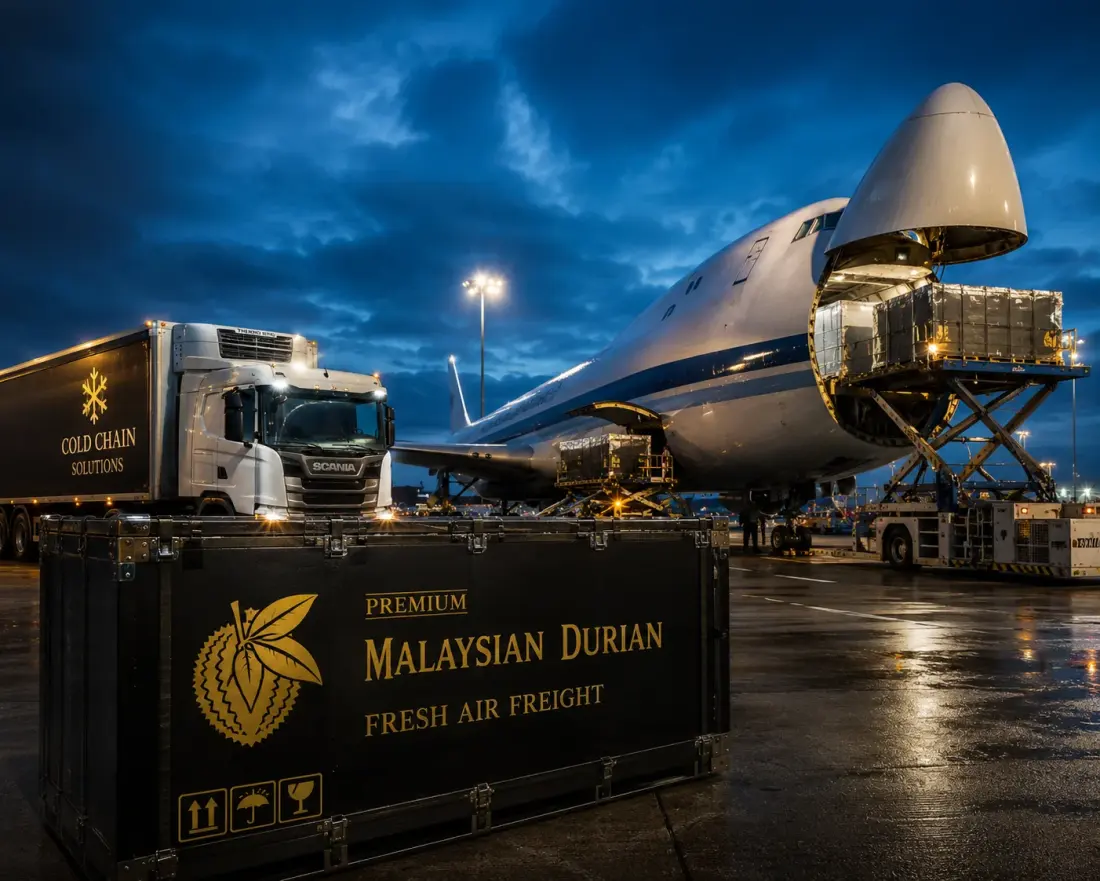
Fresh whole durian export to China requires maintaining fruit quality across a 3–5 day transit (sea freight) or 8–12 hour transit (air freight). The logistics requirements are substantial:
Temperature management: Whole durian must be kept at 13–15°C during transit. Below 10°C causes chilling injury — flesh discolours, texture degrades. Above 16°C accelerates ripening and increases spoilage risk on a 3–5 day sea voyage.
Harvest timing: Durian exported fresh must be harvested just before natural drop — when Brix is approaching peak (Musang King: 37–48 Brix) but the fruit is still firm enough to survive transit. This is a narrow window and requires experienced harvest judgment.
Packaging: Export-grade fresh durian is typically packed in individual compartmentalized trays, then boxed with ventilation holes. Whole fruits must be individually wrapped to prevent the spines of one fruit puncturing adjacent packaging.
Air vs sea freight: Air freight reaches Chinese cities in 12–24 hours (Kuala Lumpur to Shanghai). Cost: RM 15–25/kg freight. Sea freight via temperature-controlled reefer containers takes 3–5 days. Cost: RM 2–5/kg. For Musang King at RM 200–300/kg Chinese retail, air freight is viable. For lower-value varieties, sea freight is necessary for margin to work.
Update, September 2026: the rule that only pre-drop fruit can go by sea is being tested. A trial shipment of tree-drop ripe Musang King and Black Thorn reached Dalian in 12 days in a controlled-atmosphere container, arriving in what the companies describe as air-freight quality. It is one 2-tonne trial, not yet a regular route. What it means for natural-drop durian.
Who Controls the Trade
Exporter registration: Only farms with GACC registration can export whole fresh durian directly to China. As of 2024, several hundred Malaysian farms hold or are pursuing GACC registration. The process requires farm inspection, compliance with food safety and pesticide residue standards, and traceability documentation linking each consignment to a specific registered farm.
Middlemen and aggregators: Most individual small orchards do not export directly. They sell to aggregators — licensed exporters who consolidate fruit from multiple farms, handle cold chain, documentation, and Chinese customs clearance. This aggregation layer takes a margin (typically 10–25% of farm gate price) but handles the significant logistics burden.
Chinese importers: On the China side, licensed importers handle GACC compliance, Chinese customs clearance, and distribution into retail and wholesale markets. Major e-commerce platforms (Tmall, JD.com) have run direct durian sourcing campaigns.
Malaysia vs Thailand: The Competitive Reality
Thailand's position: Thailand is still the dominant durian supplier to China by volume. Monthong — the primary Thai export variety — is milder, less pungent, sweeter, and better suited to mass market Chinese consumers who are new to durian. Thai logistics infrastructure for China export is more developed. Thai durian reaches Chinese retail at RM 40–80/kg, significantly cheaper than Malaysian premium varieties.
Malaysia's position: Malaysia competes on premium differentiation, not volume. Musang King, Black Thorn, and other complex varieties command 2–4× the retail price of Thai Monthong in China. The consumer segment willing to pay these prices is smaller but growing rapidly — particularly in Tier 1 and Tier 2 Chinese cities.
Vietnam's emergence: Vietnam has expanded durian cultivation rapidly, particularly in the Mekong Delta region. Vietnamese durian entered China's GACC system and has been growing market share since 2022. Vietnamese durian is typically cheaper than Malaysian and positioned between Thai and Malaysian price points.
The competitive risk for Malaysia: Malaysia cannot compete on volume or price with Thailand or increasingly with Vietnam. The premium positioning is correct, but it depends on maintaining genuine quality differentiation and Chinese consumer willingness to pay the premium. Any quality control failure — pesticide residue exceedances, disease, inconsistent grading — would damage the premium brand significantly.
What Chinese Consumers Are Actually Buying
First-time buyers: Many Chinese consumers entering the durian category for the first time start with Monthong — the accessible, mild variety available at lower price points. This is the gateway product.
Upgrading consumers: As Chinese consumers gain familiarity with durian, a segment upgrades to more complex varieties. Musang King — with its bitter-sweet, custardy profile — is the primary upgrade target. Social media, particularly Douyin (TikTok), has dramatically increased Chinese consumer familiarity with Musang King as a premium variety.
Gift market: Musang King in China has developed significant gift market positioning — particularly during Chinese New Year and major festivals. Premium durian gift boxes (D-in-a-box, individual fruit wrapped in branded packaging) reach RM 300–600 per fruit at Chinese retail. This gift premium is significant for export economics.
The Policy Environment
GACC compliance ongoing: Export approval is not permanent. GACC can suspend approvals based on food safety non-compliance (pesticide residues, phytosanitary inspection failures). Malaysia has experienced temporary suspension episodes for individual exporters. Maintaining GACC compliance is an ongoing operational requirement.
Malaysian government support: FAMA (Federal Agricultural Marketing Authority) and MARDI (Malaysian Agricultural Research and Development Institute) have programs supporting durian export development, quality grading standards, and GACC registration assistance.
Trade relationship dependency: Malaysian durian export to China is substantially dependent on the bilateral trade relationship. Trade policy changes, tariff adjustments, or geopolitical friction between Malaysia and China would directly affect export volumes and pricing.
Practical Takeaway
Malaysia's durian export to China is a real and substantial trade — approximately RM 3.4 billion in 2022 and growing. It is driven by premium variety differentiation (Musang King, Black Thorn) rather than volume. The cold chain and GACC compliance requirements are significant barriers that favour organized, larger exporters over small individual orchards. Thailand dominates volume; Malaysia wins on premium pricing. Vietnam is an emerging competitive threat at the mid-price tier.
Common Questions
No. Only farms with GACC (General Administration of Customs and Quarantine) registration can legally export whole fresh durian to China. Registration requires farm inspection, food safety compliance, and traceability documentation. Processed or frozen durian has different regulatory pathways.
Musang King at Chinese retail typically reaches RM 150–300/kg (CNY 230–450/kg). Black Thorn is similar or slightly higher. Seasonal variation is significant — prices spike around Chinese New Year and Chinese summer months when demand peaks.
The price differential reflects air or sea freight costs (RM 2–25/kg depending on mode), cold chain logistics, GACC inspection and documentation, aggregator margin, Chinese importer margin, and retail margin. A fruit that sells for RM 80/kg at a Malaysian farm gate can realistically reach RM 250/kg at a Chinese retailer after all supply chain costs.
Thai Monthong (D159) is the primary export variety — it is sweeter, less pungent, firmer in texture, and more tolerant of extended cold chain. Brix ranges around 28–33. Malaysian Musang King is more complex — bittersweet, custardy, more intense sulfur aroma, Brix 37–48. Chinese consumers familiar with both typically rate Malaysian varieties higher for flavour complexity, with the price premium reflecting this.
The primary food safety concern for Chinese consumers is pesticide residue non-compliance. GACC standards require residue testing per shipment. Reputable importers with documented sourcing from registered farms carry lower risk. Informal channel imports (without GACC documentation) carry higher risk and are technically illegal for import.
China became the world's largest durian importing market by value, surpassing all other countries combined. Import values have grown at 15–25% annually in recent years. Consumer penetration of durian is still relatively low in China (~5% of population regular consumers) vs. Southeast Asia, suggesting continued growth runway.
Want to try fresh durian from our farm? We grow it at our own Bukit Serampang orchard in Tangkak, Johor, and sell it at our Melaka Mall stall. Stock varies daily — WhatsApp to confirm availability before you visit.
Ask About Today's Fruit