Malaysia has a genuine story to tell about durian. Musang King has built real brand recognition in China and among the Malaysian diaspora globally. The flavour profile of top Malaysian cultivars is distinct and well-regarded. But the conversation about Malaysian durian's export potential usually skips a fundamental question: how many of these farms actually meet the standards that export markets require?
The honest answer is: not many. Industry estimates suggest fewer than 20 percent of active Malaysian durian farms currently hold a valid MyGAP certification. That number hasn't been confirmed by a single official national audit, so it may be higher or lower depending on the region and the year. But the directional reality is clear — the gap between Malaysia's export ambitions and the certification infrastructure supporting those ambitions is large.
What MyGAP Actually Is
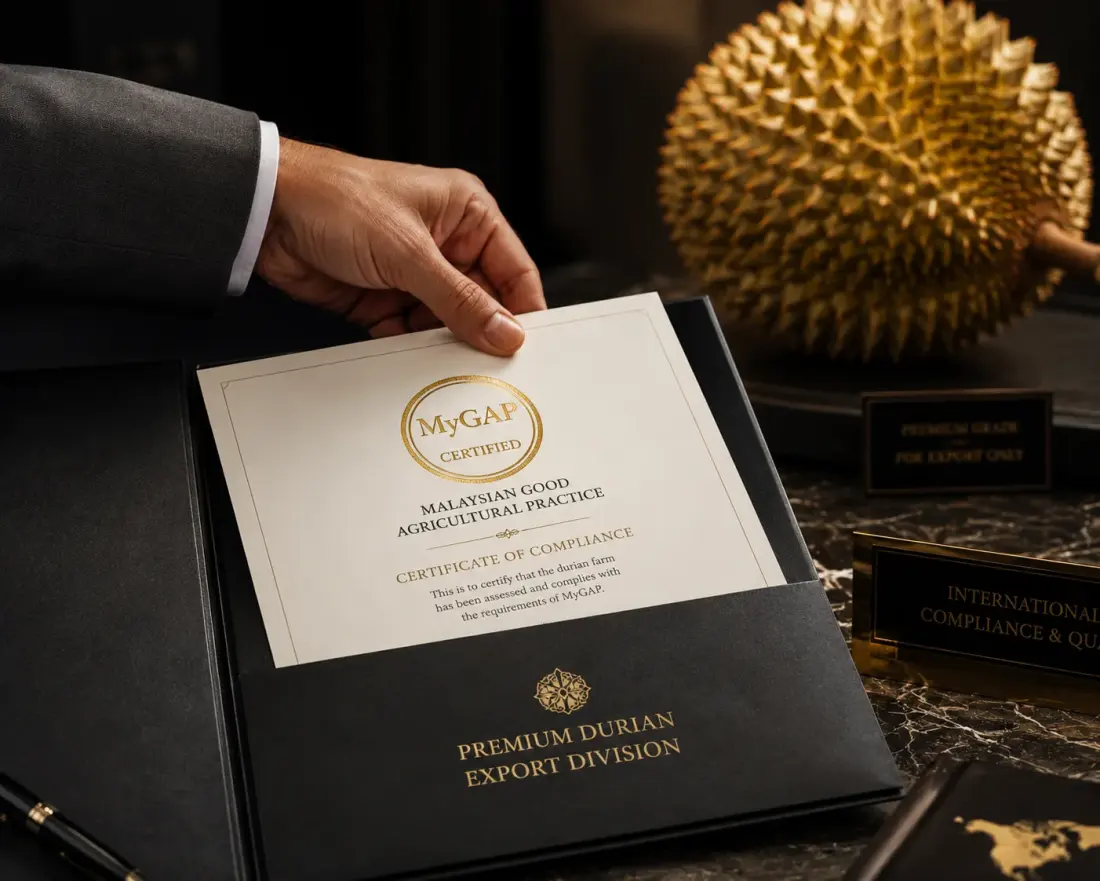
MyGAP stands for Malaysian Good Agricultural Practices, and it is the government's official framework for certifying that a farm meets defined standards in areas like pesticide management, soil and water use, nutrient application records, worker safety, traceability, and harvest hygiene. It's administered by the Department of Agriculture (DOA).
The certification is not a prestige award. It's a baseline operational standard — the minimum that a buyer in an export market has any reason to trust. A farm with MyGAP has documented processes. A farm without it may be managed just as carefully, but there's no systematic record that an external auditor or buyer can verify.
In practical terms, MyGAP functions as a credibility passport. Without it, you're essentially asking a buyer in Shanghai or Beijing to trust your word about how your farm operates, with no paper trail to back that up.
Why So Few Farms Have It
The reasons farms operate without MyGAP are consistent across the industry and aren't particularly surprising.
Documentation is a genuine burden. MyGAP requires ongoing record-keeping: spray logs, fertiliser records, harvest dates, soil test results, worker training records. For a family-operated farm of 3 to 10 acres — the most common scale in Malaysian durian farming — this level of administrative work requires time and capacity that many farm operators simply don't have.
Small farm economics. The average Malaysian durian farm is 3 to 10 acres. Thai commercial farms, by contrast, are often 50 to 200 acres. At small scale, the upfront cost of getting certified — assessments, compliance improvements, potential infrastructure upgrades — is a larger proportion of total farm revenue. For a farmer running a 5-acre Musang King plot, the ROI on MyGAP isn't obvious if they're selling domestically at the roadside or to a local dealer.
Domestic market orientation. Most Malaysian durian farmers sell fresh fruit locally — directly at the farm gate, to lorry traders, to wet markets, or increasingly to platforms like WhatsApp groups and online stores. For this market, buyers don't ask for certification. Price and freshness dominate the conversation. MyGAP adds cost without immediately adding revenue when the selling channel doesn't require it.
Traditional farm management. Many farms, particularly those operated by older growers, run on accumulated experience rather than formalized systems. This isn't a criticism of the farming knowledge itself — a 60-year-old durian farmer may understand their trees better than any agronomist. But that knowledge isn't systematized in a way that satisfies external audit requirements.
Low perceived urgency. As long as domestic prices are reasonable and local buyers keep showing up, there's limited pressure to change. The export market feels distant and complicated, and the benefits of certification are abstract compared to the immediate hassle of compliance.
The Export Market Doesn't Care About Flavour Alone
This is where the problem becomes structural rather than personal. The global market for durian has grown rapidly in the past decade, driven overwhelmingly by Chinese consumer demand. But what China's import system actually requires goes well beyond flavour preference.
China's General Administration of Customs (GACC) registration is a prerequisite for formal durian export. Without GACC approval — which requires MyGAP as a prerequisite — a farm cannot export durians to China through official channels. Full stop.
Beyond that, China's pesticide maximum residue limits (MRLs) under GB2763 are stricter than Malaysia's domestic standards for several compounds. An uncertified farm that uses pesticides according to Malaysian domestic guidelines may still fail Chinese import testing. When a shipment gets rejected at a Chinese port, the cost falls on the exporter — and the reputational damage affects the whole supply chain.
Cadmium testing is another area of increasing scrutiny. Soil cadmium levels in some durian-growing regions in Malaysia are elevated, and fruit from these areas can exceed acceptable thresholds in export markets. Certified farms must test and document, which at least produces data. Uncertified farms produce nothing traceable until a rejection happens.
The Thailand Comparison Is Instructive
The structural difference between Malaysian and Thai durian export infrastructure is not a recent development — it was built over 30 or more years of deliberate policy and industry coordination.
Thailand's major export advantage isn't a superior product. It's a supply chain. Centralized packing houses grade fruit to consistent standards. Cold chain from farm to port is maintained. Growers supply certified facilities that aggregate output into export-grade volumes. The whole system is built to satisfy institutional buyers at scale.
Compare this to Malaysia's fragmented structure. Most farms sell independently. There is no national network of certified aggregation points. A buyer wanting 20 tonnes of export-grade Musang King per month from Malaysia has no reliable way to source it — the supply is scattered across hundreds of small farms with inconsistent certification, inconsistent packaging, and inconsistent supply timing.
This structural gap is the real reason Malaysia's formal durian export numbers to China are far below what the popular narrative about "Malaysian durian in China" would suggest. Most Malaysian durian reaching Chinese consumers arrives through informal channels — carried by travellers, shipped through parallel trade routes — rather than registered export pathways. That's not a sustainable trade structure.
The Price Volatility Problem
The domestic market orientation of most Malaysian farms creates another vulnerability that is often overlooked: price exposure.
Musang King wholesale prices during peak season — June to August and November to January — can fall 40 to 60 percent from off-peak prices. When supply concentrates in a short window, prices drop sharply. Farms that sell exclusively domestically absorb all of that volatility. A grower who sells at RM 40 per kilogram in February may be selling at RM 16 or less in July when every farm in the region harvests simultaneously.
Export channels buffer this exposure. International buyers typically want consistent supply on fixed-term contracts, not price-opportunistic spot buying. A farm integrated into an export supply chain — with the certification and cold chain infrastructure to participate — can negotiate fixed prices that are lower than domestic peak but significantly higher than domestic trough. Over a full year, the realized price per kilogram is generally more stable and often higher.
This is one of the most underappreciated economic arguments for certification: it's not just about accessing a bigger market, it's about escaping the boom-bust cycle of the domestic fresh market.
What the Fix Looks Like
Nobody expects a 3-acre family farm to suddenly overhaul its operations and obtain international certification on its own. The structural solution requires institutional support.
Cooperative certification programs pool resources. A group of 10 to 20 small farms collectively pursuing MyGAP certification can share the documentation infrastructure, share audit costs, and share the technical assistance required for compliance. Several such programs exist in Malaysia but are still far from widespread.
Shared packing facilities — like Thailand's centralized grading houses — allow small farms to supply uncertified raw fruit to a centralized facility that handles grading, documentation, cold chain, and export compliance. The farmer doesn't need to be certified individually; the facility handles that layer. This model exists in Malaysian durian at very small scale, mostly in Pahang.
Farmer-to-exporter integration is the most sophisticated version. An exporter who needs consistent certified supply has economic incentive to invest in the farms supplying them — providing technical assistance, financing for compliance upgrades, and guaranteed offtake agreements in exchange for exclusivity and certification compliance. This kind of vertical integration is common in Thailand's export sector and almost absent in Malaysia's.
These are known solutions. The bottleneck isn't knowledge — it's the combination of short-term thinking, policy inaction, and a domestic market that has historically been stable enough to reduce urgency.
Practical Takeaway
For individual farmers, the question of whether to pursue MyGAP certification is an economic one: does the potential market access justify the compliance cost? For small domestic-only farms, the honest answer might be not yet. But as China's import standards tighten, as domestic demand becomes more price-volatile, and as formal export channels develop, the calculus shifts.
For the industry broadly, the MyGAP certification gap is not just a compliance issue — it's a structural constraint on how much of the global durian market Malaysia can realistically capture. Premium flavour without certification infrastructure doesn't scale.
The flavour is already there. The system around it needs to catch up.
Common Questions
MyGAP (Malaysian Good Agricultural Practices) is a government certification from the Department of Agriculture that confirms a farm meets defined standards for pesticide use, nutrient management, record-keeping, worker safety, and traceability. It's a baseline operational standard for organized farming.
Industry estimates put the figure at fewer than 20 percent of active farms, though this isn't an officially published national figure. The number varies by region and year.
No. The domestic market doesn't require it. You can sell to local dealers, at roadside stalls, or directly to consumers without any certification. MyGAP matters primarily when you want to access formal export markets.
Not through official channels. GACC registration — which China requires for formal food imports — lists MyGAP as a prerequisite. Without it, you cannot register your farm for formal export to China.
Small farm size makes individual certification economically difficult. Most farms sell domestically, where certification isn't required. Documentation demands are genuinely burdensome for traditional family operations. And historically, domestic prices were stable enough to remove urgency.
Thailand built centralized packing houses, standardized grading, and consistent cold chain infrastructure over 30+ years. Thai commercial farms also average 50 to 200 acres, versus Malaysia's typical 3 to 10 acres. The scale and infrastructure allow Thailand to supply institutional buyers reliably and at volume.
Cooperative certification programs that pool compliance costs across multiple farms, shared packing facilities that handle export compliance centrally, and farmer-to-exporter integration where exporters invest in farm-level compliance in exchange for supply agreements. None of these require individual farms to be large — they require coordination.
Not directly in the domestic market. But in export channels, certified farms can access fixed-price contracts that provide more stable revenue than the highly volatile domestic spot market. Musang King wholesale prices can swing 40 to 60 percent between peak and off-peak seasons domestically — export contracts typically narrow that range significantly.
Want to try fresh durian from our farm? We grow it at our own Bukit Serampang orchard in Tangkak, Johor, and sell it at our Melaka Mall stall. Stock varies daily — WhatsApp to confirm availability before you visit.
Ask About Today's Fruit