When buying durian, don't just trust "this one is very ripe." Truly ripe durian usually shows several signals at once: fragrance at the seams, clear shell lines, a stem that isn't overly dried out, a more hollow knock sound, and flesh with spring and oiliness when opened.
Two situations to avoid. First, underripe: flesh is hard, dry, and lacks fragrance — sweetness hasn't developed. Second, overripe: flesh is wet, sour, sometimes with an alcohol smell. Good ripeness sits in the middle — sweet, bitter, fragrant, fatty, and balanced in moisture.
What Durian Ripeness Actually Means
When durian is ripe, changes happen inside. Starches slowly convert to sugar, flesh softens, and aromatic compounds increase. Ripe durian commonly shows soluble solids around 25–48°Brix; some Musang King may reach 37–48°Brix, but this range varies by variety, tree age, rainfall, soil, and post-harvest timing.
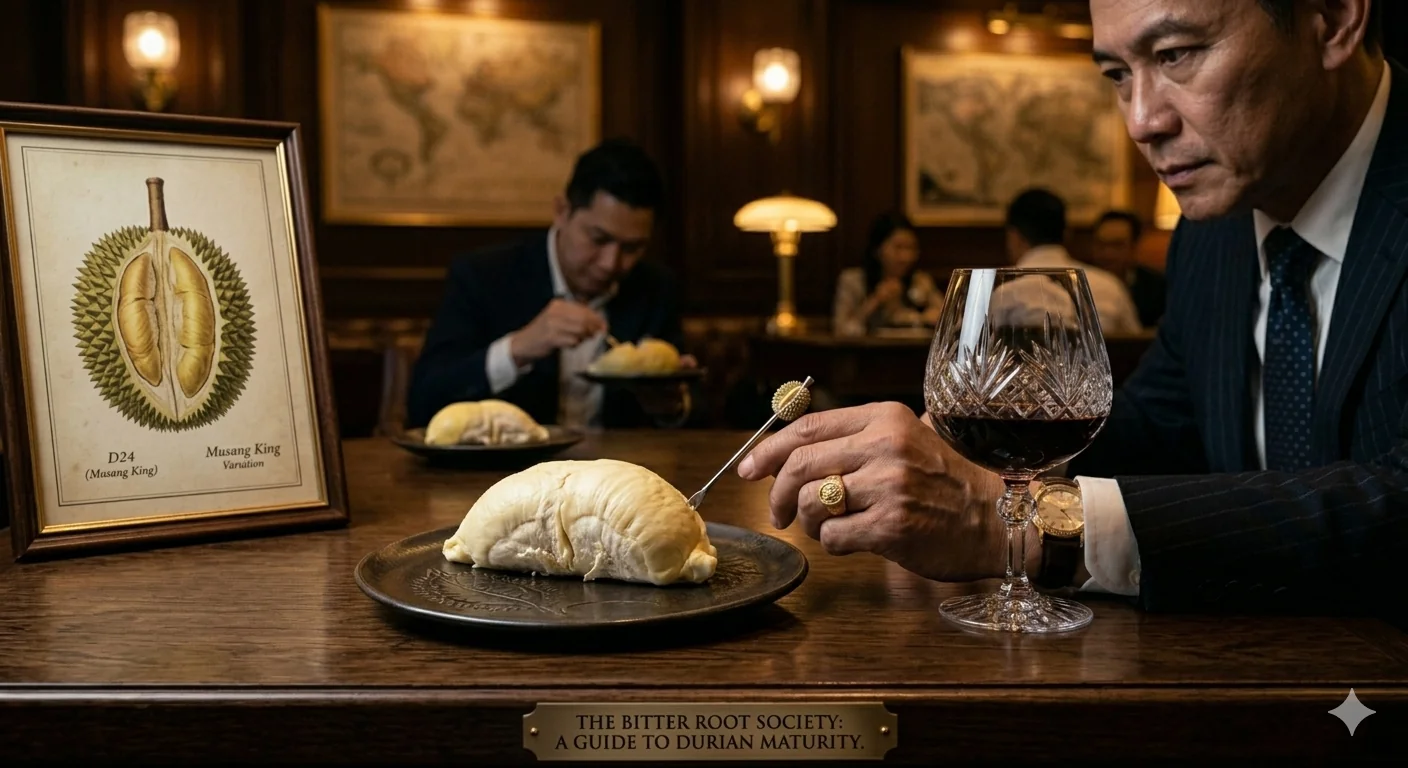
So different varieties cannot be judged by one standard. Musang King is commonly dense, sticky, sweet with a bitter edge. D24 is smoother with a nutty, creamy feel. Kampung durian varies most — even within the same basket. Judging ripeness means asking whether this particular variety has reached its own balance.
Smell the Shell Seams First, Not Just the Stem
Smell is useful, but you need to smell the right place. Bring the durian close to the seam lines. A ripe fruit typically has a sweet, creamy, lightly onion-like aroma — possibly with a natural fermentation note. This smell should feel complete, not harsh.
If there's almost no aroma, the fruit may be underripe, recently chilled, or the variety has a naturally mild aroma. If it smells sour, sharp, or like alcohol, fermentation has gone too far and the flesh is likely overripe. Tourists buying at stalls should especially watch out for that sour-alcohol smell.
Check the Seam Lines, Cracks, and Stem
The seam lines of a ripe durian are usually clear, as if the fruit is naturally preparing to open. Small cracks aren't necessarily bad, especially when the smell is clean. But if the crack is wet, leaking liquid, or smells sour, be cautious.
The stem also provides clues. On a freshly ripened fruit, the stem is usually not excessively dried. If the stem is very dry, wrinkled, and brittle, the fruit may have been sitting for some time. This doesn't automatically mean it's bad, but inspect the flesh more carefully after opening.
The Knock Sound
Stall sellers often knock durian to assess it. Ripe fruit can produce a more hollow, slightly resonant sound because the flesh has softened and may have separated slightly from the shell. Underripe fruit tends to sound tighter and more solid.
However, the knock sound isn't foolproof. Fruit size, shell thickness, variety, and compartment size all affect the sound. Treat the knock as supporting evidence — combine it with smell, seam condition, and flesh after opening.
Checking the Flesh After Opening — The Most Direct Test
After opening, the flesh is the most direct answer. Ripe flesh yields slightly under gentle pressure — it can feel like thick cream, soft butter, or dense paste, or have slight fibre depending on variety. It should not be hard like rubber, nor so wet it collapses.
Underripe durian commonly has hard, dry, starchy flesh with weak aroma. Overripe durian may be wet, sour, with obvious alcohol notes and loose texture. Soft isn't necessarily bad — but oily-soft and watery-collapsed are two different things.
More Clues: Spikes, Colour, Weight and When It Fell
Check the Spikes
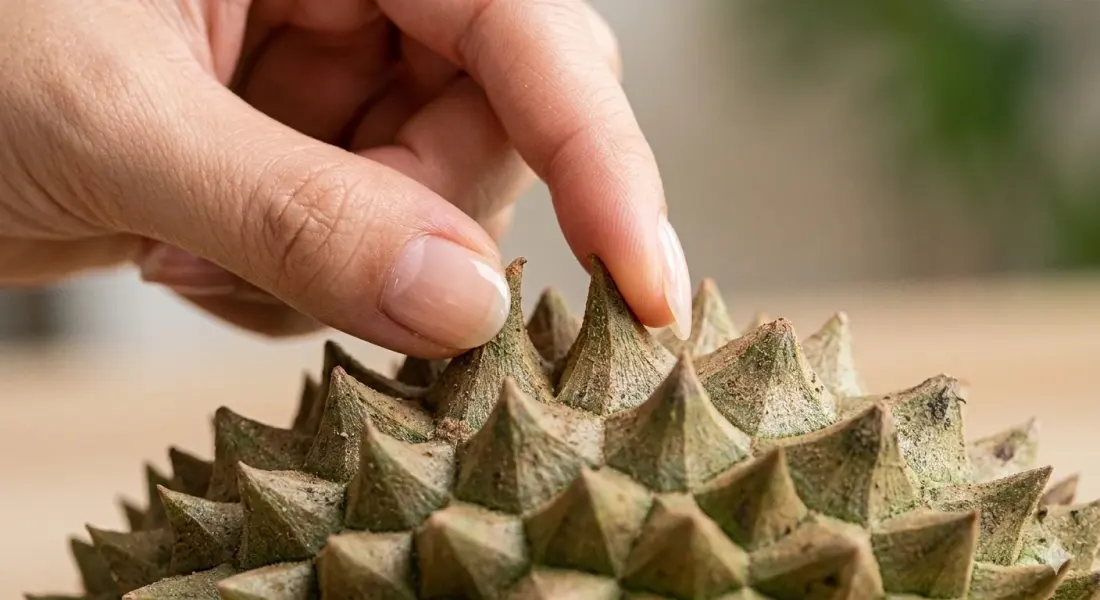
The spikes should be firm and evenly spaced, with a slight taper. For Musang King, the spikes are distinctly conical and well-spaced. For D24, they are closer together and slightly flatter.
Avoid fruit where the spikes are soft, bent, or broken in large numbers. Some surface damage is normal — durian is spiky and transport is rough — but widespread spike damage means the fruit took a hard hit, and the flesh inside may be bruised.
Look at the Colour — But Know Your Variety
Colour alone is unreliable unless you know what you are looking for. Musang King turns a deep golden-brown when ripe. D24 goes from green to a pale, yellowish-green. Black Thorn (Ochee) develops a dark, almost olive-brown hue.
A fully green durian is almost certainly under-ripe, regardless of variety. But a brown durian is not automatically good — it could be over-ripe or sun-damaged. Colour is a supporting clue, not the main signal.
Feel the Weight
Pick up two fruits of similar size. The heavier one usually has more flesh and thicker husk. A durian that feels light for its size may have dried out, or the segments inside may be thin.
This is not a perfect test — some varieties naturally have thicker husks — but as a quick comparison between two fruits at the same stall, weight is a useful tiebreaker.
Ask When It Fell
This is the single most important question. Tree-ripened durian — fruit that was allowed to mature on the branch and drop naturally — has a depth of flavour that hand-picked durian simply cannot match. The sugar content develops fully, the texture becomes creamy rather than fibrous, and the aroma reaches its peak.
Ask the seller: "Bila jatuh?" (When did it fall?) If the answer is "tadi" (just now) or "semalam" (yesterday), you are in good shape. If the seller hesitates or says it was picked, the fruit may still be decent, but it will not be at its best.
Practical Steps When Buying at a Stall
The most reliable approach: ask the seller to open it in front of you. Smell the flesh, not just the shell. Check for pooling liquid. Press one segment gently. If tasting is allowed, try a small piece. Don't just chase sweetness — good durian also needs aroma, fat feel, bitterness, and moisture balance.
If you're a tourist, ask directly: what variety is this, when was it opened, did this fruit fall today or yesterday? Honest sellers will usually explain clearly. Durian has natural variation — accepting that variation makes it easier to find fruit that suits your taste.
Common Questions
Smell the shell seams, check the seam lines, inspect the stem, and listen to the knock sound. When several signals agree, it is more reliable than any single sign.
Usually sweet, creamy, slightly onion-like, or naturally fermented. It should not smell clearly sour or like alcohol.
It can help for experienced buyers. A ripe fruit may sound more hollow and soft, while an underripe one sounds tighter, but it cannot be used alone.
Not necessarily. It could be underripe, recently chilled, or a variety with a naturally mild aroma.
It only indicates higher potential sweetness, not guaranteed quality. Aroma, fat feel, bitterness, and moisture all matter.
Flesh may be wet, sour, and collapsing, with an alcoholic or overly fermented smell.
Want to try fresh durian from our farm? We grow it at our own Bukit Serampang orchard in Tangkak, Johor, and sell it at our Melaka Mall stall. Stock varies daily — WhatsApp to confirm availability before you visit.
Ask About Today's Fruit