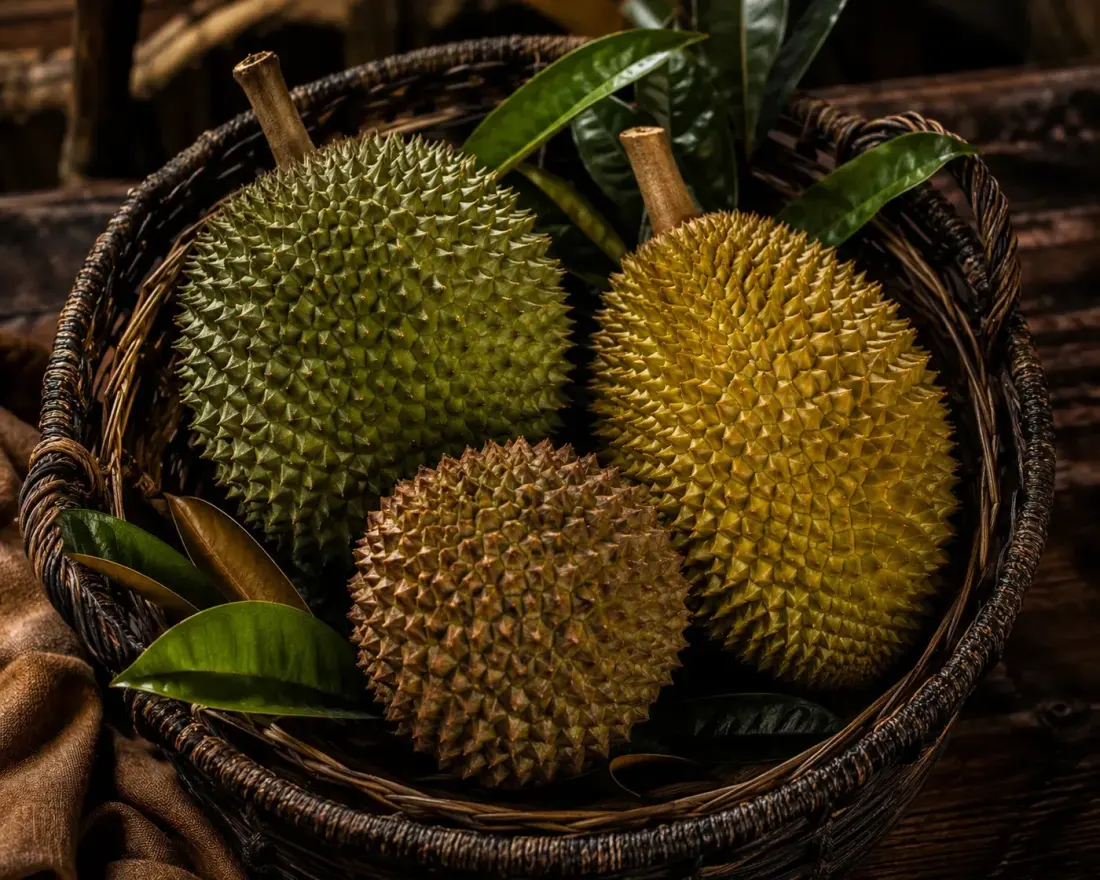
Everyone wants to plant Musang King. The name sells itself, the prices are visible, and the success stories are easy to find. What gets discussed less are the orchards that bet everything on a single variety and hit a difficult year — price collapse, pest pressure, or a narrow harvest window with no flexibility.
This is not an argument against Musang King. It is an argument for thinking about your orchard as a portfolio, not a single bet.
The Monoculture Problem
When your entire orchard produces one variety, two things become true simultaneously: your revenue is entirely dependent on that variety's market price at harvest time, and your biological exposure to disease and pests is entirely concentrated on that genetic line.
Musang King (D197) has a tight seasonal window — the main harvest falls in June–August, with a smaller second crop in some areas around November–January. In a good season, prices can run RM 30–60 per kilogram at farm gate for premium-grade fruit. In an oversupply year or during a cold export market, that price compresses significantly. If all your trees fruit at the same time and the market is weak that week, you have no adjustment available.
The biological argument is just as important. All D. zibethinus varieties share similar susceptibility to Phytophthora palmivora and Fusarium wilt. A monoculture orchard offers no diversity buffer — if a disease pressure rises in your area, all your trees are equally exposed. A mixed-variety orchard does not eliminate disease risk, but it means that a variety-specific pest or disease impact affects only a portion of your farm rather than the whole.
What Different Varieties Offer
The Malaysian durian market has distinct price tiers and demand patterns that reward variety diversification.
Musang King (D197) remains the dominant premium variety domestically and for export. Its price volatility is real — farm gate prices swing considerably between seasons. The variety is also more demanding in terms of management.
Black Thorn (D200) commands RM 80–150 per kilogram in premium buying channels when supply is tight. It has a smaller planted base, which means less oversupply risk in the near term. The trade-off is that it is even more finicky to grow and the demand base is narrower than Musang King.
D24 is worth examining for different reasons. It doesn't command the price of Musang King, but it has more consistent year-round demand from a broader consumer base, lower management intensity, and earlier fruiting compared to Musang King. D24 planted alongside Musang King adds a more predictable revenue stream.
Red Prawn (Ang Hae) has a dedicated following, particularly in northern Malaysia and among certain export buyers. The flavour profile — strong, creamy, moderately sweet — suits buyers who find Musang King too mild or Black Thorn too rich.
Harvest Timing: The Practical Reason For Variety Mix
Different varieties in the same orchard ripen at slightly different periods. A Musang King orchard has a harvest window of roughly 4–6 weeks. Add D24 trees — which typically fruit a few weeks earlier — and Red Prawn trees, which can extend into different months, and your effective harvest window extends from 6 weeks to 3–4 months.
This matters for three practical reasons:
- Labour — you are not trying to harvest, sort, and sell everything in the same compressed window
- Cash flow — income comes in over a longer period rather than as a single large pulse
- Buyer relationships — consistent supply over a longer season makes you a more reliable supplier to buyers who need continuity
Cross-pollination And Fruit Set
Durian is partially self-incompatible. A single-variety orchard relies on the same genetic line pollinating itself, which reduces pollination efficiency. Research on durian pollination indicates that having multiple varieties with overlapping flowering periods can improve fruit set by 15–25%.
Durian relies primarily on cave nectar bats (Eonycteris spelaea) for pollination, with some insect contribution. These pollinators are drawn to flowers by scent and nectar. A multi-variety orchard with staggered flowering times provides a longer period of floral resource availability, which supports pollinator populations more sustainably than a single mass-flowering event.
The Speculative Variety Problem
Every few years, a new named clone appears in the nursery market at RM 30–80 per grafted seedling — sometimes higher. XO, Tekka, Sunrise, and other named clones attract attention because of their unusual flavour profiles or the stories told about them.
Some of these varieties have genuine merit. Others have been propagated by nurseries on the basis of limited, anecdotal orchard data. The problem is simple: you will not know which category applies to your purchase until the trees fruit, which is 5–7 years away. The price volatility of these varieties is also significant — what commands RM 100 per kilogram today in a limited supply situation may be worth RM 30 when a larger planted base matures.
A practical rule: allocate no more than 10% of your planted area to experimental or new-release varieties that lack at least 3–5 years of documented commercial orchard performance in your soil and climate zone.
The Portfolio Approach
A balanced planting structure for a Malaysian artisan orchard might look like this:
60% main variety: Musang King (or whichever variety has proven demand in your specific selling channel) 30% secondary variety: D24, Black Thorn, or Red Prawn depending on your buyer relationships and local market 10% experimental or niche: a named clone with genuine upside potential, planted in limited numbers
This is not a rigid formula — your selling channels matter. If you have a direct relationship with an exporter who buys 80% Musang King, mirror that in your orchard composition. If you sell primarily to a pasar malam buyer who values D24, adjust accordingly.
The Thailand Comparison
Thailand's durian industry operates on a Monthong monoculture at scale — hundreds of thousands of hectares producing export-grade fresh Monthong for China. This model works because of export infrastructure, government support, centralized cold chain logistics, and a buyer base in China that has been trained to accept Monthong.
That context is different from a Malaysian artisan orchard. You do not have Thailand's scale or export infrastructure. Your competitive position is in variety, freshness, and the story behind your fruit — which are exactly the advantages that a multi-variety approach reinforces rather than undermines.
10-YEAR FINANCIAL COMPARISON
Consider a simple illustration for a 10-acre orchard:
Monoculture: 10 acres Musang King. In strong seasons (3 out of 10 years), farm gate returns run well. In oversupply or weak-market years (3–4 out of 10), compressed margins. In weather-event years (1–2 out of 10), partial crop loss. Revenue is highly variable with no buffer.
Multi-variety: 6 acres Musang King, 3 acres D24 or Black Thorn, 1 acre experimental. The D24 and secondary variety trees generate lower but steadier income in weak Musang King years. Total revenue is typically 5–15% lower in strong Musang King seasons (because fewer MK trees), but 20–35% higher in weak or variable seasons. Over 10 years, the cumulative revenue difference often favours the mixed orchard, and the volatility is significantly lower.
The exact numbers depend on your cost structure, selling channels, and the years you happen to experience. But the direction of the argument holds consistently across different market scenarios.
Practical Takeaway
You do not need to uproot your current Musang King trees. If you are in an early planting phase or adding acreage, consider dedicating 30–40% to secondary varieties. If you are at full capacity, manage variety diversity through your next replanting cycle. The goal is not to abandon Musang King — it is to reduce single-point exposure so that no single market event, pest pressure, or weather year wipes out your entire year's income.
Common Questions
D24 is the most practical pairing for most Malaysian orchards. It fruits earlier than Musang King (extending your harvest window), has consistent domestic demand, requires lower management intensity, and appeals to a different buyer segment. If you already have established export buyer relationships interested in Black Thorn, then Black Thorn is worth considering despite its higher management requirements.
When supply is limited and quality is high, Black Thorn commands prices that are hard to match with any other variety. The management difficulty is real — it is more sensitive to environmental stress, more prone to erratic bearing in some climates, and requires careful soil conditions. Whether the premium justifies the effort depends on your farm's soil profile and your access to buyers who will actually pay RM 80–150 per kilogram. Selling Black Thorn at D24 prices is a poor outcome.
At limited supply, some Tekka fruits have sold at those prices. That price reflects scarcity, not established market depth. Before allocating significant acreage, ask: who are the buyers at that price, and how many kilograms can they absorb? If the answer involves a handful of enthusiast buyers and social media attention, that is not a reliable commercial basis for long-term planting decisions. Plant it experimentally if you want to evaluate it — 5–10 trees, not 2 acres.
The ratio matters more than the absolute numbers. On a 2-acre farm, 60% MK / 30% secondary / 10% experimental translates to roughly 12 MK trees, 6 secondary variety trees, and 2 experimental trees in a typical planting density. This is entirely manageable and still captures the cross-pollination, harvest stagger, and market diversification benefits.
Yes. Durian is partially self-incompatible — cross-pollination between genetically different varieties is more effective than self-pollination within a single variety. Varieties that flower at the same or overlapping times will cross-pollinate through bat and insect activity. Check flowering time charts for your intended variety combination to make sure there is sufficient overlap.
In strong Musang King seasons, yes — marginally, because you have fewer MK trees. Over a full 10-year period that includes weak seasons, oversupply years, and weather events, the mixed orchard generally shows better cumulative revenue because D24 and secondary varieties continue generating income when MK prices are compressed. The revenue protection in bad years more than compensates the small reduction in peak years.
Thailand's Monthong model works because of scale (hundreds of thousands of hectares), established export infrastructure, government-managed cold chains, and a Chinese import market that has been built around Monthong. A Malaysian artisan orchard competing on freshness, variety, and quality narrative is not in that same competitive position. Copying a model that works at a different scale and with different market positioning is not necessarily the right choice.
Ask for documented commercial orchard data — not test plot data, not single-tree reports, but commercial-scale performance across at least 3–5 seasons in soil and climate conditions similar to yours. Talk to other farmers who have fruiting trees, not just nursery staff who are selling seedlings. Look at whether buyer demand for that variety is broad or narrow. If the data isn't there yet, limit your exposure to a trial plot.
Want to try fresh durian from our farm? We grow it at our own Bukit Serampang orchard in Tangkak, Johor, and sell it at our Melaka Mall stall. Stock varies daily — WhatsApp to confirm availability before you visit.
Ask About Today's Fruit