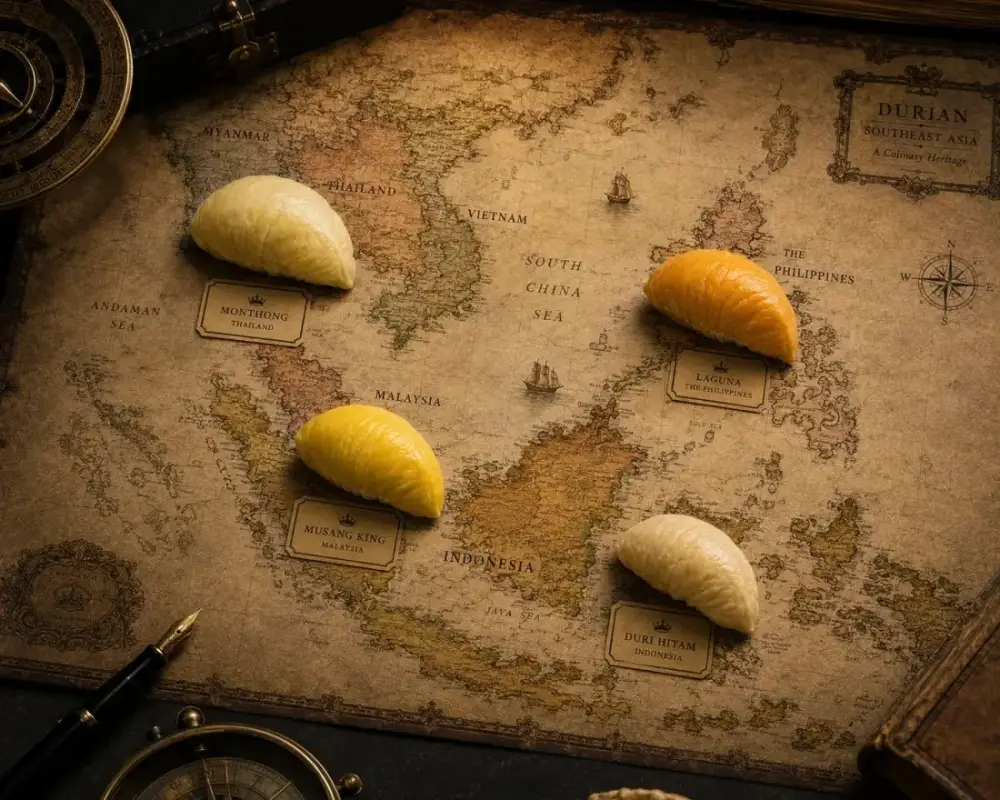
Durian is grown across a wide geographic range of tropical Southeast Asia, but the fruit from different countries tastes noticeably different. The difference is not simply marketing — it reflects genuine variation in cultivated varieties, soil chemistry, elevation, climate, harvest practices, and generations of local selective breeding.
Eating a Musang King from Pahang, a Monthong from Chanthaburi, a local cultivar from West Kalimantan, and a Ri6 from the Mekong Delta are four different flavour experiences with significant variation in sweetness, aroma, texture, and complexity. This comparison explains what drives those differences.
Malaysian Durian
Key varieties: Musang King (D197), Black Thorn (D200/Ochee), D24 (Sultan), Red Prawn (Ang Hae/D175), XO, D101, Tekka
Flavour profile: Malaysian premium varieties are typically characterized by intense complexity — bittersweet, custardy, with strong volatile sulfur compounds. Musang King Brix typically ranges 37–48 at peak natural-drop ripeness. The bitterness is a feature, not a defect — it provides the "lingering" characteristic that premium consumers value.
Geography: Primary production in Pahang (highest volume, Musang King heartland), Johor (significant variety diversity), Penang (Black Thorn origin, specialty microclimate varieties), Kelantan, Perak.
Altitude: Musang King orchards often at 200–800m elevation in Pahang hills. Higher elevation correlates with slower fruit development, more complex flavour accumulation, and higher Brix.
Harvest practice: Premium Malaysian orchards harvest after natural drop (self-fall) — the fruit falls when biologically ripe. This maximizes ripeness at harvest but requires immediate post-harvest handling. Trees are checked multiple times daily during peak season.
Export premium: Malaysia exports at the highest price per kilogram of any producing country. Musang King at Chinese retail RM 150–300/kg represents a 2–4× premium over Thai Monthong at the same market.
Thai Durian
Key varieties: Monthong (D159) — dominant, Chanee (D123), Kanyao (long-stemmed), Kradum
Flavour profile: Thai Monthong is milder, sweeter, and significantly less pungent than Malaysian premium varieties. Brix ranges 28–33 for good Monthong. The sulfur compound profile is lower — less ethanethiol and diethyl disulfide, resulting in a reduced "funk." The flesh is thicker and firmer, more tolerant of extended cold chain.
Geography: Central production in Chanthaburi, Trat, and Rayong (Eastern Thailand). Chumphon and the southern provinces, which now supply a large share of the crop.
Harvest practice: Thailand primarily harvests before natural drop — slightly underripe to tolerate the extended transit to export markets (particularly China, where Thai durian dominates volume). This practice optimizes for logistics over peak flavour.
Volume dominance: Thailand is the world's largest durian exporter by volume, supplying approximately 60–70% of global durian trade. China is the primary destination.
Consumer positioning: Thai Monthong is the "gateway" variety for new durian consumers — accessible, mild, non-threatening. It functions as the durian equivalent of a mild cheese compared to a strong blue — same category, fundamentally different intensity.
Indonesian Durian
Key varieties: Monthong (grown in Indonesia), Petruk (Central Java), Bawor (Banyumas), local varieties across Sumatra, Java, Kalimantan, and Sulawesi
Flavour profile: Extremely diverse. Indonesia has the world's greatest wild and cultivated durian diversity — the country spans an enormous geographic range with different soil chemistries, elevations, and microclimates. Sumatran wild durian varieties include species-level diversity beyond Durio zibethinus (D. graveolens, D. kutejensis, etc.). Quality varies from poor (mass-market plantation Monthong equivalent) to exceptional (specific microclimate varieties from Kalimantan highlands).
Geography: Significant production in North Sumatra, Central Java (Banyumas region), West Kalimantan, and South Sulawesi. Different regional varieties have distinct flavour characteristics.
Export development: Indonesia is developing its China export trade in competition with Malaysia and Thailand. GACC registration for Indonesian durian has been progressing. Indonesian durian typically enters China at lower price points than Malaysian premium varieties.
Wild and heritage varieties: Indonesia retains a significant population of wild Durio species — including D. graveolens (red flesh, sweet, with a complex aroma that lacks the intense sulfur of D. zibethinus). These heritage varieties are not commercially exported but have significant agricultural importance as rootstock and potential for breeding programs.
Vietnamese Durian
Key varieties: Ri6, Monthong (grown in Vietnam), Musang King (growing cultivation)
Flavour profile: Vietnamese Ri6 is sweet, less complex than Malaysian premium varieties, with moderate sulfur presence. Positioned as a quality step above Thai Monthong but significantly below Malaysian Musang King. Brix ranges approximately 26–32 depending on growing region and season.
Geography: Primary production in the Mekong Delta (Tien Giang, Ben Tre, Vinh Long provinces) — flat, low-elevation, alluvial soil environment that differs significantly from elevated Malaysian Pahang terrain.
Recent growth: Vietnam has been one of the fastest-growing durian producing countries since 2019. Rapid expansion of plantations in the Mekong Delta, with direct GACC export approval obtained for Chinese market access. Vietnamese durian has taken market share from Thailand in China's mid-price segment.
Quality considerations: Rapid plantation expansion has created significant quality inconsistency in Vietnamese durian. Soil in the Mekong Delta differs significantly from the laterite and forest soils of Malaysian highlands — resulting in a different flavour profile even for the same variety. Ri6 from the Mekong is distinctly different from Musang King from Pahang.
Head-to-Head Comparison
| Attribute | Malaysia | Thailand | Indonesia | Vietnam |
|---|---|---|---|---|
| Primary variety | Musang King | Monthong | Diverse | Ri6, Monthong |
| Typical Brix | 37–48 | 28–33 | 24–35 (varies) | 26–32 |
| Flavour complexity | Very high | Low-moderate | Variable | Moderate |
| Sulfur intensity | High | Low | Variable | Low-moderate |
| Export volume | Low-medium | Very high | Growing | Rapidly growing |
| Export price | Highest | Lower | Mid | Mid-low |
| Harvest practice | Natural drop | Pre-drop | Mixed | Mixed |
| Primary export market | China (premium) | China (volume) | China (developing) | China |
Practical Takeaway
If you want maximum flavour complexity and intensity: Malaysian Musang King or Black Thorn. If you want mild, sweet, accessible durian: Thai Monthong. If you want to explore variety diversity: Indonesian heritage varieties (harder to access commercially). If you want emerging mid-tier: Vietnamese Ri6.
The differences are real and significant. Trying Monthong after years of Musang King experience is genuinely surprising — it tastes like a different fruit category. This is not a marketing claim; it reflects genuine variety and agricultural differences.
Common Questions
Price reflects the variety (Musang King vs Monthong — fundamentally different complexity), the harvest practice (natural-drop vs pre-drop), post-harvest handling, and market positioning. Malaysian Musang King has been successfully positioned as a premium product with a 2–4× price premium over Thai Monthong at the same markets. Whether that premium reflects the actual flavour difference or marketing is a matter of consumer judgment.
Not lower quality in an absolute sense — it is a different type of quality optimized for different priorities. Monthong is optimized for logistics tolerance, accessibility, and mass-market sweetness. Musang King is optimized for flavour complexity and intensity. For consumers who prefer intense, complex durian: Malaysian wins. For consumers who want mild and sweet: Thai is the correct choice, not an inferior consolation.
Yes. The quality range in Vietnamese durian is wide — the best Vietnamese Ri6 from premium growers is genuinely enjoyable, positioned between Thai Monthong and Malaysian D24 in flavour intensity. Mass-market Vietnamese durian is more variable in quality.
Significantly different. D. graveolens has red or orange flesh, less sulfur presence, and a sweet, complex aroma that is less pungent than D. zibethinus. Many people who cannot tolerate standard durian aroma find D. graveolens more accessible. It is not widely commercially available outside Indonesia.
For cooking and baking: generally yes. Thai Monthong is actually sometimes preferred for baking because its lower sulfur content means its flavour holds better through high-heat processes. For fresh eating: the varieties are not interchangeable sensory experiences.
Want to try fresh durian from our farm? We grow it at our own Bukit Serampang orchard in Tangkak, Johor, and sell it at our Melaka Mall stall. Stock varies daily — WhatsApp to confirm availability before you visit.
Ask About Today's Fruit