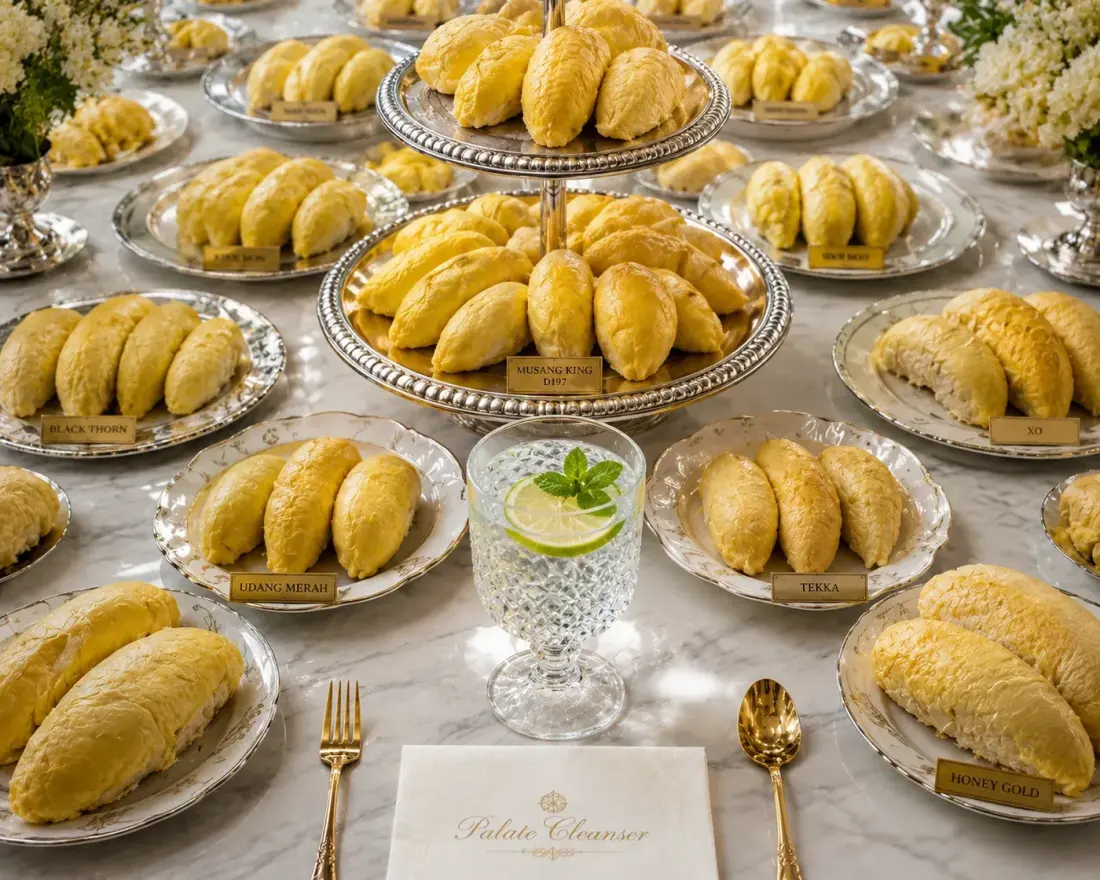
All-you-can-eat durian buffets exist across Malaysia, Singapore, and Thailand — particularly during peak durian season (June–August and December–February). Entry prices range from RM 40 for a basic spread (D24, D101, Red Prawn) to RM 100+ for premium variety events featuring Musang King and Black Thorn.
The fantasy is unlimited durian. The reality: most people hit their limit far earlier than expected. Durian is 147 kcal/100g, roughly 27g carbohydrates and 5g fat per 100g serving. It is dense, rich, and filling in a way that creeps up. Beyond a comfortable ceiling, it becomes genuinely unpleasant.
Here is how to get the most out of the experience without regretting the last three sessions.
Before You Go
Timing: Arrive on an empty or lightly empty stomach. Not starving — low blood sugar makes your judgment on "how much is enough" unreliable. A light meal 3–4 hours before is ideal.
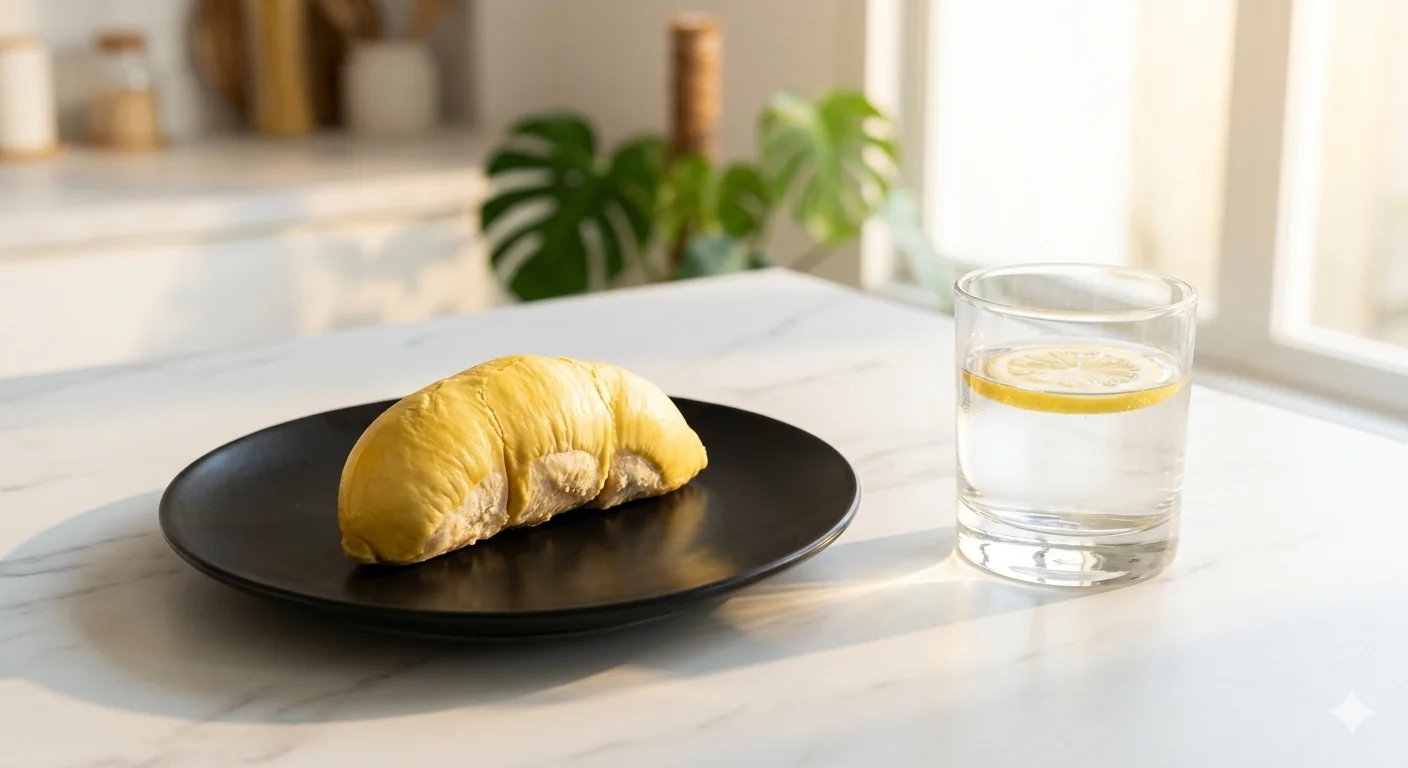
Hydration: Drink water adequately before arriving. Durian is high in fibre (3.8g/100g) and sweet, which means it draws fluid. Going in well-hydrated reduces bloating risk.
Avoid: Alcohol before a durian buffet. The ALDH inhibition mechanism means alcohol consumed before or during a durian session amplifies acetaldehyde accumulation. This is a reliable way to feel unwell within 30–60 minutes.
Clothes: Durian is sticky. The flesh and juice stain. Wear something you don't mind getting on it.
Strategy for the Spread
Start with mild varieties, build to strong. This is counterintuitive if you're a Musang King devotee, but starting with the most intense variety blunts your palate immediately. Begin with D101 or D24 — lower Brix, less sulfur — then progress to Red Prawn, then Musang King or Black Thorn. Each variety tastes distinct when approached in this sequence.
Why this matters: After two sessions of Musang King, your palate is saturated with bitterness and sulfur. D24 eaten after Musang King tastes flat. D24 eaten before Musang King tastes clean and lets you appreciate the transition.
How many varieties? Most buffets offer 4–8 varieties. Try all of them in the mild-to-strong sequence before going back for more of your favourite.
Seeds as calibration: Open seeds and check flesh thickness and seed-to-flesh ratio when evaluating which trees have better fruit that day. At a buffet, the quality variation between individual trees can be significant.
Managing Your Intake
The 400g ceiling: For most adults, approximately 300–400g of fresh durian pulp (not fruit weight — pulp only) is a comfortable maximum. This is roughly 2–3 standard segments of a full-size Musang King, or 4–6 segments of a smaller variety. At 147 kcal/100g, 400g is approximately 600 kcal from durian alone.
Pacing: The fullness from durian hits 20–30 minutes after eating, due to the fat content slowing digestion. If you feel 70% full, you are likely about to feel 100% full in 20 minutes. Stop before the signal arrives, not after.
Between varieties: Rest 5–10 minutes between variety changes. This gives your palate time to reset, and you'll taste each variety more accurately.
The shell water method: Many buffets provide the option to rinse hands and drink water from the shell. Use it between varieties — the tannins bind residual sulfur, giving your palate a partial reset between sessions.
What to drink: Coconut water, warm green tea, or plain water. Not carbonated drinks (bloating), not alcohol, not coffee.
Recognizing When to Stop
Signs you're at the actual limit:
- Slight headache (often from the richness and high sugar)
- Throat feels coated or warm
- Appetite is gone but you're considering eating more anyway
- You're eating slowly and the flavour seems less interesting
These are reliable signals. Durian is not like eating chips where you can eat past the limit with minimal consequence. The fat and fibre content means the physical result of overeating becomes apparent — nausea, heaviness, and gastric discomfort — particularly if you've eaten more than 500g.
Recovery if you overate: Light walking, warm ginger tea, and time. Lying down flat is the worst option — it promotes acid reflux. Sit upright or walk slowly.
Getting the Most Value
At premium buffets (RM 80–100+): Focus exclusively on the highest-quality varieties. If Musang King and Black Thorn are included, these should be your primary targets. D101 and D24 are easier to find and cheaper — they are filler at a premium event.
At standard buffets (RM 40–60): D24, Red Prawn, and D101 are the typical spread. These varieties are genuinely excellent at their price point — don't approach them as second-tier. A well-grown D24 from a good tree is a completely different eating experience from a mediocre Musang King.
Time of day: Most buffets run in afternoon or evening to align with peak tourist activity. Orchards that run early-morning buffets starting at 7–8am often have the freshest fruit — the overnight natural drops are collected in the morning for immediate consumption.
Buffets near orchards vs in town: Orchard-based buffets in Pahang (Raub, Bentong), Johor (Kluang), and Penang offer the freshest fruit with the shortest post-harvest time. Town-based buffets in KL or Singapore may source from multiple farms but add 1–2 days of transit time.
Practical Takeaway
Arrive lightly empty, hydrated, sober. Start mild (D101, D24), build to strong (Musang King, Black Thorn). Stop at 300–400g pulp. Drink coconut water or green tea, not alcohol. The experience is better at 350g of carefully selected fruit than at 700g of everything available.
Common Questions
RM 40–60 for standard variety buffets (D24, D101, Red Prawn) at local orchards or town venues. RM 80–120+ for premium variety events featuring Musang King, Black Thorn, and rarer clones. Singapore venues typically charge SGD 30–70+.
Peak season: June–August (main season) and December–February (off-season crop, smaller yield). Quality is highest at the peak of the main season (late June–July). During shoulder season, supply is lower and prices are higher, but top-quality fruit is still available. Off-season buffets (March–May, September–November) are less common and variety selection is limited.
For healthy adults without specific health conditions, 300–500g is safe. Beyond that, digestive discomfort becomes common. For people with diabetes or poor glycemic control, the high carbohydrate load (27g/100g) makes large portions inadvisable — see a physician before attending a buffet. People on certain medications (see the drug interaction article) should be especially cautious.
Children can safely eat durian in moderate portions. The rich fat and high sugar make large portions inadvisable for young children. A reasonable amount for a child is 50–100g. The strong smell and taste mean many children self-limit naturally.
D101 or D24. These are more accessible entry points — lower sulfur intensity, cleaner sweetness, good overall quality. Musang King as a first-ever durian experience can be too intense and may create a negative first impression that doesn't reflect the fruit's actual character.
Often significantly. At an orchard buffet, fruit from different trees (even the same variety) can vary in Brix, seed-to-flesh ratio, and flavour expression based on the individual tree's age, root health, and microclimate. Try fruit from multiple trees before settling on your favourite.
Want to try fresh durian from our farm? We grow it at our own Bukit Serampang orchard in Tangkak, Johor, and sell it at our Melaka Mall stall. Stock varies daily — WhatsApp to confirm availability before you visit.
Ask About Today's Fruit