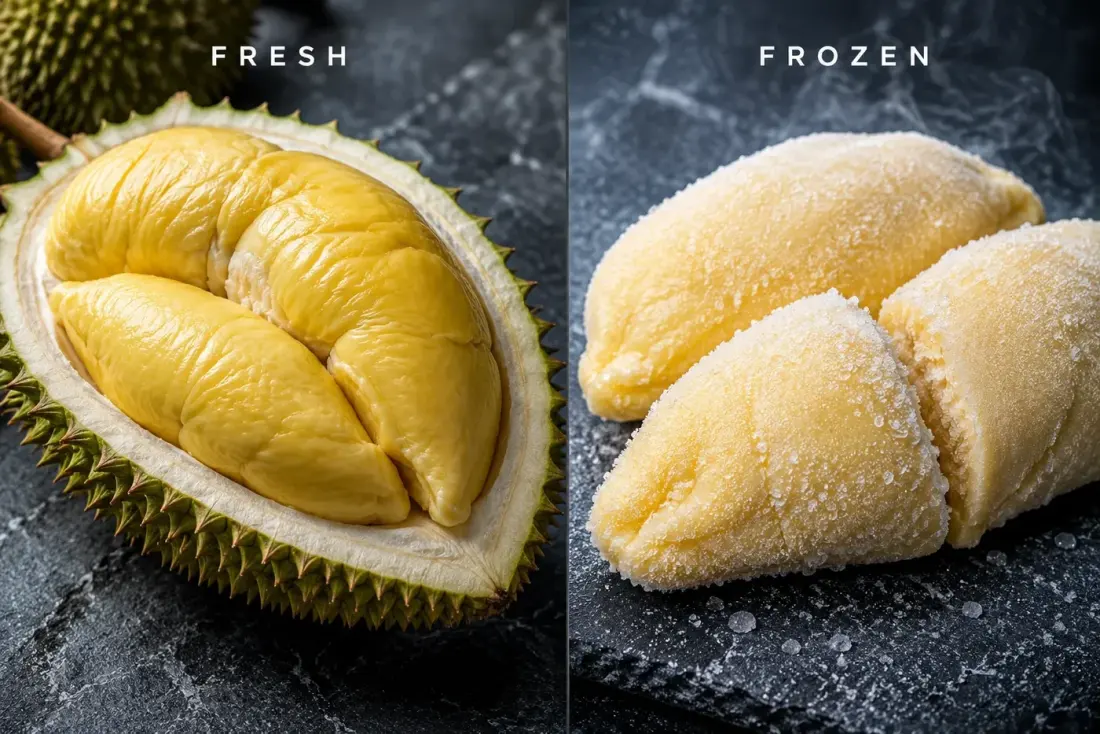
Short answer: Mostly no. Freezing keeps durian's minerals, fibre, fats, B vitamins and calories. Vitamin C takes the biggest hit. Freeze clean flesh airtight at -18°C or colder and eat it within 2–3 months.
You bought a whole Musang King at the market. You could not finish it, so you froze the leftovers. Now you are wondering — is that frozen durian still doing anything good for your body, or did the freezer kill all the nutrition?
The short answer: frozen durian retains most of its core nutrients, but some losses are real and measurable. Here is what actually happens inside the fruit when it goes below zero.
What Freezing Does at the Cellular Level
When durian flesh drops below -18°C (standard freezer temperature), the water inside the cells forms ice crystals. These crystals puncture cell walls. When you thaw the fruit, the damaged cells leak fluid — that is the watery pool you see on the plate after defrosting.
That liquid is not just water. It carries with it a portion of the fruit's water-soluble vitamins and minerals. The structural damage is physical, not chemical, but the nutrient loss happens because those compounds literally drain out with the drip.
Vitamin C Takes the Biggest Hit
Durian contains roughly 19–20 mg of vitamin C per 100g of fresh flesh. This is not exceptional compared to guava or kiwi, but it is a meaningful contribution.
Vitamin C (ascorbic acid) is the most vulnerable nutrient in any frozen fruit. Studies on frozen fruits generally show vitamin C losses of 15–30% after 3–6 months of frozen storage, depending on packaging and temperature stability. Durian is no exception. The high fat content of durian flesh (around 5%) does not protect vitamin C because ascorbic acid resides in the water phase, not the fat phase.
If your frozen durian has been in the freezer for more than two months, assume you are getting roughly 70–80% of the original vitamin C content, assuming it was sealed well.
B Vitamins Are More Stable
Thiamine (B1), riboflavin (B2), and niacin (B3) — all present in durian — are more resilient to freezing than vitamin C. These B vitamins are relatively stable at low temperatures. Losses are typically under 10% in properly frozen and sealed durian.
This matters because durian is one of the few tropical fruits with a notable B-vitamin profile. A 100g serving provides roughly 30% of the daily value for thiamine. Freezing preserves most of that.
Minerals Are Virtually Unaffected
Potassium (around 436 mg per 100g), magnesium, manganese, and iron — these minerals do not degrade with cold. They are elements. Freezing does not change their chemical structure. As long as you eat the flesh and do not discard the drip, your mineral intake from frozen durian is essentially the same as from fresh.
Fats and Fatty Acids Hold Up Well
Durian's fat content — primarily oleic acid and some palmitic acid — is relatively stable in frozen storage. Unlike fish oil or flaxseed oil, durian fat does not oxidise rapidly at freezer temperatures. You will not lose meaningful fatty acid content over a 3–6 month frozen storage period.
Fibre Is Completely Unchanged
Dietary fibre is structural. Freezing does not break down cellulose or hemicellulose in any meaningful way. The fibre content of frozen durian is identical to fresh. This is one area where there is zero compromise.
What About the Sulfur Compounds and Antioxidants?
Durian contains organo-sulfur compounds and various polyphenols that contribute to its antioxidant capacity. Research on these specific compounds in frozen durian is limited, but studies on similar sulfur-rich vegetables (like garlic and onions) show that freezing preserves most sulfur compounds well. Polyphenol losses in frozen tropical fruits generally range from 5–15%, which is modest.
The Real Culprit: Time and Temperature Fluctuation
The biggest enemy of frozen durian nutrition is not the freezer itself. It is how long it sits there and how many times the temperature fluctuates.
Every time your freezer door opens and closes, or during a defrost cycle, the temperature rises slightly. This causes small ice crystals to partially melt and then refreeze, growing larger each cycle. Larger crystals mean more cell damage, more drip loss, and more nutrient leakage.
A durian stored at a constant -18°C in vacuum-sealed packaging will retain significantly more nutrients than one stored in a loosely sealed container in a frost-free freezer that cycles temperatures.
Practical Takeaway
Frozen durian is not nutritionally dead. It is a reasonable way to preserve the fruit, and you still get most of the minerals, fibre, B vitamins, and fats. But if vitamin C and maximum antioxidant content matter to you, fresh durian wins.
If you must freeze, do it right:
- Remove the seed and extract clean flesh
- Vacuum seal or use airtight containers with minimal headspace
- Keep at consistent -18°C or below
- Use within 2–3 months for best nutrient retention
- Do not refreeze after thawing
Yes. Calories come from macronutrients — carbohydrates, fats, and proteins — none of which are destroyed by freezing. A 100g serving of frozen durian has the same caloric value as fresh, roughly 147 kcal.
You can, but it is not recommended. The shell makes it harder to seal properly, and the flesh near the shell may develop off-flavours from oxidation. Extract the flesh first, then freeze in portions.
For best nutrient retention, use within 2–3 months. After 6 months, vitamin C losses can exceed 30–40%, and texture degrades noticeably. The fruit is still safe to eat but nutritionally diminished.
If the durian stayed frozen solid (below 0°C) and was not above 4°C for more than 2 hours, it is safe. If it fully thawed and sat at room temperature for several hours, discard it. Durian's high sugar and fat content make it prone to bacterial growth once warm.
Yes, indirectly. Higher-fat varieties like Musang King (D197) and Black Thorn (D200) tend to freeze and thaw with better texture than lower-fat varieties because the fat provides some structural cushioning. But nutrient loss rates are similar across varieties.
Thaw slowly in the refrigerator (4°C) over 6–8 hours. This minimises drip loss because the gradual temperature change produces smaller ice crystals during the thawing process. Room-temperature thawing causes faster cell rupture and more nutrient leakage.
Yes. Cooking with frozen durian (in desserts, pastries, or sauces) still delivers fibre, minerals, B vitamins, and fats. The heat will cause additional vitamin C loss, but if you were going to cook it anyway, frozen is a practical and still nutritious option.
Commercially frozen durian is typically flash-frozen at -40°C or lower within hours of processing. This rapid freezing creates smaller ice crystals and causes less cell damage than home freezing. In some cases, commercially frozen durian may retain more vitamin C than durian you freeze at home, simply because the industrial process is faster and colder.
Sources
- Rickman JC, Barrett DM, Bruhn CM (2007). Nutritional comparison of fresh, frozen and canned fruits and vegetables. Part 1. Journal of the Science of Food and Agriculture 87: 930–944. Link
- U.S. Department of Agriculture. Durian, raw or frozen (FDC 168192). FoodData Central. Link
Fresh durian, farm-direct. Stock changes daily — WhatsApp us before you visit.
Check Today's Stock