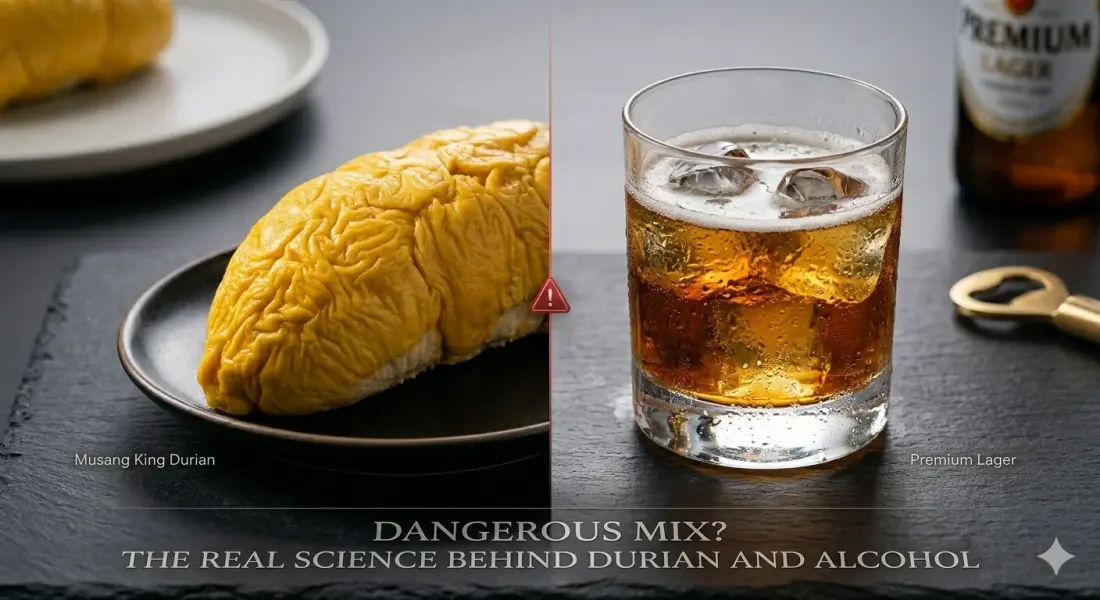
Short answer: Don't mix them. Durian's sulfur compounds slow the enzyme that clears alcohol, so a toxic by-product builds up, causing flushing, nausea and a racing heart. It is rarely deadly, but the effect is real. Leave at least 3–4 hours between eating durian and drinking.
You have probably heard the warning from older relatives: never eat durian and drink alcohol together. Some say it causes death. Others dismiss it as an old wives' tale. The truth sits somewhere in between, and the science behind it is more interesting than the myth.
From our orchard
When customers at our Melaka Mall stall ask whether they can have a beer after durian, our answer is simple: wait a few hours, and don't mix a big durian session with heavy drinking. It won't kill a healthy person, but the flushing, racing heart and nausea are real and not worth it.
What Actually Happens in Your Body
Durian contains high concentrations of sulfur compounds, including volatile sulfur-containing chemicals such as diethyl disulfide and related mercaptans. These compounds inhibit the enzyme aldehyde dehydrogenase (ALDH), with documented inhibition varying by individual and amount consumed.
Here is why that matters. When you drink alcohol, your body breaks it down in two steps:
1. Ethanol converts to acetaldehyde (a toxic compound) 2. ALDH converts acetaldehyde into harmless acetic acid
When durian's sulfur compounds partially block ALDH, acetaldehyde accumulates in your bloodstream. This is the same mechanism behind the "disulfiram reaction" — the unpleasant response that occurs when people take the medication disulfiram (Antabuse), which deliberately blocks ALDH to deter alcohol consumption.
What You Will Actually Feel
The reaction is not instant death. It is more like an amplified hangover that hits faster and harder:
- Flushing of the face and neck
- Rapid heartbeat and palpitations
- Nausea and sometimes vomiting
- Headache and dizziness
- General discomfort lasting 30 minutes to several hours
For most healthy adults, a small amount of durian combined with a small amount of alcohol causes discomfort, not a medical emergency. The danger increases significantly with large quantities of both, or for people with pre-existing heart or liver conditions.
The Real Risk Groups
- People with heart disease or arrhythmia: palpitations and blood pressure fluctuations can trigger serious cardiac events
- People with liver impairment: already reduced ALDH function means even partial inhibition is more dangerous
- People on medications that also affect ALDH: certain antibiotics and some diabetes drugs
- Elderly individuals: slower metabolism prolongs acetaldehyde clearance
Where the Myth Comes From
The myth persists for several reasons:
- The symptoms feel alarming. Flushing, nausea, and rapid heartbeat can feel like a medical emergency, even when they are not.
- Durian is already calorie-dense and high in sugar. Eating a large amount alone can cause bloating and discomfort. Alcohol amplifies this.
- Rare case reports exist involving people with pre-existing heart or liver conditions. These edge cases get generalized into "durian kills."
- Traditional medicine framing. Some Southeast Asian medical traditions classify both durian and alcohol as "heaty," making their combination seem doubly dangerous.
What the Research Shows
A study from the University of Tsukuba (Japan) confirmed that sulfur compounds in durian inhibit ALDH in laboratory conditions. The inhibition is measurable and real. However, the study did not conclude that the combination is lethal — only that it causes acetaldehyde accumulation and associated discomfort.
No peer-reviewed study has documented a healthy adult dying solely from consuming durian with alcohol.
Practical Takeaway
If you have just eaten durian, wait at least 3 to 4 hours before drinking alcohol. If you have been drinking, wait until you are fully sober and the alcohol has cleared your system before eating durian. The sulfur compounds in durian are typically metabolized within a few hours, so a gap of several hours significantly reduces the interaction.
This is not about fear — it is about giving your liver a fair chance to do its job.
Not directly in most cases. The combination causes an accumulation of acetaldehyde, leading to severe discomfort. Death is extremely rare and is associated with very large quantities combined with pre-existing conditions, particularly heart or liver disease. The risk is real enough that health authorities in several Southeast Asian countries have issued formal advisories — it is not purely mythical.
At least 3 to 4 hours in either direction. This gives your body time to metabolize the sulfur compounds from durian or the alcohol from your drink.
No. The interaction is with ethanol itself, not the type of drink. Beer, wine, spirits, and rice wine all carry the same risk when combined with durian.
If you are still feeling the effects of alcohol or have a hangover, your body is still processing acetaldehyde. Wait until you are fully sober and have eaten a normal meal first.
Individual metabolism varies. Some people have naturally higher ALDH activity and may not notice mild symptoms. However, the biochemical interaction still occurs even if symptoms are not obvious.
Cooking reduces some volatile sulfur compounds but does not eliminate them entirely. The risk is lower but not zero. Durian paste, chips, and desserts still contain sulfur compounds sufficient to cause a mild interaction.
Drink plenty of water, sit or lie down in a safe position, and monitor your symptoms. If you experience chest pain, difficulty breathing, or loss of consciousness, seek medical attention immediately.
Durian is the most well-known case, but other foods high in sulfur compounds can have a milder version of this effect. Durian's concentration of these compounds is unusually high, which is why the warning is so strongly associated with it.
Sources
- Maninang JS, Lizada MCC, Gemma H (2009). Inhibition of aldehyde dehydrogenase enzyme by durian (Durio zibethinus Murray) fruit extract. Food Chemistry 117(2): 352–355. Link
- Li JX, Schieberle P, Steinhaus M (2012). Characterization of the major odor-active compounds in Thai durian (Durio zibethinus L. 'Monthong'). Journal of Agricultural and Food Chemistry 60(45): 11253–11262. Link
Durian Khakha is a durian grower, not a medical provider. For personal health advice, speak to your doctor.
Fresh durian, farm-direct. Stock changes daily — WhatsApp us before you visit.
Check Today's Stock