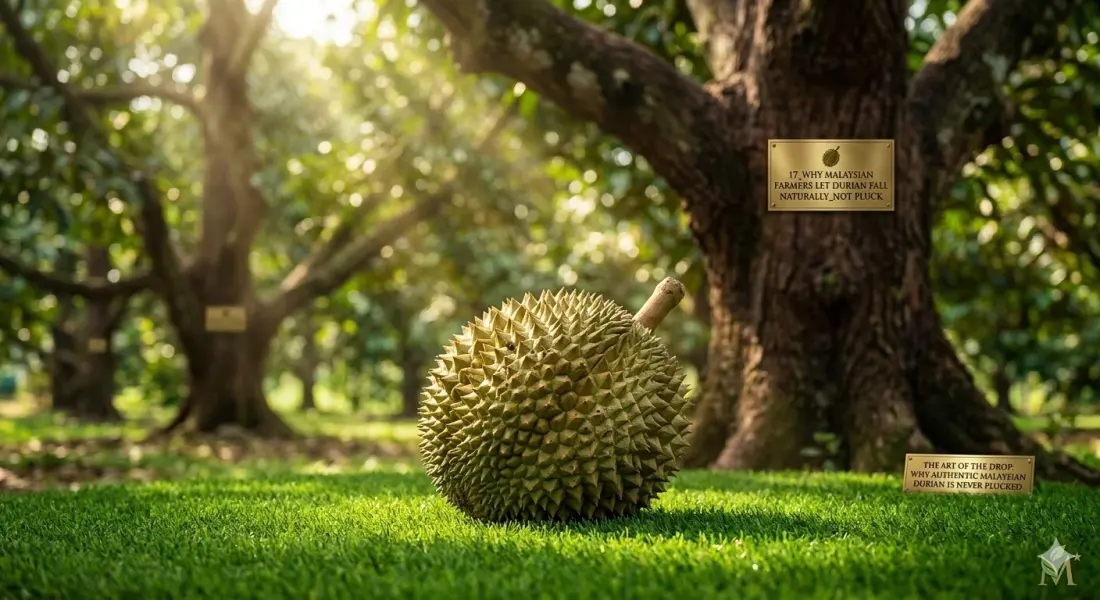
Walk through any durian orchard in Pahang or Penang during harvest season, and you will notice something unusual. There are no ladders. No long poles with hooks. No workers reaching up into the canopy to pull fruit off the branches. Instead, you see nets strung between trees, and farmers sitting under tarps, waiting.
They are waiting for the durian to drop.
This is not laziness. It is not tradition for tradition's sake. It is a deliberate agricultural decision rooted in how the fruit develops its flavour, texture, and aroma. Understanding why durian must fall on its own tells you more about what makes a good durian than any grading label ever could.
The Science of Natural Abscission
Durian does not ripen the way many fruits do. Once a durian is detached from the tree — whether plucked, cut, or pulled — its internal development stops almost immediately. The complex chain of enzymatic reactions that convert starches into sugars, that build the volatile sulfur compounds responsible for durian's distinctive aroma, and that soften the flesh into its characteristic creamy texture — all of this requires the fruit to remain attached to the tree until the very last moment.
When a durian reaches full maturity on the tree, a thin layer of cells at the stem junction, called the abscission layer, begins to form. This layer weakens the connection between fruit and branch. The durian is still attached, but barely. It is at this precise point — when the abscission layer has formed but the fruit has not yet fallen — that the durian has accumulated its maximum sugar content, typically between 28 and 35 Brix depending on the variety, and its full aromatic profile.
If a farmer plucks the fruit even one or two days before this point, the durian will still be edible, but it will lack the depth of flavour and the creamy, almost custard-like texture that commands premium prices at market. The flesh may taste slightly starchy or flat. The aroma will be muted.
What Happens After the Fall
Once the durian drops, the clock starts. Malaysian farmers typically collect fallen fruit within 12 to 24 hours. The fruit continues to undergo subtle changes after falling — the shell begins to open slightly along its natural seams, and the flesh softens further. But this post-fall window is narrow. After 48 hours, the durian begins to degrade. The flesh can become overly soft, watery, or develop off-flavours from microbial activity.
This is why timing matters so much in the orchard. Farmers check their trees early in the morning and again in the late afternoon, collecting fruit that has fallen overnight or during the day. The fruit is then sorted, graded, and transported to markets or processing facilities as quickly as possible.
The Practical Reality
There is also a practical reason farmers do not climb trees to harvest durian. The trees are tall — often 25 to 50 metres at maturity. The fruit hangs at the top of the canopy, attached by a thick but short stem. Climbing these trees is dangerous, and the risk of damaging the fruit or the branches during harvest is high. A damaged branch means fewer fruiting sites the following season.
Nets and ground collection are simply safer and more efficient. Farmers spread nets beneath the canopy to catch falling fruit, which also prevents the durian from hitting the ground and cracking open. A cracked durian sells for a fraction of the price of an intact one.
What This Means for You as a Buyer
When someone tells you that their durian is "tree-ripened" or "naturally fallen," they are not using a marketing buzzword. They are describing a fundamental requirement for quality durian. A durian that was plucked green and ripened off the tree — as is sometimes done for export to meet shipping timelines — will never match the complexity of one that was allowed to complete its full development on the branch.
This is also why fresh durian from a Malaysian orchard, eaten within a day of falling, tastes fundamentally different from frozen durian that has been shipped overseas. The frozen product is often excellent, but it is a snapshot of the fruit at the moment it was processed, not the culmination of a full on-tree ripening process.
Durian does soften and open slightly after falling, but it does not continue to develop sugars or aroma the way it does on the tree. The major flavour development happens while the fruit is still attached. Post-fall, the window for optimal eating is 12 to 48 hours.
Judging ripeness from the ground is unreliable. A durian can look mature on the outside while still developing internally. The abscission layer — the natural separation point — is the only reliable indicator that the fruit has finished its development. Plucking before this point means the fruit has not reached its full potential.
Safety is not the primary reason for natural falling. The main reason is flavour and texture development. However, naturally fallen durian does tend to have a more intact shell since it was not pulled or cut, which can reduce the chance of contamination at the stem wound.
Experienced farmers watch for signs: the fruit's skin colour shifts from deep green to a slightly lighter green or yellowish-green, the smell becomes detectable from the ground, and the stem begins to dry and thin. Some farmers also gently shake branches to test if fruit is loosely attached, though this risks knocking off fruit prematurely.
Yes. Whether it is Musang King, D24, D101, or any other variety, the principle is the same. All durian varieties develop their best flavour when allowed to mature fully on the tree and detach naturally. Some varieties may have slightly different drop windows — Musang King tends to drop around 90 to 100 days after flowering, while other varieties may vary by a week or two.
This is partly related to harvesting practices. Thai durian, particularly for the Chinese export market, is often harvested at 70 to 80 percent maturity (plucked) to survive the shipping process. Malaysian durian sold domestically is more likely to be naturally fallen, which preserves the full flavour profile. This is a generalisation — excellent Thai durian exists — but the harvesting method is one factor among many.
If you are buying whole durian that was naturally fallen and is fresh, store it at room temperature and eat it within 24 hours of purchase. Do not refrigerate a whole durian you plan to eat soon — cold temperatures halt the subtle post-fall softening process. Once opened, refrigerate the flesh and consume within two days.
From pollination to natural drop, most durian varieties take between 90 and 120 days. The exact duration depends on the variety, weather conditions, and tree health. Rainfall and temperature during the final weeks of development have a significant impact on sugar accumulation and aroma.
Fresh durian, farm-direct. Stock changes daily — WhatsApp us before you visit.
Check Today's Stock