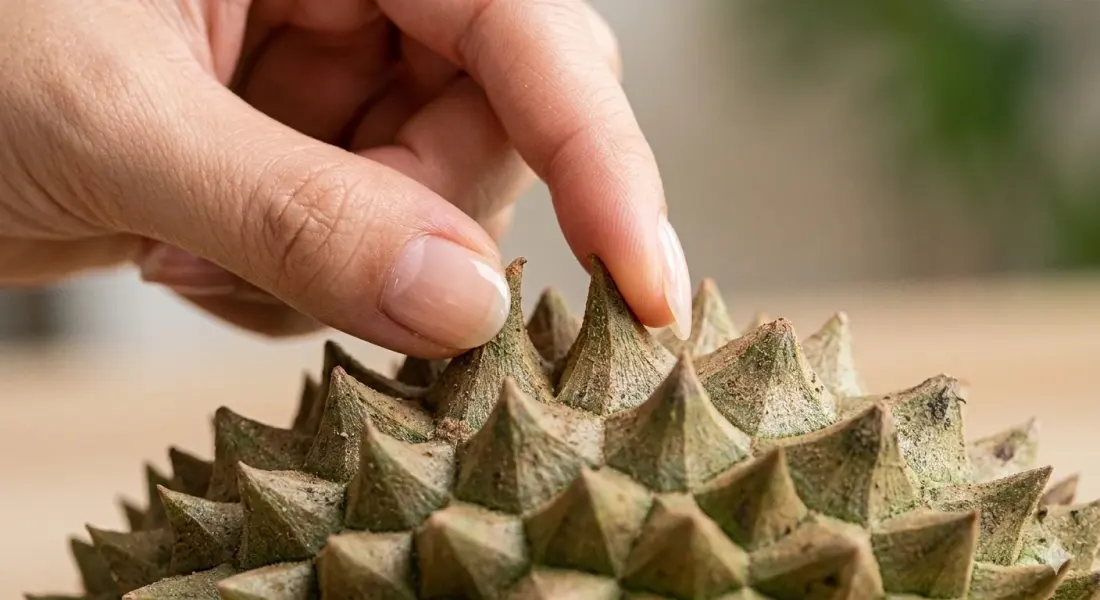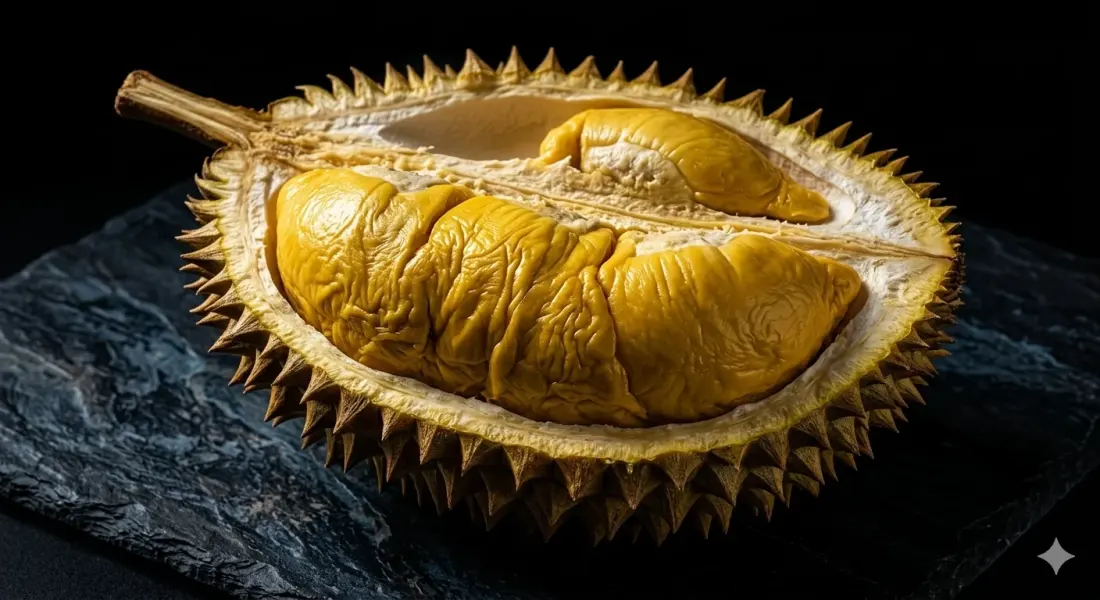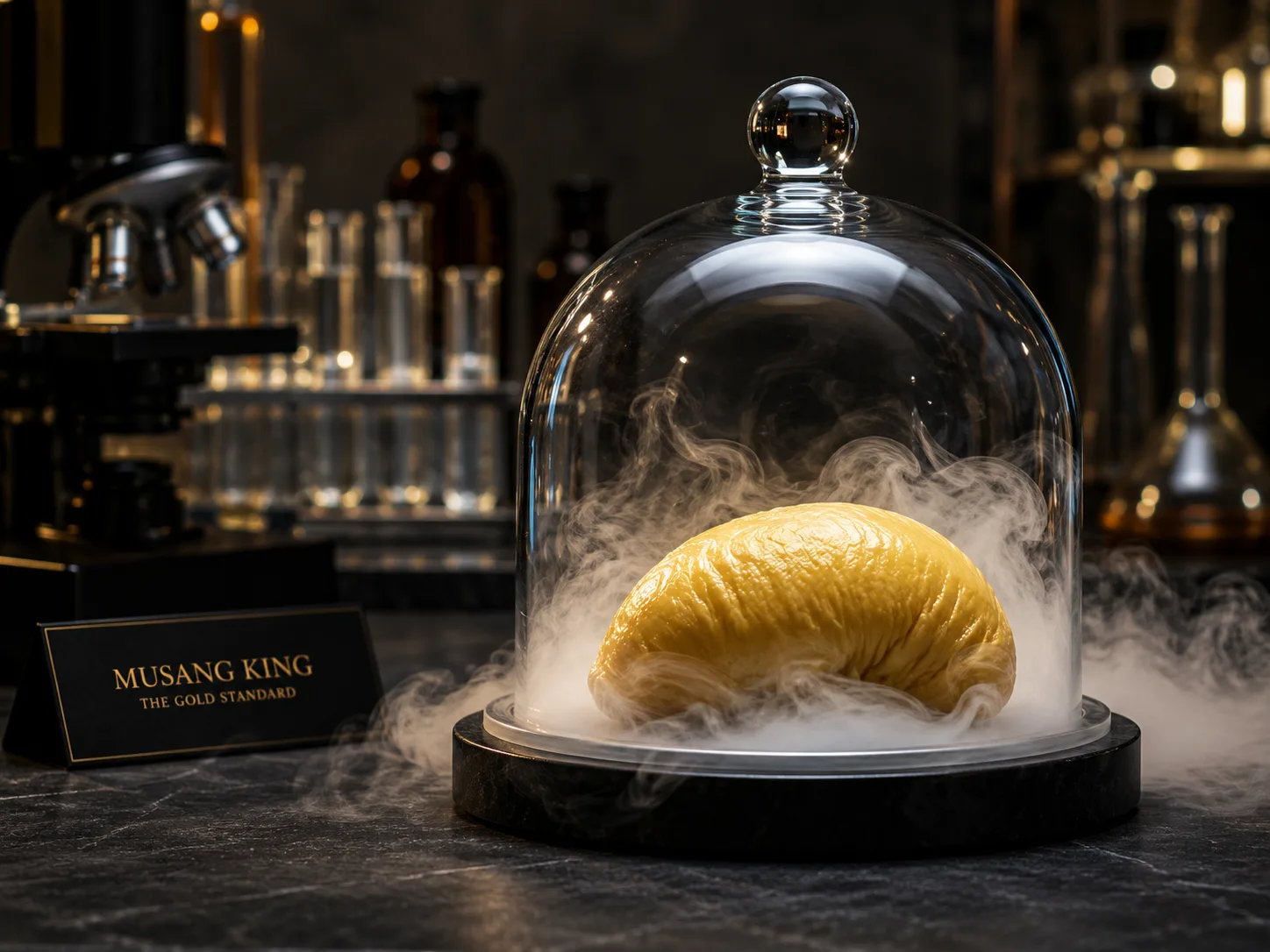
No other fruit provokes the reaction durian does. People either recoil from a hotel hallway or queue for hours at a stall. The gap between what durian smells like and what it tastes like is one of the more interesting puzzles in food chemistry — and the answer involves sulfur, fermentation biology, and how the human brain processes conflicting sensory signals.
The 44 Compounds Behind the Smell
In 2012, researchers at the German Research Centre for Food Chemistry used gas chromatography-olfactometry to identify the key aroma compounds in Thai Monthong durian. They found 44 odour-active compounds spanning several chemical classes:
- Esters (fruity, sweet notes): ethyl propanoate, ethyl 2-methylbutanoate
- Ketones: acetoin, diacetyl — buttery, dairy-like character
- Sulfur compounds: ethanethiol (natural gas odorant), methanethiol (rotting cabbage), diethyl disulfide (garlic and onion)
- Alcohols and aldehydes: floral and green notes
The sulfur compounds are present in relatively small concentrations — but human olfactory receptors are exquisitely sensitive to sulfur. We can detect ethanethiol at concentrations below 1 part per billion.
Why the Flesh Produces These Compounds
Durian's intense odour is an evolved dispersal mechanism. The fruit's evolutionary partners are large mammals — orangutans, sun bears, and Asian elephants — that can detect the ripening signal from a distance and swallow seeds whole, dispersing them undigested.
The sulfur volatiles are produced by enzymatic breakdown of sulfur-containing amino acids as the fruit ripens. The enzyme cystine lyase catalyzes the conversion of cysteine derivatives into volatile sulfur compounds. This process accelerates rapidly after the fruit detaches from the tree — which is why a freshly fallen durian smells significantly more intense than one picked earlier.
Why It Tastes Nothing Like It Smells
Taste and smell are processed in separate brain regions. When you smell durian from a distance, olfactory signals go to the piriform cortex and amygdala — areas associated with emotional response and threat detection. Sulfur compounds activate threat-related associations.
When you eat durian, you experience retronasal olfaction — smell from inside the mouth. The taste receptors detect sweetness (27g carbohydrate per 100g), fat (5g), and umami (unusually high glutamate for a fruit). These signals override the sulfur association in the brain's flavour integration regions (orbitofrontal cortex). The result is a flavour experience dominated by sweetness and creaminess.
What Makes Musang King Different from Other Varieties
Musang King (D197) is high in ethyl propanoate and propan-1-ol, giving it a relatively fruity, wine-like nose alongside the sulfur. D24 tends to be higher in methyl acetate and lower in longer-chain sulfur compounds, making it slightly milder. Kampung varieties often have higher ethanethiol concentrations and are described as more aggressively smelly.
MARDI has identified that sulfur compound production is partially heritable — meaning it is theoretically possible to breed lower-odor durian varieties without sacrificing flavour complexity.
Temperature and Time Effects on Durian Aroma
Durian flesh continues enzymatic activity after the fruit falls. At ambient tropical temperatures (30 to 35 degrees C), sulfur compound production accelerates over the first 2 to 4 hours after drop, then peaks, then begins to degrade as enzymes denature and flesh ferments further.
Cold temperatures slow the enzymatic activity dramatically. Durian stored at 4 degrees C loses very little sulfur compound concentration compared to room temperature storage — which is why refrigerated durian retains its flavour profile longer.
Common Questions
44 odour-active compounds were identified in Thai Monthong durian by German researchers in 2012. The total number of volatile compounds is higher (over 200 catalogued across varieties), but 44 are considered odour-active at concentrations relevant to human perception.
Ethanethiol — the same compound added to natural gas to make gas leaks detectable — is one of durian's sulfur volatiles. Humans can detect it at below 1 part per billion. The concentration in durian is well below harmful levels.
Freezing slows the enzymatic processes that produce sulfur compounds. Frozen durian smells less intense when first removed from the freezer. As it thaws, some compound production resumes, but overall intensity is lower than fresh durian at peak ripeness.
Yes, in principle. Research shows sulfur compound production is heritable and linked to specific enzyme pathways. MARDI and private breeders have been working on varieties with modulated aroma profiles.
Olfactory response to durian is largely learned. People who grew up eating it associate the smell with positive experiences. People who first encounter it as adults experience the sulfur compounds as threat signals — the dominant factor is learning history.
Sources
- Li JX, Schieberle P, Steinhaus M (2012). Characterization of the major odor-active compounds in Thai durian (Durio zibethinus L. 'Monthong'). Journal of Agricultural and Food Chemistry 60(45): 11253–11262. Link
Want to try fresh durian from our farm? We grow it at our own Bukit Serampang orchard in Tangkak, Johor, and sell it at our Melaka Mall stall. Stock varies daily — WhatsApp to confirm availability before you visit.
Ask About Today's Fruit