Spacing is the one decision in durian farming that you cannot undo. Every other mistake — wrong fertiliser, delayed pruning, missed irrigation — can be corrected or at least mitigated over time. Plant your trees too close together, and you've created a problem that compounds for decades. The canopies will merge, light will be blocked, disease pressure will rise, and yields will fall — all traceable back to a decision made on planting day.
Here's what experienced growers actually use, why, and what the long-term consequences look like.
Why Canopy Size Drives Everything
A mature Musang King tree develops a canopy that can reach 12 to 18 metres in diameter. Read that again: a single tree, fully grown, may spread 12 to 18 metres side to side. This is not a bush. This is a canopy tree.
Most durian varieties reach meaningful canopy spread by year 8 to 12. Before that, the trees look manageable and the orchard looks properly spaced. After that, the canopy closes in, and trees start competing with each other for light, airflow, and root space.
When durian trees compete for light:
- Lower branches are shaded out and die, reducing the tree's productive surface area
- Flower induction is weakened — durian flowers primarily on branches with good light exposure
- Fruit set declines even when flowers form
- The microclimate under the canopy becomes humid, increasing Phytophthora and other fungal disease pressure
None of this is visible in year 3. It becomes obvious by year 10.
The Standard Commercial Spacing: 9m × 9m
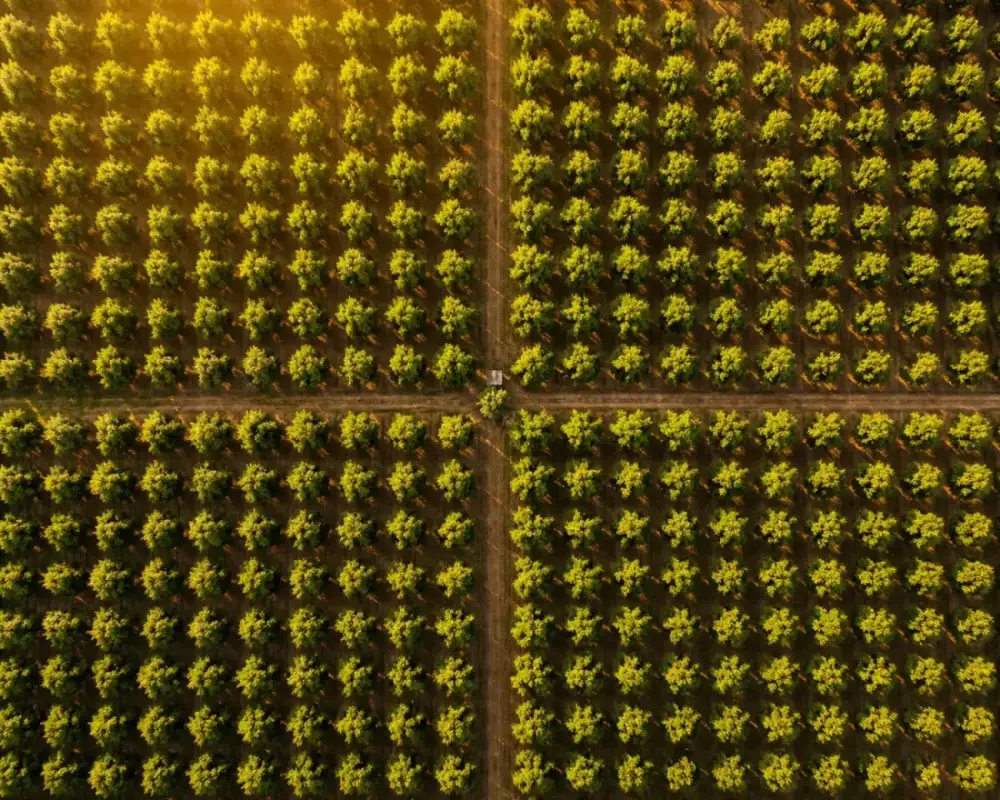
The most common spacing used in Malaysian commercial durian orchards is 9 metres by 9 metres, arranged in a square grid. This gives approximately 111 trees per hectare (10,000 sq m ÷ 81 sq m per tree).
This spacing is a compromise. It allows reasonable canopy development for the first decade, and at current Musang King prices, having more trees per hectare is economically attractive in the early years. The trade-off is that by year 10–12, many 9×9 orchards start facing canopy competition, and growers need to make thinning decisions.
The benefit of designing for thinning: some commercial orchards intentionally plant at 9×9 knowing they will thin to 18m×9m or 18m×18m spacing at year 10, removing every second tree or every second row. This "intensive then thin" approach captures early income from more trees while eventually giving remaining trees the space they need. It requires discipline to follow through — growers who keep all trees too long pay with reduced yields.
Wide Spacing: 12m × 12m
At 12 metres by 12 metres, you plant approximately 69 trees per hectare. Fewer trees, more space per tree.
The advantages are real and long-term:
- Better airflow between canopies, reducing humidity and fungal pressure
- More light reaches lower branches on every tree, supporting better flower induction
- Lower Phytophthora incidence in consistently managed wide-spaced orchards
- Higher per-tree yield as canopy size and complexity grows over decades
- Less competition for water and soil nutrients, particularly in drier periods
The disadvantage is lower income in the first decade. With fewer trees, even if each tree produces well, total hectare yield is lower during the early years. At year 5–7, a 12×12 orchard has 69 productive trees versus 111 in a 9×9 orchard — that's a real difference in early cashflow.
For growers with strong working capital who are managing for the long term (20+ year horizon), 12×12 is often the better agronomic choice. For growers who need income to service land loans in the first decade, 9×9 with a thinning plan can make financial sense.
Intensive Planting: 6m × 6m With Planned Thinning
Some growers — particularly those entering durian farming with aggressive cash-flow targets — begin with 6 metre by 6 metre spacing, which gives approximately 278 trees per hectare. This maximises early production per hectare when trees first fruit at years 4–6.
The critical condition: this only works if you commit to a thinning schedule. At year 8–10, you must remove trees to bring effective spacing back to 12×12 or at minimum 9×9. That means permanently removing healthy, productive trees — which takes financial and psychological commitment.
Many growers who start at 6×6 either delay thinning or don't thin at all. The result is exactly what you'd expect from trees planted too close: competitive canopy closure, plummeting per-tree yields, and the same fungal disease problems as any overcrowded orchard. The income advantage from denser early planting is quickly erased.
Triangular Spacing: A More Efficient Grid
Instead of planting trees in a square grid (rows aligned), some orchards use equilateral triangular spacing — each tree is equidistant from six neighbours rather than four. An equilateral triangle layout with 9 metres between trees fits approximately 15% more trees per hectare than the equivalent square grid.
Practically: 9m equilateral triangular spacing fits about 128 trees per hectare versus 111 for a square grid. The trees don't actually have more space between immediate neighbours, but each tree has a more uniform distribution of open space around it.
This approach is particularly useful on irregularly shaped or sloped land, where following terrain contours naturally creates something closer to triangular placement. It is more complex to lay out on flat rectangular land.
Slope And Terrain Adjustments
On hillside orchards — which are common for premium durian cultivation in Malaysia, Thailand, and Indonesia — spacing calculations need to adapt for terrain:
- On slopes, measure planting distances along the contour, not down the slope. If you measure straight down a 30° slope, your actual horizontal distance is shorter than you intended.
- Contour planting (rows running across the slope rather than up and down) naturally reduces erosion and makes irrigation management easier.
- On very steep slopes (above 30°), the effective canopy spread per tree is somewhat reduced by gravity's effect on branch orientation, but this does not mean you can plant significantly closer without consequence.
Calculating Your Actual Tree Count
For planning purposes:
At 9m × 9m square grid:
- 1 acre (0.405 hectare) = approximately 45 trees
- 1 hectare = approximately 111 trees
At 12m × 12m square grid:
- 1 acre = approximately 28 trees
- 1 hectare = approximately 69 trees
At 6m × 6m (intensive, pre-thinning):
- 1 acre = approximately 113 trees
- 1 hectare = approximately 278 trees
These are approximate — actual numbers vary based on land shape, edge effects, and how planting points are laid out near boundaries.
The Long-term Cost Of Getting It Wrong
A durian tree lives and produces for 30, 40, even 50 years or more in well-managed orchards. The spacing decision made at planting day is effectively permanent — removing established durian trees is economically and physically painful, and the gaps left behind take years to fill.
The pattern in poorly spaced orchards is consistent: good early yields as trees establish, followed by a decline as canopies close, followed by a plateau at well below maximum per-tree potential. Growers who planned for wide spacing consistently report higher per-tree yields in the mature phase, even though they had fewer trees producing in the early years.
The math is straightforward: 69 trees at 40 kg per tree per harvest = 2,760 kg per hectare. Versus 111 trees at 18 kg per tree in a closed-canopy overcrowded orchard = 1,998 kg per hectare. More trees, but less fruit.
Choosing Your Spacing: Variety, Soil, Rain and Slope
Most Malaysian commercial orchards operate on 8 to 10 meter spacing, and this range reflects accumulated experience across different farm conditions. At 9x9 meters square grid, you get approximately 111 trees per hectare. Move to 12x12 meters, and that drops to 69 trees per hectare.
Neither number is automatically right or wrong. The appropriate spacing depends on several factors that vary from farm to farm.
Variety. Musang King is the obvious example — it's known for vigorous growth and wide canopy spread at maturity. Most experienced growers using Musang King lean toward the wider end of the range, 10 to 12 meters minimum, precisely because the canopy expansion is so pronounced. D24, XO, or Black Thorn may be somewhat more compact but still need room to breathe.
Soil fertility. Rich, deep loamy soil with good organic matter will push tree growth harder than lateritic or sandy soil. On highly fertile land, trees grow more aggressively, which means canopies close faster. You may need to add a meter or two of spacing compared to a leaner soil profile.
Annual rainfall and humidity. High-rainfall areas in Pahang, Kelantan, or Johor already deal with elevated ambient humidity. The less airflow there is between trees, the worse disease pressure becomes. In these regions, erring toward wider spacing — 10 to 12 meters — pays dividends in disease control over the long run.
Topography. Flat land allows more uniform spacing. Sloped land introduces constraints depending on whether rows run along or across the contour. Spacing decisions on slopes also interact with water runoff and erosion management.
Pruning intensity. Farmers who commit to aggressive canopy management can maintain productive trees at somewhat tighter spacing than those who prune minimally. But pruning discipline must be sustained throughout the orchard's life — most farms don't achieve this consistently.
Intercropping to Make Early Years Pay
One practical solution to the economic pressure of wide spacing is intercropping. A durian orchard planted at 9x9 or 10x10 meters has a lot of open ground in years one through five. That space can be planted with banana, papaya, or other short-cycle crops that generate income while waiting for the durian canopy to close.
A well-managed intercrop of bananas can yield RM 8,000 to 15,000 per hectare per year during the establishment phase. Papaya follows a similar timeline. The revenue isn't a replacement for durian income, but it covers a meaningful portion of annual maintenance costs — which typically run RM 5,000 to 10,000 per hectare per year in a well-managed commercial orchard.
As the durian canopy expands and starts to shade out the intercrop (typically year five to six), the intercropping phase ends naturally. By that point, the durian trees should be approaching first fruiting if grafted stock was used.
Practical Takeaway
Choose your spacing based on your time horizon and financial position:
- 30+ year horizon, strong capital: 12m × 12m
- 15–25 year horizon with thinning plan: 9m × 9m, commit to thinning by year 10
- Intensive with strict thinning discipline: 6m × 6m, thin to 12m × 12m by year 10 without exception
- Terrain and intercropping: 12m × 12m allows the best intercropping window and contour management
Whatever you choose — mark the spacing, plant accordingly, and don't let early optimism push you to squeeze in an extra row.
Common Questions
You can, but by year 10–12 you'll see the consequences — reduced yields, more disease, harder to manage canopy. Many orchards run at below-potential yields permanently because of this.
Yes, somewhat. Compact varieties with smaller mature canopy spread can tolerate slightly closer spacing. Musang King is a large canopy variety and benefits from wider spacing. D24 and many Thai varieties are also large canopy.
Banana, papaya, and short-cycle vegetables work well. They provide income and some shade during the 0–4 year establishment period. Remove them before the durian canopy closes — usually around year 5–6.
Yes. Drip irrigation lines and emitter placement must be designed around final tree spacing, not sapling size. Designing for 9m spacing and then thinning to 18m requires rethinking the irrigation layout.
Leave at least half your spacing distance from the boundary — so for 9m spacing, your edge trees should be at least 4.5m from the property line. Canopy will extend to and beyond the boundary otherwise, and roots even further.
There's no official minimum. Practically, below 2 hectares the economics are tight — the fixed costs of fertiliser, labour, and infrastructure per kilogram of fruit become harder to justify at small scale. Many viable small commercial operations run 3–5 hectares.
Yes. Plan your nearest row to account for their canopy spread, not just your own. Canopy from neighbouring trees creates the same competition and humidity problems as your own trees planted too close.
Want to try fresh durian from our farm? We grow it at our own Bukit Serampang orchard in Tangkak, Johor, and sell it at our Melaka Mall stall. Stock varies daily — WhatsApp to confirm availability before you visit.
Ask About Today's Fruit