You have done it before. You paid RM80 for a Musang King, carried it home with excitement, cracked it open — and the flesh was pale, watery, and barely sweet. The seller swore it was ready. It was not.
Picking a durian is not luck. It is a skill, and it is learnable. After years of watching buyers get it wrong at roadside stalls and wholesale markets, here is what actually matters when you are standing in front of a pile of spiky fruit trying to decide which one to take home.
The 7 Signs of a Perfectly Ripe Durian
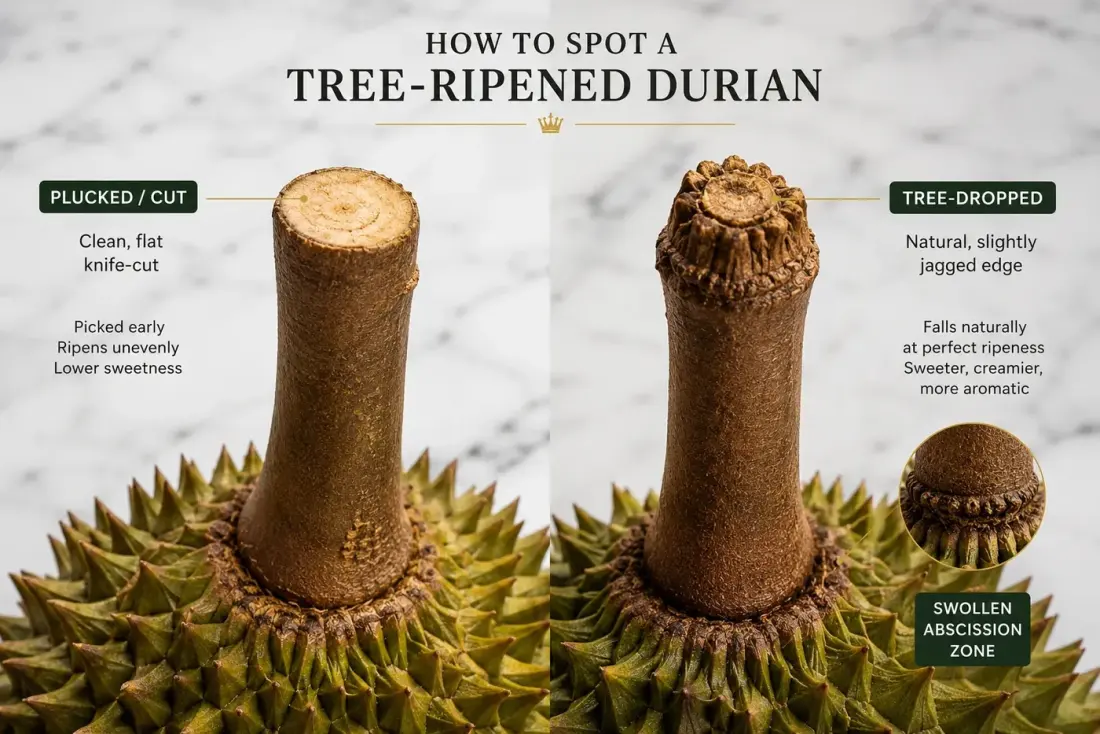
1. The Stem Tells the Story
Look at the stem — the part where the fruit was attached to the branch. A freshly harvested durian has a stem that looks greenish and slightly moist. If the stem is dry, dark brown, and shrunken, that fruit has been sitting around for days. It may still be edible, but the flesh has likely started to degrade.
A good seller will trim the stem cleanly. A messy, torn stem suggests rough handling or old stock.
2. Shake It — But Do It Right
Everyone shakes durian. Most people do it wrong. You are not trying to hear a loud rattle. You want a subtle, muffled thud — the sound of flesh that has separated slightly from the shell. That separation is what happens as the fruit ripens on the tree.
If you hear a tight, hard knock, the flesh is still glued to the shell. It is under-ripe. If you hear a wet, sloshing sound, the fruit may be over-fermented. You want the middle ground: a soft, confident wobble when you tilt it.
3. Smell the Base, Not the Top
The strongest aroma should come from the bottom of the fruit, near the base where the segments meet. A ripe durian gives off a complex smell — creamy, slightly alcoholic, with a sweetness that is hard to mistake once you have learned it.
If the smell is sharp and sour, the fruit is over-ripe. If there is almost no smell, it is not ready yet. And if the smell is uniform all over including the top near the stem, that can indicate the fruit was picked too early and ripened off the tree — the flavour will be flatter.
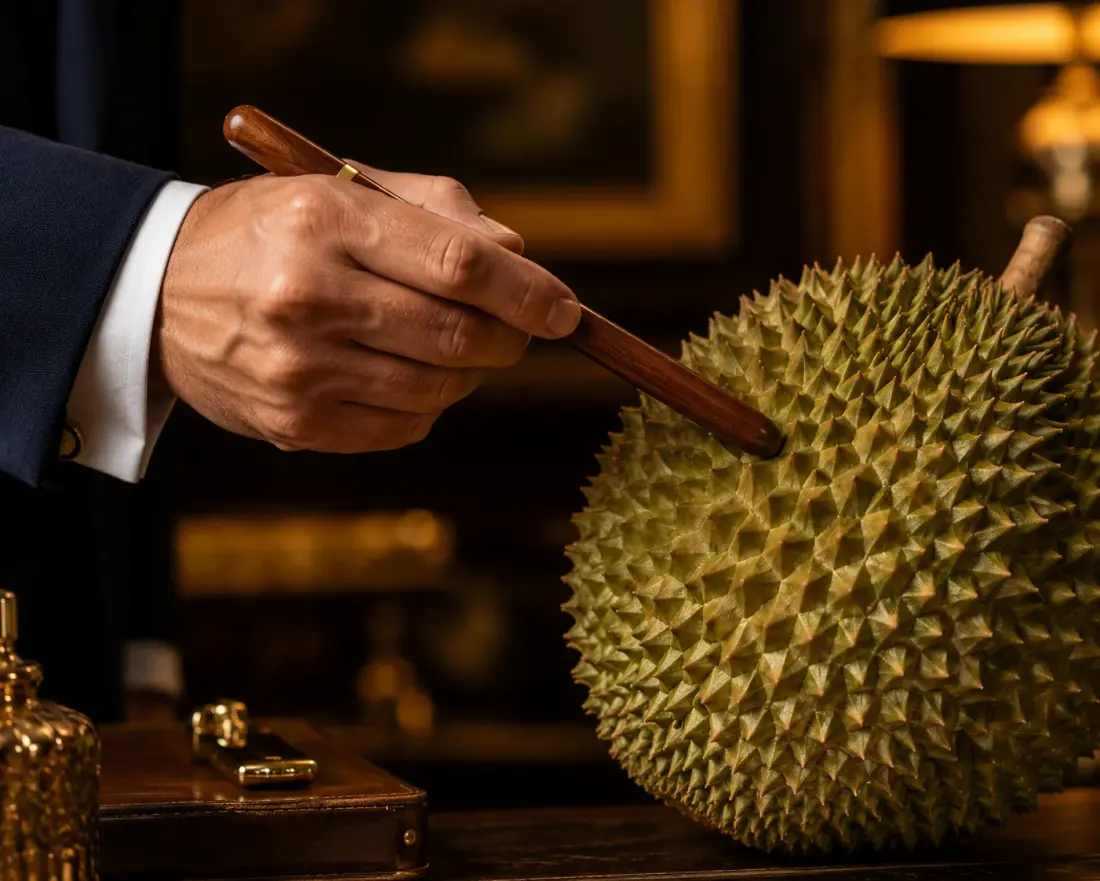
4. Check the Spikes
The spikes should be firm and evenly spaced, with a slight taper. For Musang King, the spikes are distinctly conical and well-spaced. For D24, they are closer together and slightly flatter.
Avoid fruit where the spikes are soft, bent, or broken in large numbers. Some surface damage is normal — durian is spiky and transport is rough — but widespread spike damage means the fruit took a hard hit, and the flesh inside may be bruised.
5. Look at the Colour — But Know Your Variety
Colour alone is unreliable unless you know what you are looking for. Musang King turns a deep golden-brown when ripe. D24 goes from green to a pale, yellowish-green. Black Thorn (Ochee) develops a dark, almost olive-brown hue.
A fully green durian is almost certainly under-ripe, regardless of variety. But a brown durian is not automatically good — it could be over-ripe or sun-damaged. Colour is a supporting clue, not the main signal.
6. Feel the Weight
Pick up two fruits of similar size. The heavier one usually has more flesh and thicker husk. A durian that feels light for its size may have dried out, or the segments inside may be thin.
This is not a perfect test — some varieties naturally have thicker husks — but as a quick comparison between two fruits at the same stall, weight is a useful tiebreaker.
7. Ask When It Fell
This is the single most important question. Tree-ripened durian — fruit that was allowed to mature on the branch and drop naturally — has a depth of flavour that hand-picked durian simply cannot match. The sugar content develops fully, the texture becomes creamy rather than fibrous, and the aroma reaches its peak.
Ask the seller: "Bila jatuh?" (When did it fall?) If the answer is "tadi" (just now) or "semalam" (yesterday), you are in good shape. If the seller hesitates or says it was picked, the fruit may still be decent, but it will not be at its best.
Practical Takeaway
Next time you are at a durian stall, do this in order: check the stem, smell the base, shake it gently, and ask when it fell. Those four steps will eliminate most bad choices. The spike check, colour, and weight are secondary — useful for choosing between two good fruits, but not reliable on their own.
And if a seller refuses to let you shake or smell the fruit, walk away. A confident seller knows their durian is good.
Fresh durian, farm-direct. Stock changes daily — WhatsApp us before you visit.
Check Today's Stock