Short answer: Dropped durian is usually riper because it fell at full maturity, but riper isn't always better. Freshness matters more than the drop story: a dropped fruit left in the sun for hours can taste worse than a well-kept plucked one.
Walk into any durian stall in Malaysia or Thailand and someone will inevitably tell you: "This one dropped naturally — much better." The price tag often backs up the claim. But is there a real, measurable difference between a durian that fell from the tree on its own and one that was cut and plucked by hand? Or is this mostly marketing wrapped in tradition?
The answer is more nuanced than either side admits.
What "Dropped" Actually Means
A durian that drops from the tree has reached full physiological maturity. The abscission layer — the natural weak point where the stem meets the branch — has formed, and gravity does the rest. This usually happens when the fruit is at or very near peak ripeness. Sugar content is fully developed, fats have accumulated, and the aroma compounds are at their most complex.
In practice, orchard workers spread nets beneath the canopy and check the ground each morning to collect fallen fruit. A naturally dropped durian is typically collected from the ground within hours of detaching, because the window between "perfect" and "overripe" is short.
What "Plucked" Actually Means
Plucked durian is cut from the tree before it drops, usually with a knife or clippers. Farmers do this for practical reasons: to avoid damage from the fall, to control timing, and to reduce losses from animals or rain. The fruit is typically harvested at 80–90% maturity, then allowed to ripen further off the tree.
Here is where the debate gets interesting. A plucked durian that is given 2–4 days after harvest to soften can develop flavour that is very close to a naturally dropped one. The key variable is not how it left the tree — it is how mature it was when it was picked and how it was handled afterward.
Where the Real Difference Lies
The measurable differences between dropped and plucked durian come down to three factors:
1. Sugar concentration. A fruit that stays on the tree until natural drop has had more time to convert starch to sugar. Brix readings on fully tree-ripened durian typically range from 28–36%, while early-plucked fruit may sit at 22–28% even after post-harvest ripening. The gap narrows significantly when plucked fruit is harvested at the right stage.
2. Texture and fat development. The creamy, almost custard-like texture that people prize comes from fat accumulation in the aril, which continues late in the maturation process. Dropped durian tends to have a slightly denser, more cohesive flesh. Plucked durian, if picked too early, can feel a bit more watery or fibrous.
3. Aroma complexity. Volatile sulfur compounds — the chemicals responsible for durian's distinctive smell — increase in both variety and concentration as the fruit matures on the tree. Dropped durian often has a deeper, more layered aroma. Plucked durian can smell slightly sharper or less rounded.
What Happens After the Fall
Once the durian drops, the clock starts. Malaysian farmers typically collect fallen fruit within 12 to 24 hours. The fruit continues to undergo subtle changes after falling — the shell begins to open slightly along its natural seams, and the flesh softens further. But this post-fall window is narrow. After 48 hours, the durian begins to degrade. The flesh can become overly soft, watery, or develop off-flavours from microbial activity.
This is why timing matters so much in the orchard. Farmers check their trees early in the morning and again in the late afternoon, collecting fruit that has fallen overnight or during the day. The fruit is then sorted, graded, and transported to markets or processing facilities as quickly as possible.
The Honest Bottom Line
A naturally dropped durian from a well-managed orchard, collected quickly and sold fresh, will generally have a slight edge in flavour depth. But the difference is not dramatic, and it can be closed almost entirely by proper harvesting and post-harvest handling.
What matters more than dropped vs plucked is the variety, the tree's age and health, soil conditions, and how the fruit was stored after harvest. A Musang King picked at the right time and handled well will outperform a randomly dropped D24 every time.
Practical Takeaway
If you are buying durian and the seller claims it is "naturally dropped," ask when it was collected and how it has been stored. A dropped durian that sat in the sun for six hours is worse than a carefully plucked one kept cool. Prioritise freshness and variety over the drop story.
Generally yes, because it detached at full maturity. But "riper" does not always mean "better" — overripe durian can develop off-flavours and a boozy, fermented taste.
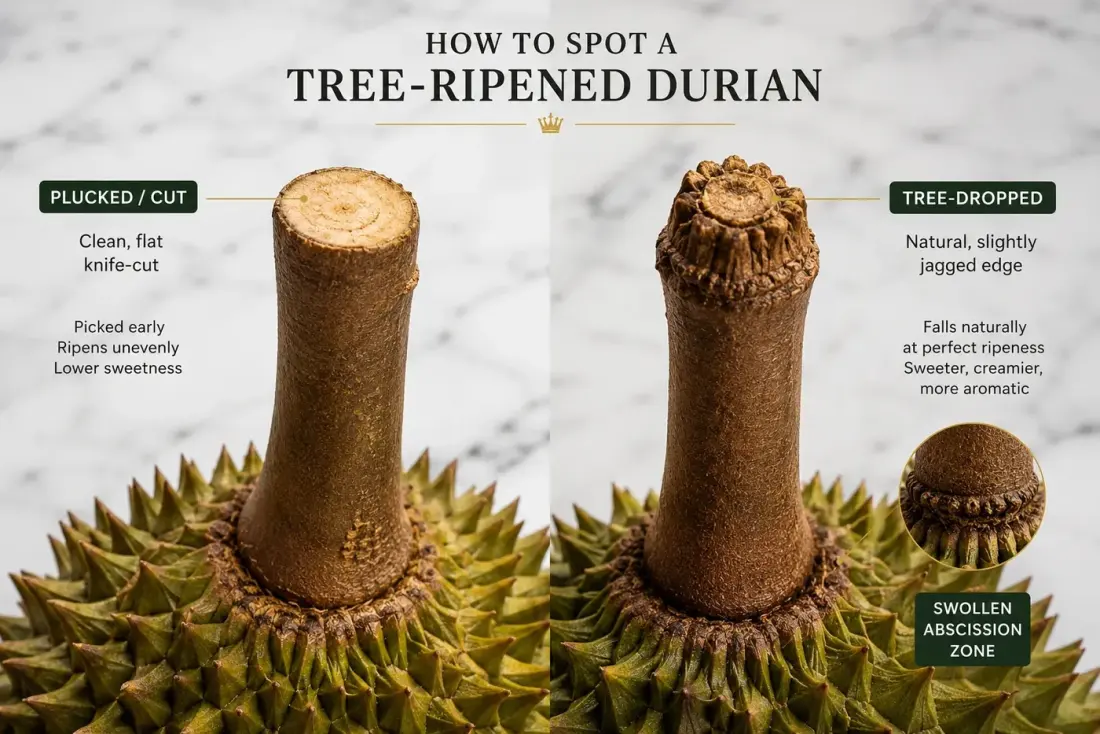
Not reliably. Some sellers point to the stem end — a clean cut suggests plucking, while a torn or ragged stem suggests natural drop. However, this is not a reliable guarantee of flavour.
Scarcity and labour. Farmers cannot control when fruit drops, collection requires daily ground checks, and losses from damage or animals are higher. The price reflects cost, not necessarily superior quality.
Yes, if it was mature enough when harvested. Durian is a climacteric fruit, meaning it continues to ripen after detachment. The critical factor is the maturity stage at harvest, not whether it was cut or fell.
Ideally within 12–24 hours. After that, the flesh begins to degrade, especially in hot weather. Refrigeration slows this down but does not stop it.
Thai farmers traditionally pluck more often because the export supply chain requires fruit that can survive transport. Malaysian farmers selling to local markets are more likely to collect naturally dropped fruit, since the supply chain is shorter.
No meaningful difference in vitamins, minerals, or calories. The variation in sugar content is small enough that it does not affect nutritional value in any practical sense.
No. Buy from a seller you trust, prioritise variety and freshness, and do not pay a large premium for the "dropped" label alone.
Fresh durian, farm-direct. Stock changes daily — WhatsApp us before you visit.
Check Today's Stock