Most durian growers I know learned the land by walking it. They read the soil by feel, judged canopy health by eye, and made irrigation calls from experience built over decades. That knowledge still matters. But the orchard has gotten more complicated — input costs are up, labour is harder to find, and buyers increasingly want consistency that instinct alone cannot guarantee.
Precision agriculture tools built around IoT sensors, AI analysis, and automated systems can fill some of those gaps. Not replace the farmer — but extend what one person or a small team can monitor and act on. This guide covers how the full technology stack works, what it costs, where to start if you are on a tight budget, and what realistic returns look like for a working durian orchard.
How the Full Precision Agriculture Stack Works
The complete system has five main components. They are designed to work together, not in isolation.
1. IoT Soil Sensors
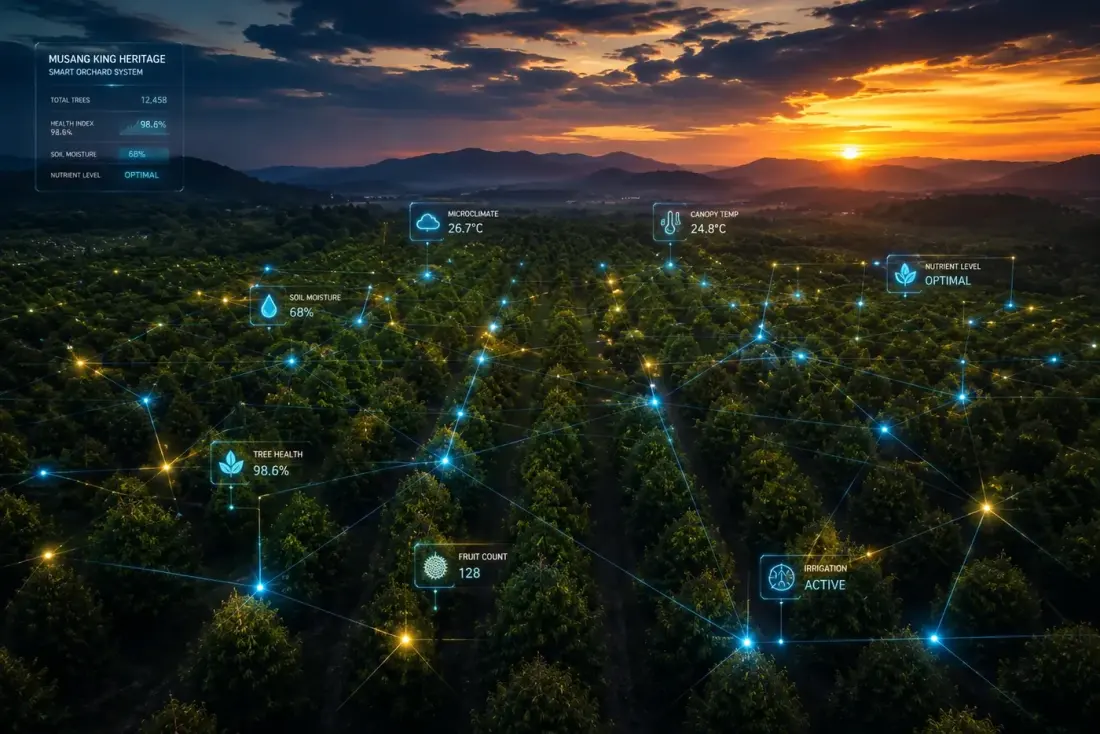
These are nodes buried at root-zone depth — typically 30 cm and 60 cm — that continuously log soil moisture, electrical conductivity (a proxy for fertilizer salt concentration), pH, and temperature. Each node transmits data via LoRaWAN or cellular to a cloud platform. Readings update every 15–30 minutes.
2. NDVI Drone Surveys
A drone equipped with a multispectral camera flies a pre-programmed grid over the orchard. The imagery is processed to produce Normalised Difference Vegetation Index (NDVI) maps — a measure of canopy health derived from how plants reflect near-infrared light. Stressed trees, nutrient deficiencies, and early disease patches show up as lower NDVI values before they are visible to the naked eye.
3. AI Disease Detection
Smartphone-based AI apps (such as those offered through MARDI's digital agriculture programs or commercial platforms) allow field workers to photograph leaves, bark, and fruit. The model identifies likely pathogens — Phytophthora root rot, anthracnose, stem canker — and suggests management responses. More advanced systems use cameras mounted in the orchard that feed a continuous detection pipeline.
4. Automated Fertigation
Fertigation controllers linked to soil sensor readings regulate irrigation volume and nutrient dosing automatically. When soil moisture drops below a set threshold, irrigation triggers. When EC readings indicate fertilizer depletion, the system adjusts the next fertigation cycle. The farmer reviews and approves schedules but does not need to manually calculate inputs for each cycle.
5. Yield Prediction Models
AI models trained on historical yield data, flowering records, weather inputs, and current NDVI scores generate season-ahead yield estimates. These are not perfectly accurate, but they provide a planning baseline — useful for labour scheduling, logistics, and pricing negotiations with buyers.
Data Flow
The underlying logic is: sensors collect data → data uploads to cloud platform → AI analysis runs → automated response is triggered (irrigation valve opens, fertigation pump activates) AND a smartphone alert goes to the farmer. The farmer remains in the loop for anything outside normal parameters.
What This Costs
Full integrated system: RM 30,000–120,000 per 10 acres. The wide range reflects sensor density and automation level. A minimalist setup — basic soil moisture nodes, a simple fertigation controller, no drones — sits at the lower end. A dense sensor network with NDVI drone surveys, AI cameras, and full fertigation automation sits at the upper end.
Individual component costs:
- Soil sensor node (LoRaWAN, multi-parameter): RM 1,500–4,000 per node
- Drone NDVI survey (contracted service): RM 300–800 per flight per 10 acres
- AI disease detection app (subscription): RM 50–150/month
- Cloud platform subscription (FarmAs, AgriConnect, or similar): RM 100–300/month
- Automated fertigation controller (per zone): RM 2,000–6,000
Data platforms: Malaysian agri-tech companies like FarmAs and AgriConnect offer managed platforms where sensor data feeds into a pre-built dashboard with alerts and basic analytics. An alternative is a DIY LoRaWAN network — you buy sensors, set up a gateway, and manage data storage yourself, which reduces ongoing subscription costs but requires technical ability to configure and maintain.
Does the Investment Pay Back?
The ROI calculation has two sides: input savings and yield improvement.
Input savings:
- Water use: automated fertigation based on real soil moisture readings typically reduces irrigation water consumption by 30–40% compared to schedule-based irrigation.
- Fertilizer: precision application guided by EC readings and soil analysis reduces fertilizer spend by 20–35%.
For a 15-acre Musang King orchard spending RM 60,000–90,000 per year on water and fertilizer inputs, a 25% average reduction saves RM 15,000–22,500 annually.
Yield improvement:
- Early disease detection and faster response reduces crop losses.
- More consistent soil moisture during fruit development reduces premature drop and improves fruit fill.
- Reported yield improvements from precision management: 8–15% above baseline.
At Musang King farm-gate prices of RM 25–45/kg, a 10% yield improvement on a 15-acre orchard producing 15,000–20,000 kg per season adds RM 37,500–90,000 in gross revenue.
Payback period: For a 10-acre orchard investing RM 50,000–80,000 in a mid-range precision agriculture setup, the payback period is typically 3–5 years, assuming both input savings and yield improvement materialize. Smaller orchards under 5 acres will find the payback period stretches to 7–10 years for a full system, which is why the entry-point approach matters.
Entry Points for Small Farms
You do not need to install the full stack on day one. The practical starting sequence for farms under 10 acres:
Phase 1 — Apps only (under 5 acres): Start with a smartphone AI disease detection app and free or low-cost weather monitoring. Cost: under RM 2,000/year including subscriptions. This phase builds familiarity with data-driven decision-making before any hardware investment.
Phase 2 — IoT + apps (5–10 acres): Add 3–5 soil sensor nodes at key locations (near young trees, in areas with drainage variation, near the water source). Connect to a cloud platform. Now you have real data on soil moisture and EC to guide irrigation and fertigation timing. Cost: RM 8,000–20,000 for hardware, plus RM 100–300/month for platform.
Phase 3 — Full stack (10+ acres): Once you have baseline data from Phase 2 and understand where your biggest loss points are (disease, water stress, pest pressure), expand to full automation with drone surveys and predictive models. Cost: RM 30,000–120,000 for full 10-acre setup.
Government Support Available
Several programs currently support precision agriculture adoption for registered durian farms:
- MARDI precision agriculture grants: Research collaboration and pilot program funding for farms willing to share yield data.
- DOA (Department of Agriculture) digital farming incentives: Equipment subsidies for registered farmers, covering up to 50% of approved equipment costs.
- MDEC agri-tech programs: Support for technology adoption including connectivity infrastructure (relevant for farms in areas without cellular coverage needing LoRaWAN gateways).
Subsidies can cover up to 50% of system cost for farms with active Farm Registration (Pendaftaran Ladang). The application process requires farm registration documentation, a basic farm management plan, and quotes from approved technology vendors. Processing time is typically 3–6 months, so plan for this before committing to vendor contracts.
A Real Before-and-After: 15-Acre Pahang Orchard
A Musang King orchard in Pahang provides a useful reference point.
Before technology:
- 3 full-time workers dedicated primarily to monitoring, scouting for disease, and managing irrigation schedules.
- Irrigation based on a fixed weekly schedule, adjusted by worker observation — resulting in variable soil moisture and occasional drought stress during flowering.
- Disease management reactive: workers spotted visible symptoms, reported, treatment began 3–7 days after infection was established.
- Labour cost for monitoring alone: approximately RM 5,500–7,000/month.
After a mid-range precision agriculture installation (RM 65,000 total):
- 1 worker with a monitoring and response role, supported by sensor alerts and the farm management app.
- Irrigation automated and linked to soil moisture sensors — water use reduced by 35%.
- Disease alerts generated by AI image analysis, with intervention starting within 24–48 hours of detection.
- Labour cost reduced to approximately RM 2,000–2,500/month for the monitoring role.
- Yield increased by approximately 12% in the first full season under the system.
The orchard owner's assessment: the biggest gain was not the technology itself but the consistency it created — soil moisture stayed within the right range during the critical 10–12 weeks of fruit development, which was previously difficult to maintain with manual scheduling.
The Satellite Alternative
For farms that want vegetation health monitoring without the cost of drone surveys, Sentinel-2 satellite imagery offers a usable alternative. The European Space Agency's Sentinel-2 program provides multispectral imagery at 10-metre resolution, updated every 5 days, available at no cost through platforms like Copernicus Open Access Hub or Google Earth Engine.
At 10-metre resolution, you cannot detect disease in individual trees the way a drone at 5-metre flight height can. But you can monitor orchard-level canopy health trends across seasons, spot areas of consistent low NDVI, and track changes after interventions. For a small farm managing 3–7 acres, this level of information can guide targeted scouting far more efficiently than walking the entire block.
The Human Element
No sensor tells you whether a Musang King tree's fruit is at the right stage for harvest. AI disease detection models trained largely on generic tropical crops still miss variety-specific symptoms. An automated fertigation system cannot account for a particular tree's unusual vigour or a microclimate pocket created by a hill shadow.
Experienced farmer judgment remains irreplaceable for harvest timing, reading variety-specific cues, and making calls in unusual weather conditions. Technology works best as an amplifier — it lets one experienced farmer monitor and manage what previously required three, and it provides data that grounds decisions that were previously made purely by intuition. That is a real gain. It is not the same as replacing the farmer.
What System Belongs on What Farm
| Farm size | Recommended approach | Approximate cost |
|---|---|---|
| Under 5 acres | Smartphone AI apps + free satellite imagery | Under RM 2,000/year |
| 5–10 acres | 3–5 IoT sensor nodes + apps + cloud platform | RM 10,000–25,000 |
| 10–20 acres | Full stack: sensors, automation, drone surveys, AI system | RM 30,000–80,000 |
| 20+ acres | Full stack + dedicated farm management dashboard | RM 80,000–120,000+ |
The most important principle: all systems should feed into a single farm management dashboard. A soil sensor platform that does not connect to your fertigation controller, a disease detection app that logs separately from your yield records, and a drone survey service that emails PDFs you never look at — these do not create value. Integration is what turns data into decisions.
Practical Takeaway
Start where your biggest visible loss is. If disease is your main problem, the RM 50–150/month AI disease detection app is your first move. If water management during flowering is costing you yield, 3–4 soil sensor nodes and an automated irrigation controller are the priority. If theft and post-harvest collection are the bottleneck, that is a different system entirely.
The technology exists, the costs are declining, and the government subsidy framework makes the numbers more workable than they look on paper. But the farmer who understands the problem clearly will get far more from these tools than the one who installs the most expensive system hoping it will reveal the answer.
Common Questions
Yes, but it affects your setup choices. LoRaWAN networks operate on a different radio frequency (915 MHz in Malaysia) and can transmit data up to 10–15 km to a gateway with clear line of sight. You can install your own LoRaWAN gateway that connects via satellite backhaul or a directional antenna link to the nearest cellular tower. Budget an extra RM 3,000–8,000 for gateway and connectivity infrastructure if mobile coverage is poor.
A minimum of 4–6 nodes to capture meaningful variation across soil types, drainage patterns, and slope positions. Place nodes in representative zones — one in a low-lying area prone to waterlogging, one on higher ground, one near the main water distribution line, one in an area with known soil variability. More nodes improve precision; 4–6 is the practical minimum before returns diminish.
Most commercial apps were trained primarily on Musang King data because it dominates the local market and has the most documented disease photography. Performance on D24, Black Thorn, and other varieties is measurably lower — estimated 15–25% lower detection accuracy on less-common varieties. If you are growing minority varieties, supplement app results with physical scouting rather than relying solely on the AI output.
This is a real risk and most systems have safeguards: maximum volume limits per cycle, flow sensors that detect if a valve is stuck open, and automatic shutoff if readings go out of expected range. Ask vendors specifically about fail-safe mechanisms before purchasing. Keep manual override capability active — never fully remove the ability to cut the system at the valve.
Ask for case studies from orchards of similar size and variety in Malaysia, not Singapore or Thailand. Request actual input cost data before and after implementation, not just yield numbers. Also ask what the failure rate and downtime frequency is for their sensor nodes — a system that is offline 20% of the season produces worse ROI than the pitch suggests.
Yes. Farmers who install full systems without a clear plan for who reviews the data and acts on alerts often find the dashboards become ignored. Start with 2–3 key metrics you will actually act on — soil moisture at root zone, and one disease alert channel. Build the habit of checking and responding before adding more data streams.
DOA and MDEC programs typically require you to use vendors on an approved supplier list. This limits choice but those lists generally include the main Malaysian agri-tech players. Check the current approved list before designing your system, as vendor lists are updated annually and some programs specify equipment categories rather than brand names.
Quality nodes from established suppliers have a rated field life of 5–7 years. In Malaysian orchard conditions — high humidity, occasional flooding, soil acidification in durian orchards — real-world life is typically 3–5 years before calibration drift becomes significant. Budget for recalibration or replacement cycles in your long-term cost calculations.
Want to try fresh durian from our farm? We sell direct from our Bukit Serampang orchard at Melaka Mall. Stock varies daily — WhatsApp to confirm availability before you visit.
Ask About Today's Fruit