Every person who decides to grow durian eventually faces this choice. Seeds are cheap and easy to find. Grafted saplings cost more and require a trip to a proper nursery. It seems like a straightforward trade-off between cost and convenience — but what you're actually choosing is how many years you're willing to wait, and whether you're willing to gamble on the fruit quality at the end of it.
Here's the full picture.
The Core Difference: Genetics And Time
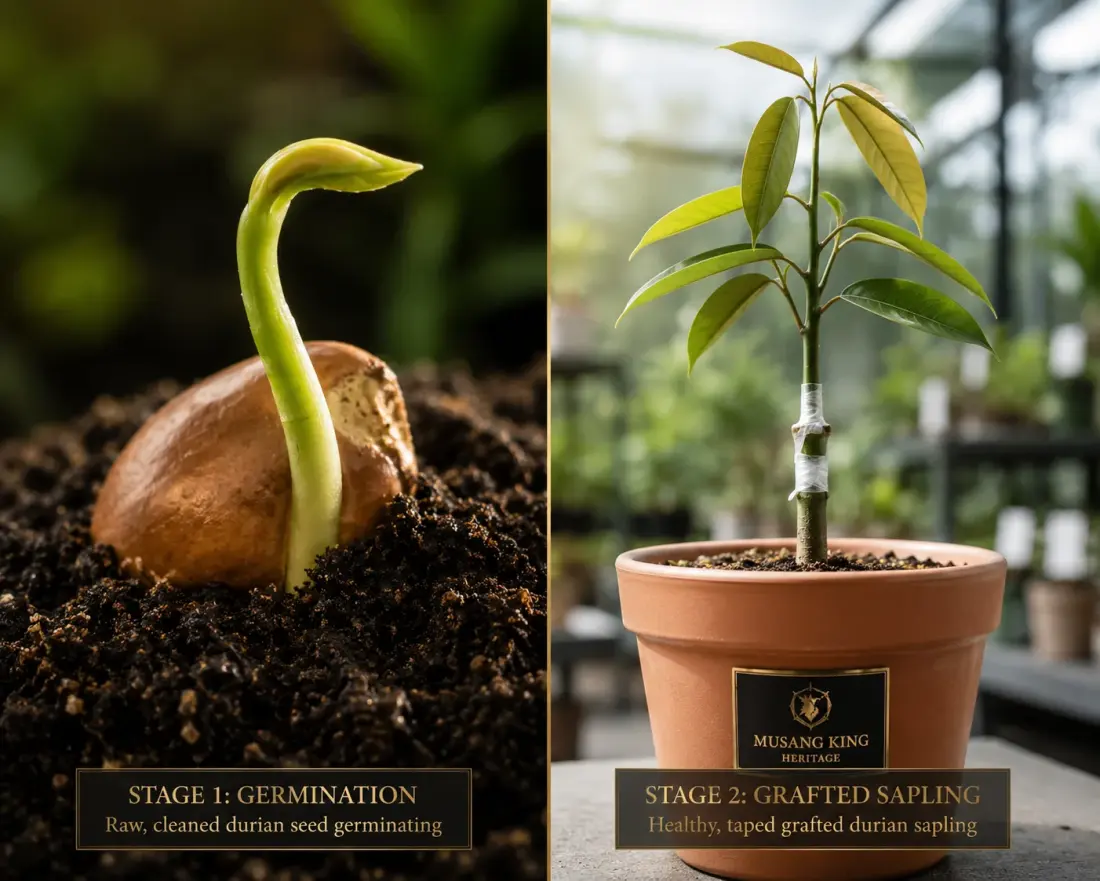
When a durian seed falls from the tree, it carries half its genetic material from the mother tree and half from whatever pollinated it. Durian flowers are pollinated by bats, insects, and wind — which means the genetic contribution is unpredictable. You may plant a seed from a prize-winning Musang King cluster and grow a tree that produces mediocre, thin-fleshed fruit. Or you might get something surprisingly good. You don't know until the tree fruits, and that takes 7 to 12 years.
A grafted tree is cloned from a specific mother tree. The scion — the top portion that will become the fruiting tree — is taken from a verified tree of the correct variety and joined to a rootstock. The resulting tree carries the genetic identity of that mother exactly. No lottery.
The time difference compounds this: grafted trees typically produce their first fruit in 4 to 6 years from planting. Seed-grown trees take 7 to 12 years. For a commercial grower, losing 3 to 6 years of production is not a small consideration.
The Cost Comparison
Seed-grown seedlings: RM 5 to 15 per plant, widely available from nurseries, markets, and even collected from fruit stalls. No documentation needed.
Certified grafted clones (Musang King, D24, Black Thorn, etc.): RM 25 to 80 per tree, depending on tree size and nursery. Higher-quality nurseries sometimes charge more. Grafted trees of popular varieties from reputable sources can be harder to find, especially during planting season.
The cost difference sounds significant when you're buying 50 or 100 trees. But the economics reverse quickly when you factor in the time to first fruit. A grafted tree that produces 15 kg of Musang King in year 5 has already returned its premium many times over compared to a seed tree still years away from its first flower.
How Grafting Works
The most common grafting method used in Malaysian durian nurseries is cleft grafting. A scion (a short shoot from the desired variety) is cut and inserted into a split in the rootstock stem, then sealed with grafting tape. If the cambium layers of the scion and rootstock align properly, the tissues fuse and the graft takes.
Other methods used include:
- Approach grafting: both scion and rootstock remain rooted while fusing. Less common but good for difficult-to-graft varieties.
- Chip budding: a single bud is inserted under a chip of rootstock bark. Used in some commercial nurseries for efficiency.
Cleft grafting remains the most common because it is reliable and relatively fast for trained nursery workers. Success rates in professional nurseries typically exceed 80%.
The Rootstock Question
The rootstock — the lower portion of the grafted tree — is not irrelevant. It contributes the root system, which determines how the tree handles soil conditions, drought, and disease.
The most commonly used rootstock in Malaysia is Durio zibethinus (the common durian species), usually grown from seeds of unselected local varieties. This works adequately in most conditions.
Some nurseries and farmers experiment with Durio graveolens rootstock (red-fleshed durian) for planting in more acidic or waterlogged soils, as D. graveolens is somewhat more tolerant of these conditions. If you're working with marginal soil, it's worth asking your nursery whether rootstock selection has been considered.
Seed-grown trees, by contrast, develop their own deep taproot system from germination. This often results in better anchorage and potentially more drought resistance than shallow-rooted grafted trees, particularly in the first decade. This is one genuine advantage of the seed-grown approach, though it rarely outweighs the time penalty for most growers.
Nursery Fraud: A Real Problem
This is not a theoretical concern. The market for Musang King grafted saplings is substantial, and fraudulent labelling is common. Trees labelled as "Musang King" or "D197" with no verifiable source documentation are sold across Malaysia at every price point.
The problem is that you often cannot tell by looking at a young sapling whether it's genuinely the variety advertised. The tree looks like a durian tree. The label says Musang King. But without knowing that the scion was cut from a verified mother tree at a DOA-registered nursery, you're taking the seller's word for it.
How to reduce your risk:
- Buy from DOA-registered nurseries where possible
- Ask for the mother tree source — a reputable nursery can tell you
- Be skeptical of bargain-priced grafted Musang King. If certified trees typically cost RM 40–80, a seller offering them at RM 15–20 should be questioned
- Consider buying from a nursery recommended by the Malaysian Durian Association or other established industry body
If you find out your "Musang King" was mislabelled only when the tree fruits 5 or 6 years later, there is no recourse.
Graft Union Care: The First Six Months Matter
When you receive a grafted sapling, the graft union — the join between scion and rootstock — is the most vulnerable point of the tree. The tissue is still consolidating, and physical stress to this area can break the graft.
During the first six months:
- Avoid any contact or pressure on the graft union area
- Water carefully; don't let pressurized irrigation directly hit the join
- Remove any rootstock suckers immediately — these grow from below the graft union and are a different variety. They grow vigorously and will outcompete the grafted scion if not removed promptly
- Support the sapling so wind doesn't create repeated stress on the union
After about a year, the graft is typically well-healed and substantially stronger. But ongoing rootstock sucker management remains necessary for the life of the tree.
Who Should Use Seed-grown Trees?
Honestly, the circumstances where seed-grown makes sense are limited:
- Hobbyists with a large property, a long time horizon, and genuine curiosity about what variety emerges
- Anyone who wants to trial-grow local wild varieties that have no available graft source
- Rootstock production — nurseries grow seed-grown trees specifically as rootstock material for grafting
- Situations where certified grafted material is genuinely unavailable
If you are growing durian with any intention to sell the fruit, the answer is nearly always grafted clones. The 5 to 9 year head start, combined with guaranteed variety consistency, is commercially decisive.
Practical Takeaway
The seed vs. graft decision is essentially a choice between patience and certainty. Seeds are cheap and produce trees with good root systems — but you're accepting a decade or more of waiting and an unknown fruit at the end. Grafted clones cost more upfront but give you the variety you selected, in a fraction of the time.
For anyone growing durian to eat or sell, use certified grafted clones. For a backyard experiment with time and space to spare, seeds are a legitimate choice — just go in with open expectations about what you'll eventually harvest.
Common Questions
Technically possible but unlikely. Durian flowers cross-pollinate freely. The seed has the mother's genetics on one side, but the pollen donor's genetics on the other. The outcome is usually a hybrid with unpredictable traits.
They develop from a taproot that grows straight down from germination. Grafted trees inherit the rootstock's root architecture, which may be shallower depending on the rootstock variety. Deep taproots generally anchor better and access deeper soil moisture.
You can't reliably tell from the sapling. The only way to be sure is to buy from a nursery with documented scion sources. Once the tree fruits, experienced growers can identify variety characteristics, but that takes years.
The sucker — growing from below the graft union — will eventually become the dominant portion of the tree, outcompeting the grafted scion. You'll end up with a tree that fruits, but produces the rootstock variety's fruit (usually a non-premium wild type), not the variety you paid for.
Yes. This is actually how rootstocks are produced. You grow a seedling for 6–12 months until it reaches grafting thickness, then graft a scion from the desired variety onto it. It adds some time but lets you start from your own seed material. Not common for small-scale growers due to the skill required.
The initial fusion takes 3–6 weeks. The union is functionally strong after about 6 months. Full tissue integration can take 1–2 years. Protect the union from physical impact during the first year.
Not inherently. Disease susceptibility depends more on the specific rootstock and local pathogen pressure. Grafted trees on well-matched rootstocks perform comparably to seed-grown trees in most conditions.
Want to try fresh durian from our farm? We grow it at our own Bukit Serampang orchard in Tangkak, Johor, and sell it at our Melaka Mall stall. Stock varies daily — WhatsApp to confirm availability before you visit.
Ask About Today's Fruit