Key takeaways
- China's durian imports rose about 47% in the first half of 2026 — the market did not disappear.
- Malaysia's 2026 price fall was a supply story: too much fruit reaching the market at once, not weak demand.
- Prices rebounded in late July as the season ended and supply tightened.
- A growing market does not mean every orchard earns more. Yield, grade, cost and sales channel decide who profits.
There is something about Malaysia's 2026 durian market that is worth looking at more carefully.
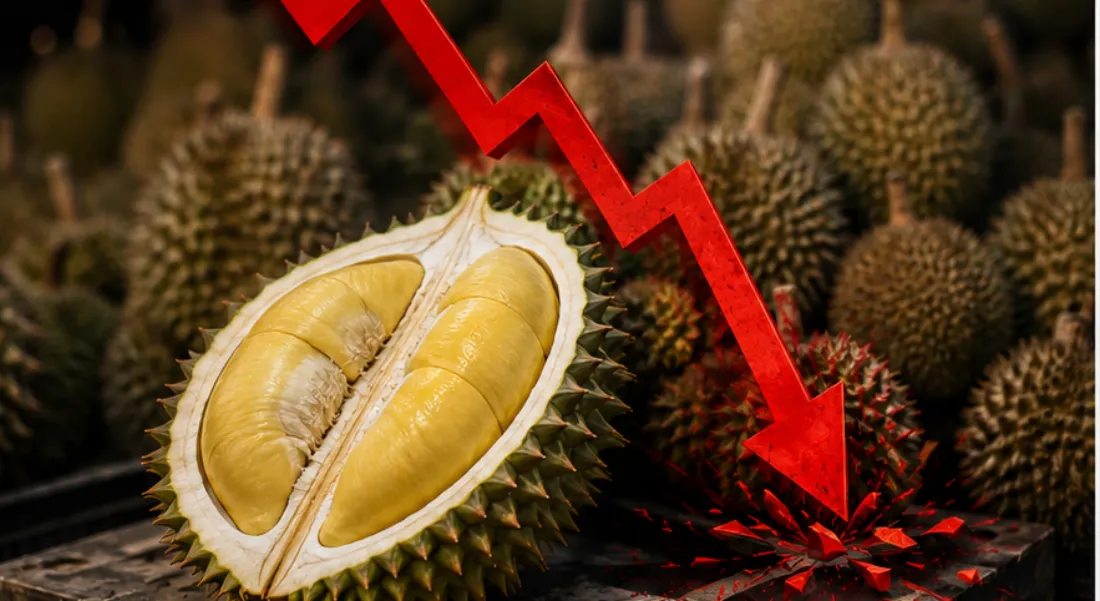
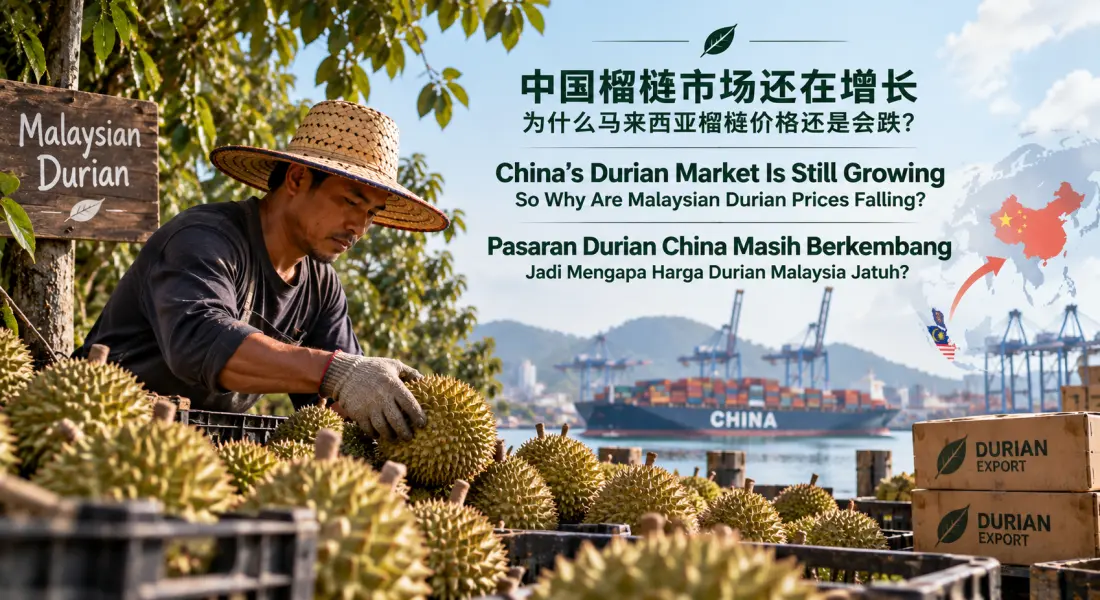
On one side, China's durian market is still growing. On the other, Malaysia experienced a major oversupply during the 2026 season, and farm-gate prices fell sharply in some areas.
At first, those two things seem contradictory. If Chinese consumers are eating more durian, and Malaysia has already gained access to China's fresh durian market, why did prices fall so much?
I don't think the answer is simply that "China does not have enough demand." And I don't think it is accurate to say that Malaysian durian no longer has an opportunity. The more interesting question is: is Malaysian durian supply growing faster than the market can absorb it?
China's durian market is still growing
Let's start with the numbers. China imported about 1.07 million tonnes of durian during the first half of 2026, up about 47% from 708,000 tonnes in the same period of 2025.
So China's market clearly did not disappear because Malaysian durian prices fell. Imports actually increased significantly.
Chinese customs data reported by Malay Mail showed that Thailand remained by far the largest supplier, with about US$3.79 billion worth of durian exports to China during the first half of 2026, representing about 81% of the market by value. Vietnam accounted for about US$846 million, or 18%. Malaysia exported about US$30.26 million worth of durian to China, up 342% year-on-year.
The 342% figure sounds enormous. But there is an important distinction. A very high growth percentage does not necessarily mean a large absolute market share. Malaysia's exports are growing quickly, but Thailand and Vietnam still operate on a much larger scale in the Chinese market.
So: China's market is large. Malaysia's exports are growing quickly. Both statements can be true without meaning that every Malaysian durian orchard will automatically become more profitable.
[Source: Malay Mail, 24 July 2026]
The problem in 2026 was not that nobody wanted durian
The most obvious problem this year was supply.
FAMA said in June that the durian season was occurring simultaneously across many states from June to August. Favourable weather conditions also contributed to higher supply. FAMA reported that kampung durian farm-gate prices in some areas had fallen to around RM1–RM4 per kilogramme, depending on location and quality. Premium varieties such as Musang King had also fallen below RM30 per kilogramme at the time.
[Source: Bernama / FAMA, 24 June 2026]
This is a familiar problem in agriculture. A factory can reduce production when inventory becomes excessive. A durian tree does not work that way. Once the fruit is developing, the grower cannot simply tell the tree:
"Demand is weak this year. Please wait."
The fruit still has to mature. And when several producing regions reach peak production around the same time, a large volume of fruit can enter the market within a short period. There are suddenly many sellers competing for roughly the same pool of buyers. Prices come under pressure.
How low did prices actually go?
By late June, FAMA's monitoring in Kedah found kampung durian farm-gate prices averaging around RM1–RM4 per kilogramme in some areas.
That does not mean every durian in Malaysia was selling at RM1/kg. Durian prices vary significantly by:
- Variety
- Grade
- Location
- Quality
- Supply
- Buyer
- Sales channel
Premium varieties continued to command higher prices, although they were also affected by the oversupply.
[Source: Bernama, 29 June 2026]
In some areas, the problem became serious enough that additional processing capacity was needed. In Terengganu, FAMA began processing durian into pulp from 22 June as part of its intervention programme. The processing centre expected to handle around 10 tonnes of durian pulp per month, with pulp supplied to downstream industries such as traditional cakes and ice cream. FAMA said the initiative was introduced after farm-gate prices fell below about RM3.50/kg, with FAMA purchasing durians from registered collectors at around RM3/kg for processing.
[Source: Malay Mail, 30 June 2026]
This is more interesting than simply saying "durian became cheap." It shows what happens when the fresh-fruit market cannot absorb the available supply. The industry needs another outlet. Fresh consumption is one outlet. Exports are another. Processing is another.
Then something changed in late July
If you only followed the June headlines, it would have been easy to conclude: "Durian prices have collapsed." But by late July, the situation was already changing.
As the main season approached its end and supplies declined, premium durians became harder to source. The New Straits Times reported on 25 July that Musang King and Black Thorn were being sold from around RM25/kg, while hybrid varieties were around RM18/kg and kampung durians around RM8/kg. Some traders were even struggling to secure enough premium fruit.
[Source: New Straits Times, 25 July 2026]
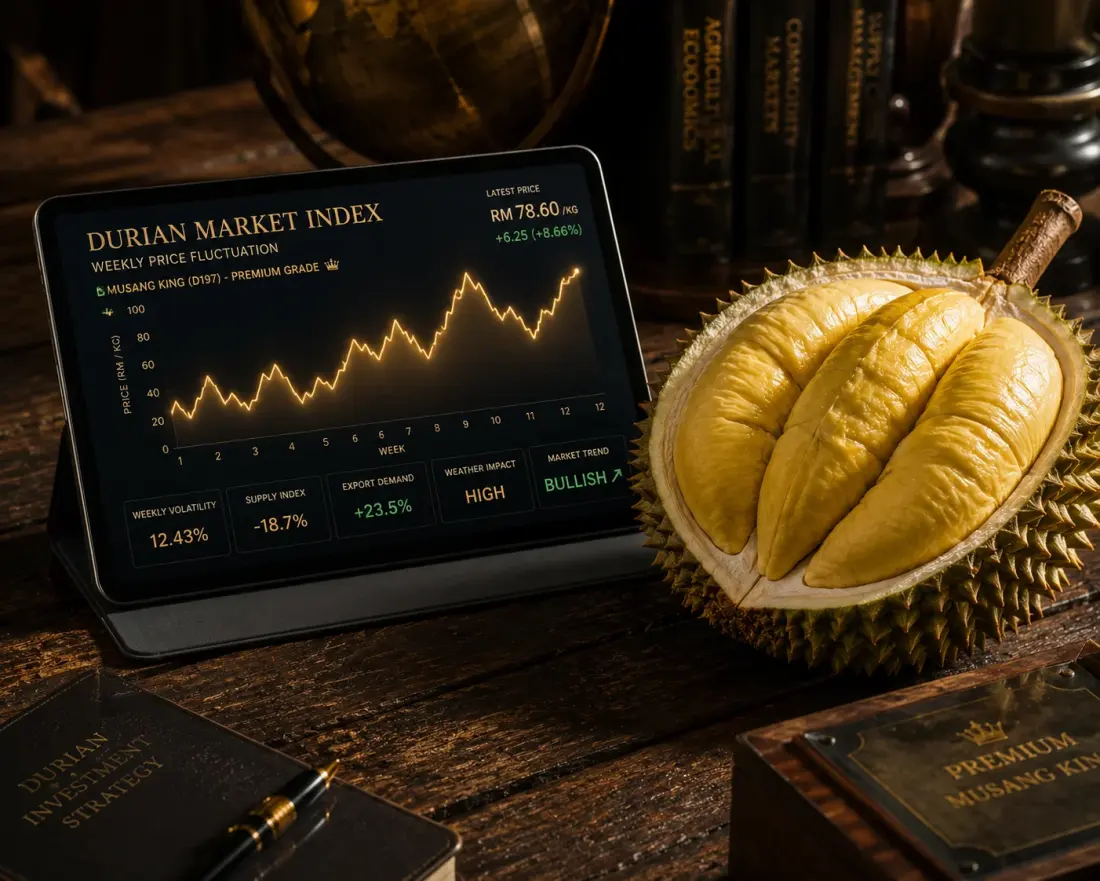
This is an important part of the story. A sharp price decline in June did not necessarily mean that demand had disappeared. When supply tightened, prices moved back up. That looks much more like a supply-cycle problem than a simple collapse in demand.
When too much fruit arrives at once, prices fall. When supply declines, prices can recover. So I would be careful about looking at the June low and concluding that Malaysian durian has "lost its market." If you want the week-to-week version of this, we wrote a whole piece on why durian prices change every week.
So why doesn't a huge Chinese market solve everything?
This is probably the easiest part of the story to misunderstand. China has a huge consumer market. Imports are still growing. But: a large market does not mean that the market can absorb unlimited supply at premium prices.
Chinese consumers are buying durian. That does not mean every durian receives the same price. Variety matters. Quality matters. Maturity matters. Grade matters. Origin matters. Logistics matter. The sales channel matters.
And Malaysia is not competing alone. Thailand remains the dominant supplier to China. Vietnam has also grown rapidly. So the more useful question may not be: "Are there enough Chinese consumers?" It may be: "Which durian are Chinese consumers willing to pay more for?" Those are very different questions.
What is Malaysia's real advantage?
Malaysia does have competitive advantages. Musang King and Black Thorn have established premium positioning in international markets. FAMA has also identified the international recognition of Musang King as an advantage for Malaysian durian. At the same time, Malaysia is looking at markets such as Canada, the United Kingdom, New Zealand and Japan to broaden its export base.
[Source: Bernama, 24 June 2026]
But there is another distinction worth making: Malaysia having competitive advantages does not mean every Malaysian orchard is equally competitive.
An orchard with:
- Reliable water
- Good drainage
- Consistent tree health
- Clear varieties
- Experienced management
- Stable buyers
is not necessarily comparable with an orchard that has:
- Mixed tree ages
- Water problems
- Poor drainage
- Inconsistent quality
- Unstable yields
- No reliable buyer
Both may be called "durian orchards." Their economics can be completely different. As the industry matures, I suspect it will become increasingly difficult to judge a durian orchard simply by its asking price per acre.
More trees are now entering production
Another factor behind the increase in supply is the maturation of orchards planted several years ago. Malay Mail reported in July that many Malaysian durian trees planted roughly six to ten years earlier were reaching maturity, contributing to higher production.
[Source: Malay Mail, 24 July 2026]
This matters to anyone thinking about planting durian. Because the tree you plant today does not give you an immediate answer. You may have to wait years. So when you plant today, you are effectively making a bet on the market several years from now.
How much will China import? How much will Thailand supply? How much will Vietnam supply? How many Malaysian orchards will reach full production? How much premium will Musang King command? What will logistics cost? How large will the processing market become? Nobody can guarantee those answers today.
So the simple chain of thinking — China likes durian → China has a huge market → Malaysian durian has a strong brand → therefore planting more must be profitable — is missing several steps in between.
Was Thai durian really responsible for Malaysia's price pressure?
This is another assumption worth checking. In July, Deputy Agriculture and Food Security Minister Chan Foong Hin said Malaysia's durian imports from Thailand fell 36.67% during January–June 2026, from 6,606.86 tonnes to 4,184.58 tonnes. He said Thai imports represented only around 2% of Malaysia's domestic production and that the main challenge was domestic production during the June–August peak season.
[Source: Bernama, 21 July 2026]
That is interesting. When prices fall, it is easy to look for an external explanation: "Was Thailand sending too much durian into Malaysia?" But according to the official figures, that was not the main issue this year. The more direct explanation was: too much Malaysian durian was reaching the market at the same time.
Durian has another problem: it is a tree
In August, The Star reported on the increasingly difficult operating environment faced by Malaysian durian growers. A Karak orchard operator described flooding, damage to trees and equipment, repeated rainfall during flowering periods that affected pollination, and increased irrigation and fertilisation needs during hot weather. Fuel and fertiliser costs also increased. The grower said that breaking even would already be a good result under those conditions.
[Source: The Star, 25 August 2026]
This is what makes agriculture difficult. When prices are good, higher costs may be manageable. When prices are weak: water still has to be supplied, fertiliser still has to be applied, workers still have to be paid, drainage still has to be maintained, trees still have to be managed.
An orchard does not stop generating costs simply because the market price is weak. So the question is not simply: "How much can I sell a kilogramme for?" It is: "How long can that price last, and what does it cost me to produce the fruit?" If you want the real cost side of this, see our breakdown of what it costs to maintain a durian farm in Malaysia.
So, is this a good time to plant or buy a durian orchard?
I don't think there is a universal yes-or-no answer. Someone who already has land, water, experienced management, established buyers and enough financial capacity to withstand several years of cash-flow pressure may find opportunities worth studying during a weak market.
But if someone sees "durian orchards are cheaper now" and immediately concludes "it must be a bargain," I would start with a calculator instead.
Don't start with the price per acre. Start with: How much did the orchard actually produce over the last three years? What is the average yield per tree? What varieties are planted? How old are the trees? How much is spent on fertiliser? Labour? Irrigation? Pesticides? Transport? Who currently buys the fruit? What does each grade sell for? Where do lower-grade fruits go? And if prices remain weak, can the orchard still generate enough cash flow to cover its costs?
Only after answering those questions should the land price become part of the discussion. A RM100,000-per-acre orchard is not necessarily cheap. And a more expensive orchard with healthy trees, stable production and established sales channels is not necessarily expensive.
The land price is only one number. What matters is whether the asset can generate sustainable cash flow after you buy it.
What does the 2026 durian market actually tell us?
I think there are at least three useful observations.
First, China's market has not disappeared. China's durian imports increased about 47% year-on-year in the first half of 2026, while Malaysia's durian exports to China increased 342% in value. [Source: Malay Mail, 24 July 2026]
Second, a growing market does not automatically mean every producer will earn more. Malaysia experienced significant oversupply this year, and FAMA had to use purchasing, sales and processing measures to help absorb supply. [Source: Bernama, 24 June 2026]
Third, durian prices are highly sensitive to supply cycles. Prices fell sharply during the concentrated June supply period, then premium varieties became more expensive again as supplies declined toward the end of July. [Source: New Straits Times, 25 July 2026]
So I would not look at 2026 and say "the Malaysian durian industry has no future." But I also would not look at China's growing market and say "planting durian must be a great opportunity." Both conclusions are too simple.
The more useful question is: China's market is growing — but who is actually able to capture the profit from that growth? Perhaps we should stop asking only "how much can one durian tree sell for in a year?" and start asking: "how much money does one tree actually leave after all the costs?" That may be the more useful lesson from Malaysia's 2026 durian oversupply.
We grow and grade our own durian at our Bukit Serampang orchard in Tangkak, Johor — priced by what it's actually worth, glut or not. Stock changes daily; WhatsApp us before you come.
See what's available todayFrequently asked questions
The main pressure came from concentrated domestic supply during the June–August peak season. FAMA said multiple states entered peak production at around the same time, increasing supply and putting pressure on prices.
China's import volume continued to grow strongly in the first half of 2026. However, growing national demand does not mean every variety, grade or orchard receives a premium price.
Because exports are only one part of the market. Domestic production, timing, quality, export requirements, logistics and available sales channels all influence the price received by growers.
There is no reliable basis for assuming that. Prices already recovered as the 2026 season moved toward its end and supplies declined.
Musang King continues to have premium positioning, but individual fruit prices still depend on quality, grade, maturity, location, buyer and sales channel.
That depends on the orchard's economics rather than the headline market price. Production history, tree age, water, costs, buyers and cash flow should be examined before the land price.
Look at at least three years of production records, tree age, varieties, yield per tree, water, drainage, labour, fertiliser, pesticide, transport, buyers and actual selling prices.
Official Malaysian data showed Thai durian imports fell 36.67% in the first half of 2026. The Agriculture Ministry said domestic production during the peak season was the main source of excess supply.
China is a major market, but Malaysia is also looking at markets including Canada, the United Kingdom, New Zealand and Japan.
A growing market does not automatically create higher profits for every grower. Yield, quality, selling price, costs and market access all matter.
Sources
- Malay Mail — 24 July 2026: China imports 1.07M tonnes (+47% YoY); Thailand/Vietnam/Malaysia China market shares; maturing trees adding supply.
- Bernama / FAMA — 24 June 2026: 2026 oversupply; kampung durian RM1–RM4/kg; Musang King below RM30/kg; FAMA intervention.
- Bernama — 29 June 2026: Kedah oversupply and RM1–RM4/kg farm-gate prices.
- Malay Mail — 30 June 2026: Terengganu FAMA pulp processing; RM3/kg purchase; below-RM3.50/kg farm-gate.
- New Straits Times — 25 July 2026: prices rebound as supply runs low (Musang King/Black Thorn/hybrid/kampung).
- Bernama — 21 July 2026: Thai durian imports down 36.67%; domestic oversupply the main pressure.
- The Star — 25 August 2026: Karak grower on weather, irrigation, pollination and input costs.