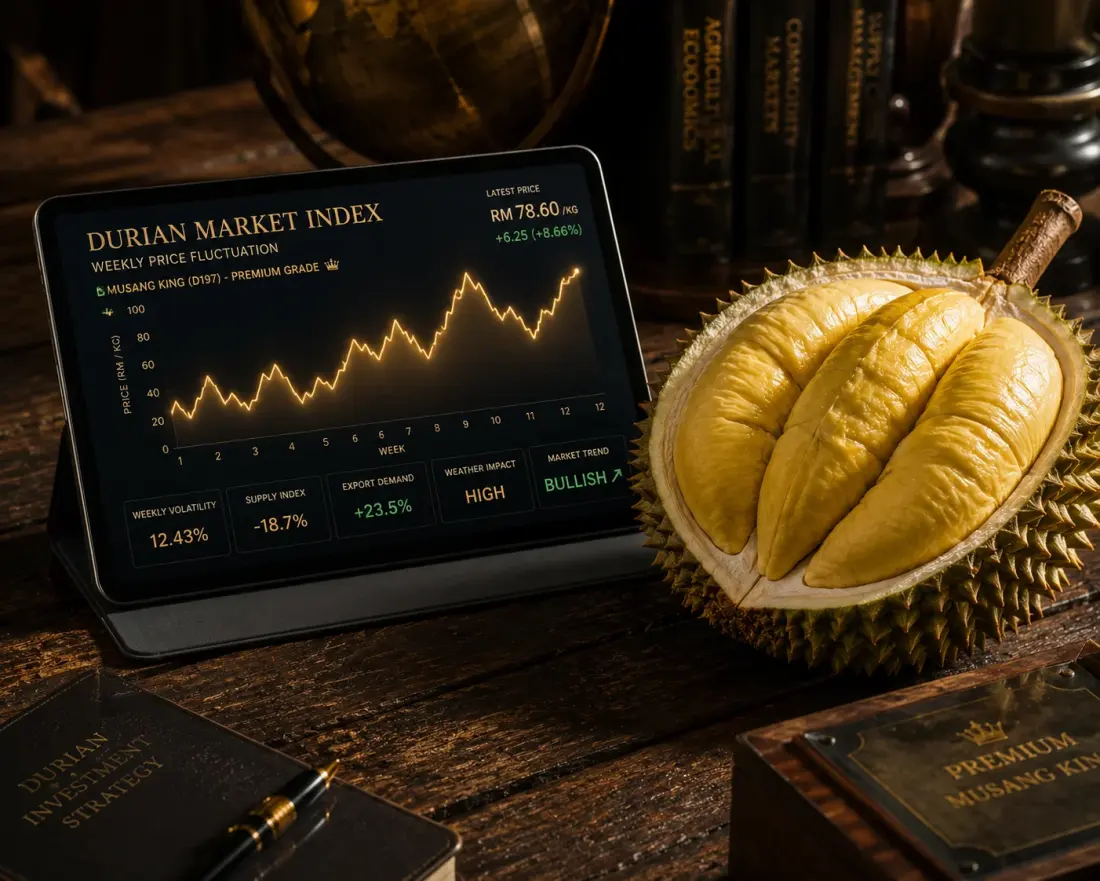
If you have ever walked into a durian stall on Monday and come back on Thursday to find the price has jumped — or dropped — you are not imagining things. Durian prices in Malaysia can shift noticeably within a single week, sometimes by 20–40%. For buyers, it feels unpredictable. For farmers, it is simply how the supply chain works.
Here is what actually drives these weekly price changes — not from an economist's desk, but from the orchard floor.
1. Harvest Is Not a Factory Schedule
Durian trees do not produce fruit on a Monday-to-Friday timetable. A tree might drop 30 fruits on Tuesday, then nothing for four days, then another 50 on Saturday. Weather plays a role — heavy rain can cause a sudden mass drop, while a dry spell slows things down. This means the volume arriving at collection points changes every few days, not every few weeks.
When supply suddenly increases, wholesale prices soften. When there is a gap between drops, prices tighten. This is the single biggest reason for weekly price movement.
2. The Grading Bottleneck
Not every durian is sold at the same price. After harvest, fruits are sorted by grade — Musang King D197, D24, D101, and so on — and within each grade, by flesh quality, seed size, and freshness. This sorting happens at collection centres, and the output varies day to day.
On a day when a large batch of high-grade Musang King arrives, the price for that grade may actually drop slightly because there is more supply. Meanwhile, a scarce grade like Black Thorn might hold its price or rise. So even within the same week, different cultivars move in different directions.
3. Middlemen and Transport Timing
Most farmers do not sell directly to your neighbourhood stall. The fruit passes through at least two or three hands — the village collector, the wholesale market (like the one in Raub or Bentong), and the retail seller. Each layer adds a margin, and each layer reacts to supply signals with a delay.
If a big harvest hits the collection centre on Wednesday, the wholesale price might drop that same day. But the retail stall may not reflect that change until Friday, because they are still selling fruit bought at Tuesday's higher price. This lag creates the feeling that prices are "always going up" — by the time the discount reaches you, the next supply gap has already pushed prices back up.
4. Demand Spikes Are Predictable — But Short
Weekends, public holidays, and festival seasons (Chinese New Year, Hari Raya, school holidays) create short bursts of high demand. Stalls and exporters stock up in advance, which pushes wholesale prices up a few days before the event. After the rush, demand drops and prices follow — but not always immediately.
5. Weather and Road Conditions
This is the factor most buyers never see. Heavy rain does not just affect the trees — it also disrupts transport from highland orchards to lowland markets. A landslide or flooded road in the Raub-Bentong corridor can delay shipments by a day or two, creating a temporary shortage in the Klang Valley even when the orchards have plenty of fruit.
Practical Takeaway
If you want to buy durian at a better price, avoid the first two days after a public holiday and the last two days before one. Mid-week (Tuesday to Thursday) during a normal supply period tends to be when prices are most stable and sometimes slightly softer. Follow a few local durian groups on Facebook or WhatsApp — farmers and collectors often post real-time harvest updates that give you a 1–2 day heads-up on supply changes.
Musang King has a smaller yield per tree, and much higher demand from export markets, especially China. The supply is naturally tighter.
At retail stalls, prices are usually fixed per kg. However, if you are buying more than 5–10 kg, some sellers will offer a small discount. Wholesale buyers at collection centres negotiate more freely.
Usually yes, but not always in a straight line. End-of-season fruit can be lower in quality (smaller seeds but thinner flesh), so premium grades may hold their price while lower grades drop significantly.
Transport cost, middleman margins, and local demand. A Musang King that sells for RM45–55/kg in Raub might be RM65–80/kg in KL. The gap covers logistics and the city seller's overhead.
Not far. Farmers can estimate based on flowering and fruit set, but the actual drop depends on weather in the final 1–2 weeks before harvest. Most farmers only know their real volume 2–3 days before collection.
Yes. Frozen durian (whole pulp or paste) is processed in bulk and stored, so it is not subject to the same weekly fresh-supply fluctuations. Prices change, but on a monthly or seasonal cycle rather than weekly.
Not always. Light rain can increase the drop rate, which increases supply and softens prices. But heavy rain that damages fruit or blocks roads can reduce the volume of sellable durian reaching the market, which pushes prices up.
Fresh durian, farm-direct. Stock changes daily — WhatsApp us before you visit.
Check Today's Stock