Every Musang King tree in every orchard in Malaysia is genetically identical. They are all clones — not from a laboratory, but from a cutting taken from the original tree and grafted onto a rootstock. This is how almost all premium durian varieties are propagated commercially.
The alternative — growing from seed — produces trees that don't breed true. A seed from a Musang King fruit will grow into a tree with unpredictable characteristics, potentially producing fruit that resembles its parent in some ways and differs in others. For a crop where a single variety commands RM 100/kg at farm gate and another variety is worth RM 20/kg, genetic consistency is economically critical.
This article explains how grafting works, how new varieties are officially registered, and how the Musang King itself came to exist.
Why Seeds Don't Work for Variety Propagation
Durian (Durio zibethinus) is an outbreeding species — it requires cross-pollination from a different tree to set fruit. This means the seeds inside any given durian fruit contain genetic material from both the mother tree and the pollen donor (often a different variety entirely, carried by bats or insects).
The result: durian seeds do not breed true to variety. A seed from a Musang King tree will grow a genetically unique tree — sometimes producing excellent fruit, often producing something mediocre, occasionally producing something exceptional. This unpredictability is valuable for creating new varieties (breeders deliberately cross varieties to generate new seedlings with novel characteristics), but useless for producing consistent commercial supply.
Grafting solves this by bypassing the seed entirely.
What Grafting Does
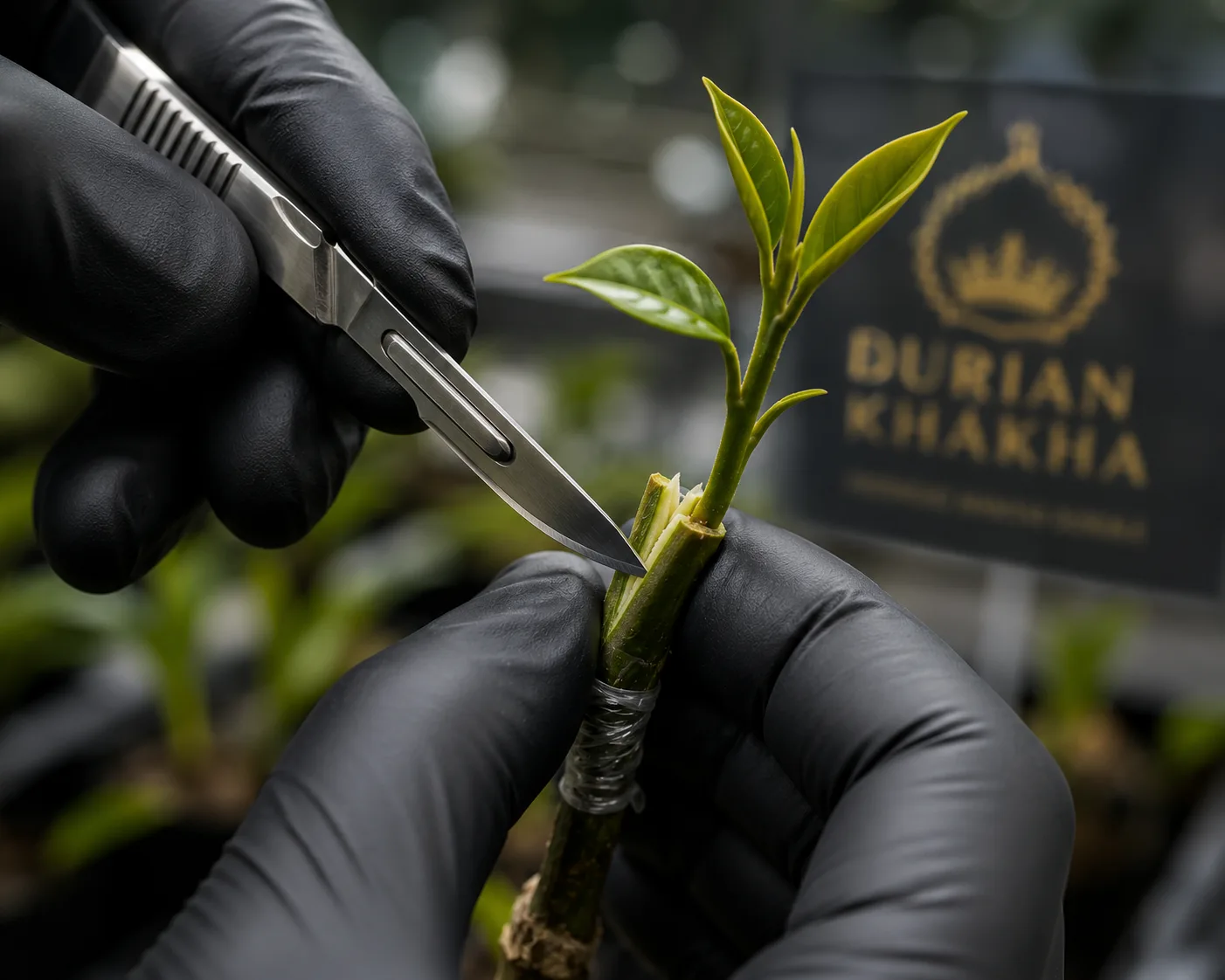
Grafting joins two plants into one: the scion (the cutting from a known variety, which provides the above-ground fruiting portion) and the rootstock (a seedling grown from seed, which provides the root system and stem base).
The scion carries the exact genetics of the source tree. When the graft heals and the two tissues merge at the cambium layer, the resulting tree has the root vigour of the rootstock variety and the fruiting characteristics of the scion variety. Every tree grafted from Musang King scion material will produce Musang King fruit — identical genetic profile, every time.
Why this matters:
- Varietal consistency: every fruit from a grafted Musang King tree will have the same characteristic bittersweet, custardy profile, the same Brix range (37–48), the same seed-to-flesh ratio.
- Faster production: grafted trees produce their first fruit in 4–6 years vs. 7–12 years for seed-grown trees.
- Known productivity: disease resistance, tree architecture, and yield characteristics of the scion variety are predictable.
Common Grafting Methods Used in Durian
Approach grafting: Two living plants (both still rooted) are brought together and their stems wounded and bound at the wound site. After the graft union forms, the scion's original root connection is cut. This method is reliable but labour-intensive. Success rates: 70–85%.
Cleft grafting: A cleft is cut into the rootstock stem, and a wedge-shaped scion cutting is inserted into the cleft and bound. Used when the scion and rootstock differ significantly in diameter. Success rates: 60–75%.
Chip budding: A chip of bark and cambium (including a bud) from the scion variety is inserted into a matching chip cut from the rootstock bark. The cambium layers must align. Success rates: 65–80% in skilled hands.
Patch budding: Similar to chip budding but uses a rectangular patch of bark. Common in Malaysia for durian propagation by trained grafters.
Success rate factors: Temperature, humidity, scion and rootstock health, and grafter skill all significantly affect outcome. A skilled grafter in good conditions achieves 75–85% success; an unskilled grafter in poor conditions may achieve 40–50%. Commercial nurseries maintain controlled environments for grafting to maximize success rate.
How New Varieties Are Officially Created
Step 1 — Discovery: Most named durian varieties were discovered, not deliberately bred. A farmer finds an exceptional tree — outstanding flavour, unusual flesh colour, high productivity — in a naturally grown durian grove. Musang King (D197) traces back to a tree from the Gua Musang area of Kelantan, where it was known as Raja Kunyit; a Raub farmer, Tan Lai Fook, propagated it in the 1980s, and it was registered as D197 in 1993. The trees showed exceptional custardy-bitter flavour and large, thick-fleshed fruit. Black Thorn (D200, Ochee) was discovered in Penang.
Step 2 — Propagation and observation: Scion material from the exceptional tree is grafted onto rootstocks and the resulting trees grown for several years to confirm that the exceptional characteristics are consistent and reproducible across multiple grafted trees.
Step 3 — Official registration (DOA): Malaysia's durian variety registration system is managed by the Department of Agriculture (DOA). Growers submit a formal application with tree and fruit characteristics, photographic documentation, and performance data across multiple harvests. The DOA assigns a D-number (D197 for Musang King, D200 for Black Thorn, D24 for Sultan, etc.) upon confirmed registration.
Step 4 — Commercial propagation: Once registered, nurseries can produce certified grafted seedlings from authenticated scion material from the registered variety. This creates the commercial supply chain of consistent planting material.
What about deliberate breeding? MARDI and university research programs do conduct deliberate crossing — selecting parent trees with specific characteristics (disease resistance, productivity, flavour profile) and cross-pollinating to generate new seedling populations. Promising seedlings are grown to fruiting (7–12 years), evaluated, and the best selections propagated. This pipeline exists but is slow — a new variety from a deliberate cross takes 15–25 years from crossing to commercial registration and availability. Most commercially significant varieties are still discovery-based.
The Rootstock Question
The rootstock affects the grafted tree more than is commonly recognized. Rootstock variety influences:
- Root system depth and spread (affects drought and waterlogging tolerance)
- Tree vigour (affects overall growth rate and eventual canopy size)
- Nutrient uptake efficiency
- Some disease resistance (particularly Phytophthora tolerance in roots)
In Malaysian commercial practice, the most common durian rootstocks are D24 seedlings (widely available, proven) and local wild durian (Durio graveolens, D. kutejensis) for their Phytophthora tolerance in wetter regions. Matching scion to rootstock for local soil and climate conditions is an underappreciated element of orchard establishment.
What This Means for Consumers
Consistent quality: When you buy Musang King from a certified orchard, you are buying fruit from a tree that is genetically identical to the original mother tree. The flavour profile is not approximate — it should be the same biological expression, subject to growing conditions and ripeness.
The counterfeiting problem: "Musang King" in informal markets can be misrepresented. Without verified grafted seedling provenance, a tree labelled "Musang King" might be a mislabelled inferior variety, or a seedling grown from a Musang King seed (which will not produce true Musang King characteristics). Price is not a reliable indicator — verified sourcing from a registered, known orchard is the only way to be certain.
Practical Takeaway
Every premium durian variety exists because someone found one exceptional tree and propagated it through grafting. Grafted trees produce consistent, predictable, commercially viable fruit in 4–6 years instead of a decade. New varieties continue to emerge through discovery and deliberate breeding, but the pipeline is slow — commercial significance requires consistent performance across many trees, multiple seasons, and formal DOA registration.
Common Questions
You can grow a tree from the seed, but it will not produce Musang King characteristics consistently. Durian cross-pollinates, so seeds carry mixed genetics from both parent trees. The resulting tree may produce edible fruit, but it will have its own unique (unpredictable) characteristics. For genuine Musang King, you need a grafted seedling from authenticated scion material.
Grafted seedlings typically produce their first (light) fruit 4–6 years after planting. Meaningful commercial production begins at year 7–8. Full production (50–150 fruits per tree per season) at year 10–12.
The Department of Agriculture assigns D-numbers to officially registered durian varieties. D197 = Musang King (Mao Shan Wang), D200 = Black Thorn (Ochee), D24 = Sultan, D101 = a popular commercial variety, D159 = Monthong (Thai). The numbering system is sequential based on registration order, not quality ranking.
Black Thorn (D200, also called Ochee or 黑刺) was reportedly discovered in Penang. The variety is named for the distinctive dark-colored thorns on the husk. It is characterized by amber-orange flesh, creamy texture, and a complex bitter-sweet flavour profile. Like Musang King, it was a discovery-based variety propagated by grafting.
Yes — it's technically possible to graft multiple scion varieties onto the same rootstock (called topworking or multi-variety grafting). In practice, commercial orchards plant single-variety trees. Some experimental and research plots use multi-scion grafting to evaluate multiple varieties on the same tree simultaneously.
Not inherently. A well-managed grafted durian tree can live and produce for 50–80 years. The union between scion and rootstock is permanent once healed. Some historic orchards in Penang have grafted trees over 60 years old that still produce commercially.
Growing conditions significantly affect flavour expression even in genetically identical trees. Soil mineral composition, rainfall during fruit development, harvest timing relative to natural drop, and postharvest handling all affect the final eating experience. A Musang King tree in high-altitude Pahang red laterite soil at natural-drop ripeness will produce different flavour intensity than the same genetic tree on coastal alluvial soil harvested early. The genetic potential is consistent; its expression is not.
Want to try fresh durian from our farm? We grow it at our own Bukit Serampang orchard in Tangkak, Johor, and sell it at our Melaka Mall stall. Stock varies daily — WhatsApp to confirm availability before you visit.
Ask About Today's Fruit