Durian doesn't appear on your plate by accident. Between the day a seed goes into the soil and the moment a ripe fruit lands at the market, there are years of waiting, months of careful monitoring, and hours of precise handling. Most consumers never see any of this. They only see the price tag.
This is what actually happens — from seed to harvest, step by step.
Phase 1: Choosing the Starting Material
Commercial durian farming almost never starts from seed. Seed-grown trees take 7–12 years to fruit, and the fruit quality is unpredictable — you might get something excellent, or you might get something nobody wants.
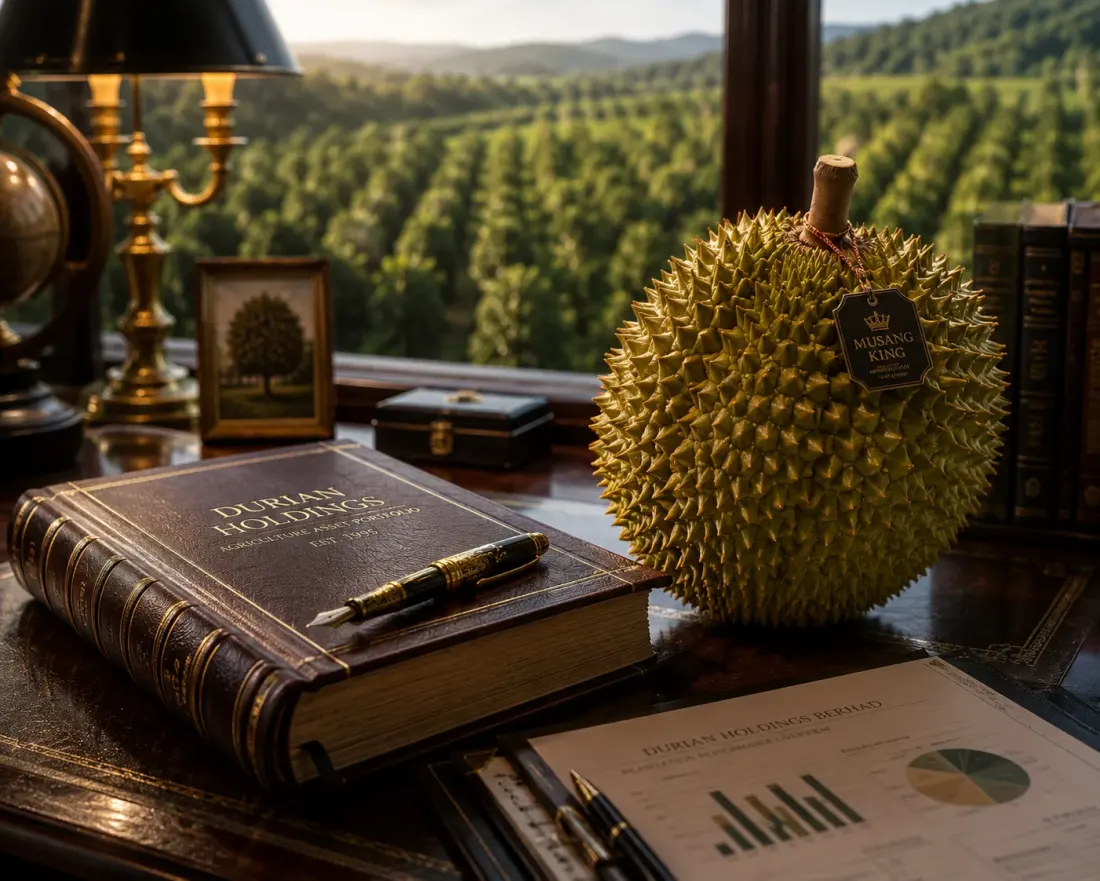
Instead, nearly all commercial orchards use grafted trees. A scion (a branch cutting) from a proven variety — Musang King, D24, Black Thorn — is grafted onto a seedling rootstock. This gives you two advantages: the fruit quality is consistent with the parent tree, and the tree fruits in 5–7 years instead of 15.
Rootstock selection matters. Seedlings from vigorous, disease-resistant mother trees are preferred. The rootstock determines how well the tree handles drought, waterlogging, and soil-borne diseases like Phytophthora.
Phase 2: Planting and Early Care
Durian trees need space. Standard planting distance is 10–12 meters between trees, sometimes up to 15 meters for vigorous varieties. A hectare holds roughly 80–100 trees.
The first three years are pure investment. The tree is not fruiting. During this period, farmers focus on:
- Canopy shaping: Pruning to build a strong, open structure that allows light penetration and air circulation
- Fertilisation: Balanced NPK fertilisers applied every 2–3 months, with micronutrients like zinc and boron added as needed
- Water management: Young trees need consistent moisture but cannot tolerate waterlogged roots
- Pest monitoring: Leaf-eating caterpillars, borers, and fungal infections are common in young trees
Soil preparation before planting is critical. Durian prefers deep, well-drained, slightly acidic soil (pH 5.5–6.5). Heavy clay soils need organic matter amendment. In sloping terrain, terracing or individual planting holes of at least 60cm x 60cm x 60cm are standard.
Phase 3: The Waiting Years (Year 3–7)
Grafted trees typically start flowering between year 4 and 6, depending on variety, climate, and management. The first fruiting is usually light — maybe 10–20 fruits per tree.
During this phase, the farmer's job is to build tree health for the long haul:
- Fertiliser regime shifts: More potassium and phosphorus to support flowering and fruiting, less nitrogen (which pushes leafy growth at the expense of fruit)
- Mulching: Organic mulch around the base retains moisture, suppresses weeds, and feeds soil biology
- Disease surveillance: Patch canker (caused by Phytophthora palmivora) is the most feared disease. It attacks the trunk and main branches. Infected tissue must be cut out and painted with fungicide paste. In severe cases, the tree dies
A well-managed tree reaches full production around year 8–12, producing 50–150 fruits per season.
Phase 4: Flowering and Fruit Set
Durian flowers open in the late afternoon and evening. Pollination is primarily done by the cave fruit bat (Eonycteris spelaea), though other nocturnal insects contribute.
Flowering is triggered by a dry spell followed by rain. In Malaysia, this often means the main flowering season follows a brief drought period, typically between February and April, with fruit maturing 90–120 days later.
Not every flower becomes a fruit. Natural fruit drop is heavy — the tree may set 100+ fruitlets but shed 60–80% of them over the following weeks. This is normal. The tree is self-thinning, keeping only what it can support.
Farmers do not interfere with this process. There is no practical way to artificially increase fruit set at commercial scale.
Phase 5: Fruit Development (90–120 Days)
Once a fruit is set, it takes roughly 3–4 months to reach maturity. During this period:
- The fruit grows rapidly in the final 4–6 weeks, gaining most of its final weight
- Starch converts to sugar: Brix levels climb from around 15–18% early on to 28–38% at full maturity, depending on variety
- Fat content develops: Musang King, for example, reaches 5–8% fat content, which gives it that creamy, almost buttery texture
- Aroma compounds build: The sulfur-containing compounds that give durian its distinctive smell accumulate primarily in the final 2–3 weeks
Farmers monitor fruit development by:
- Tracking days after fruit set
- Observing fruit colour change (from bright green to a duller, yellowish-green)
- Checking for slight softening at the stem end
- Watching for the first natural drops — this signals that harvest is near
Phase 6: Harvest — Timing Is Everything
Durian is not picked based on a calendar date. It is picked based on maturity indicators:
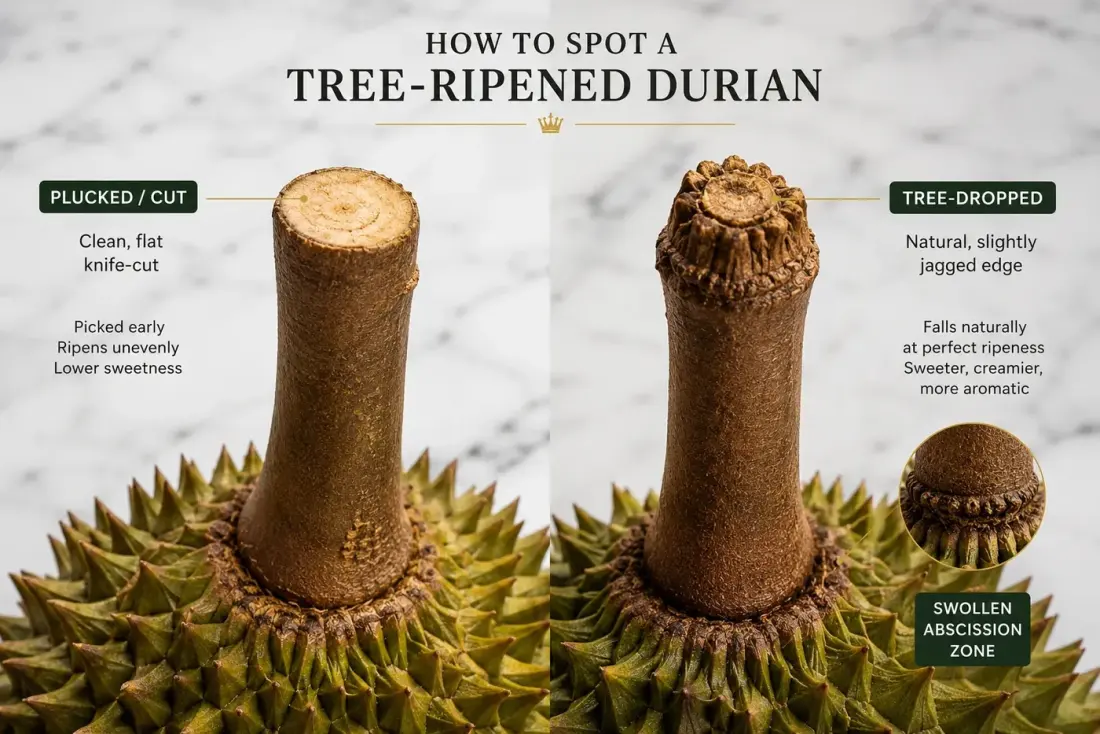
1. Days after fruit set: Most varieties are harvested at 90–120 days, but this varies with weather 2. Sound test: A ripe fruit, when tapped with a knuckle, produces a hollow sound. An unripe fruit sounds dense 3. Stem condition: The abscission zone (where the stem meets the branch) begins to weaken. In some varieties, the fruit detaches naturally 4. Skin colour: Segments may show a slight yellowing, especially along the suture lines 5. Aroma: A mature fruit emits a stronger smell even while still on the tree
Natural drop vs. hand harvest:
- In many traditional orchards, farmers collect fallen fruit each morning. This guarantees full maturity but risks bruising and shortens shelf life
- In commercial operations, fruit is hand-harvested at 85–95% maturity. Workers climb the tree or use long poles with nets. The fruit is caught, not dropped
- Hand-harvested fruit has a longer shelf life (5–7 days vs. 2–3 days for fallen fruit) and better appearance
Harvest is done in the morning. Fruit picked in the heat of the day has higher field heat, which accelerates spoilage.
Phase 7: Post-Harvest Handling
What happens in the first hour after harvest determines market quality.
At the orchard:
- Fruit is sorted immediately. Cracked, insect-damaged, or undersized fruit is separated
- Stems are trimmed to prevent puncturing neighbouring fruit during transport
- Fruit is placed in single-layer crates or baskets — never piled
Grading criteria include:
- Weight (Musang King Grade A: 1.8–2.5 kg)
- Shape symmetry
- Number of full lobes (5–6 is ideal)
- Absence of cracks, holes, or fungal spots
- Stem freshness (a dry, brown stem means the fruit was harvested days ago)
Cold chain:
- Ideally, fruit is pre-cooled to 15–18°C within 6 hours of harvest
- Transport temperature: 13–15°C for whole fruit
- At retail: displayed at ambient temperature for 1–2 days to allow aroma development
Durian does not tolerate temperatures below 10°C. Chilling injury causes the flesh to turn watery and lose flavour. This is why durian is almost never refrigerated whole — only the extracted pulp is frozen for export.
Phase 8: From Orchard to Consumer
For domestic markets, fruit reaches wholesale markets within 24–48 hours of harvest. From there, it goes to retail stalls, supermarkets, or direct-sale orchards.
For export (primarily to China), the supply chain is more complex:
1. Sorting and grading at packing houses 2. Vacuum freezing of extracted pulp at -35°C to -40°C 3. Cold chain shipping at -18°C or below 4. Customs clearance (China requires GACC-registered Malaysian facilities) 5. Last-mile delivery in frozen or chilled form
Frozen whole durian has been exported to China since 2019, and fresh whole durian was approved in 2024. Fresh fruit must arrive within 5–7 days of harvest, which means air freight for most shipments.
Practical Takeaway
If you are buying durian:
- Look at the stem: Fresh, greenish stem = recently harvested. Dry, brown stem = older
- Check the aroma: A strong smell means the fruit is ripe. No smell means it needs more time
- Feel the weight: A heavy fruit for its size has thick, full lobes
- Ask the vendor when it was harvested: A mature durian only ripens a little more for a day or two after harvest; after that it goes downhill. Fresher is better
If you are growing durian:
- Start with grafted trees from a reputable nursery
- Be patient — the first 3–5 years are investment with no return
- Manage soil health and drainage above all else
- Harvest at the right maturity. Picking too early is the most common mistake
Fresh durian, farm-direct. Stock changes daily — WhatsApp us before you visit.
Check Today's Stock