A durian tree left entirely to its own devices will grow upward — tall, narrow, and increasingly difficult to manage. Given 20 years and no intervention, it can reach 25–40 metres. At that height, monitoring for disease, managing pests, applying fertiliser, and harvesting become dangerous and expensive propositions.
Formative pruning addresses this from the beginning. The goal is not to make the tree smaller for aesthetics — it's to establish a structure that maximises productive canopy, allows light into the centre of the tree, promotes good airflow that reduces disease pressure, and keeps the tree at a height where a person with a long pole can still do meaningful work.
This is one area where the investment of time in the first 3–5 years pays dividends for the next 25.
What Formative Pruning Actually Aims For
The target structure for a managed durian tree is:
- A clear trunk to 1.5–2.5 metres height
- 3–4 primary scaffold branches emerging from this point, spreading outward at roughly equal angles
- Secondary branches developing from these scaffolds, gradually filling the canopy
- An open centre that allows light penetration and air movement
- Manageable overall height of 6–8 metres at maturity
This structure is not achieved overnight. It's built progressively over the first 3–5 years through selective cuts that encourage the tree to develop in the direction you want.
When to Begin
The timing question catches some new growers off guard.
Do not prune a newly planted sapling. Transplanting is already a significant stress event. Cutting branches before the tree has re-established its root system simply adds more stress without benefit.
The appropriate time to begin formative pruning is 1.5–2 years after planting, when the tree has established a stable root system and has begun growing actively. At this point, the tree is large enough to show its natural branching structure, and early intervention can guide that structure before it becomes difficult to correct.
The Central Leader Decision
This is where durian pruning gets slightly controversial among experienced growers.
The central leader is the main vertical shoot growing upward from the trunk. Cutting it — called "topping" or "central leader removal" — at 2–3 metres height forces the tree to produce lateral branches from below the cut, creating the wide, spreading canopy structure that makes management easier.
Arguments for removing the central leader:
- Produces a shorter, more accessible canopy faster
- Light penetration to lower branches is significantly better
- Harvest monitoring and management at 6–8m is practical with standard equipment
Arguments against:
- Some growers and researchers observe that removing the leader can reduce early production, as the tree redirects energy to rebuilding vertical structure
- Trees that are topped aggressively can produce excessive water sprouts (vertical shoots from the cut point) that require ongoing removal
- For very vigorous clonal varieties, leaving the leader and managing height through annual maintenance pruning may achieve similar results with less disruption
The practical middle ground used by many Malaysian orchard managers: cut the central leader once at 2–2.5m to establish scaffold branches, then manage height through selective annual pruning rather than repeated topping.
What to Remove
Crossing branches: Two branches growing toward each other will eventually compete, creating rubbing wounds and entry points for disease. Remove the weaker of the two early.
Water sprouts: Vigorous, vertical shoots that grow rapidly from the trunk or main branches. They consume nutrients and produce very little fruit. Remove them as soon as they appear — if allowed to grow large, removal creates larger wounds.
Rootstock suckers: If the tree is a grafted clone (which most commercial trees are), shoots emerging from below the graft union come from the rootstock — not the desirable scion variety. These must be removed promptly; if allowed to dominate, the tree reverts to rootstock characteristics.
Dead and diseased wood: Remove as soon as identified. Do not leave stubs — cut flush or slightly below the branch collar to allow clean wound healing.
Branches below 1 metre height: These intercept light that should reach the productive canopy, are at risk of soil contact, and make weed management and fertiliser application difficult.
Branches that hang below 45 degrees from horizontal: Heavily downward-angling branches are usually unproductive, often diseased, and difficult to manage.
Tools and Hygiene
Pruning durian without attention to tool hygiene is an efficient way to spread Phytophthora and other pathogens from one tree to another.
Sterilize pruning shears and saws with 70% isopropyl alcohol between each tree — not just when you see diseased wood, but routinely. Phytophthora spores are invisible; by the time a tree shows symptoms, the pathogen has often already been in the tissue for weeks.
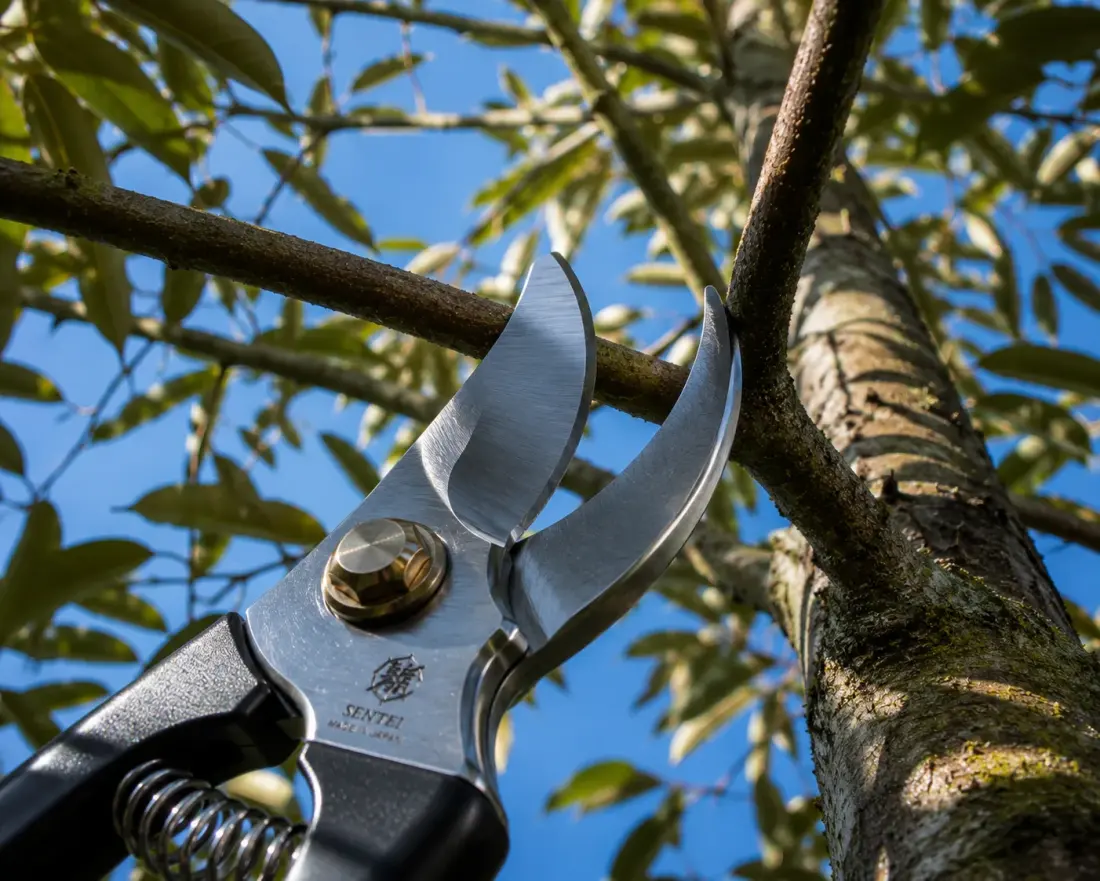
Pruning saws for branches above 5cm diameter; loppers for branches 1–5cm; sharp bypass shears for small diameter cuts. Dull tools tear wood rather than cutting cleanly — torn wood heals more slowly and invites infection.
Wound sealing: For any cut larger than 2cm diameter, apply a pruning paint, bituminous wound dressing, or copper-based fungicide paste immediately after the cut. The window between cutting and application matters — do not paint the wound an hour later.
Canopy Management in Mature Trees
Once formative pruning has established the scaffold structure (typically by years 4–6), the focus shifts to maintenance pruning.
Annual pruning objectives in a mature orchard:
- Remove any new crossing or rubbing branches
- Cut back branches that are extending the canopy height above 6–8m
- Remove dead and diseased wood
- Thin overcrowded sections where multiple branches are competing for the same space
The Malaysia Department of Agriculture recommends maintaining durian at 6–8 metres as the working height target. Research supports this: trees maintained at this height show 15–25% higher flower induction rates compared to tall, unpruned trees, largely due to better light distribution through the canopy. Light reaching inner branches is a direct driver of flower initiation in durian.
When Not to Prune
Timing relative to the production cycle matters.
The appropriate pruning window is immediately after harvest — once fruits are picked, the tree enters a recovery phase before the next flush. Pruning during this window allows wounds to heal before the next major growth period.
Avoid pruning within 4 months of expected flowering. Pruning during this window can trigger a vegetative flush — a wave of new leaf and shoot growth — which delays or displaces the flowering response. If the tree sends out a vegetative flush just as it should be initiating flower buds, you've effectively pushed the production calendar back by weeks or months.
Common Mistakes
Over-pruning: Removing too many branches in a single session is stressful and counterproductive. A general rule: do not remove more than 25% of the canopy in any single pruning event. Spread major structural work over 2–3 seasons if needed.
Late pruning: Pruning during or just before the pre-flowering period stimulates vegetative growth at exactly the wrong time. If you've missed the post-harvest window, it's better to wait for the next cycle than to prune at an unfavourable time.
Leaving large stubs: Stubs die back and become entry points for rot and disease. Always cut back to the branch collar or parent branch.
Ignoring water sprouts: Water sprouts that are left to grow become structural branches — replacing them later requires major cuts that should have been avoided. Check for and remove water sprouts every 2–3 months.
Not sterilising tools: A single pass through an infected tree with unsterilised tools can spread pathogen material to every subsequent tree. This is not theoretical — disease movement in orchards where tool hygiene is poor is well-documented.
Practical Takeaway
Formative pruning is a 3–5-year project in the early life of the orchard. The decisions you make in years 1–4 determine the structure and management difficulty for the next two decades.
The principles are simple: establish a clear scaffold early, keep height manageable, remove anything that competes with or damages productive wood, and sterilize your tools. What makes it difficult in practice is consistency — pruning lightly but regularly beats major corrective surgery every few years.
Common Questions
Yes, but it takes time and should be done incrementally. Don't try to reshape a decade of growth in one season — you'll lose too much canopy and the tree will respond with a flood of water sprouts. Plan on 3–4 seasons of progressive work to bring height down and open the canopy.
Very light work only — removing suckers from below the graft line, or any clearly dead or diseased material. Structural shaping should wait until year 1.5–2. Cutting branches on a tree that's still establishing its root system is more harmful than helpful.
A water sprout is a fast-growing, vertical shoot emerging directly from the trunk or a main branch — often from a pruning cut or wound site. They grow rapidly but produce almost no fruit, and they drain nutrients from productive branches. Remove them as soon as you notice them; small cuts are much better than large ones.
As a practical limit, no more than 20–25% of the canopy in a single session. Major structural work that requires more should be spread over 2–3 seasons. Excessive pruning triggers the tree to allocate energy to recovery rather than production.
It can, depending on timing. Pruning immediately after harvest has minimal effect on the following season. Pruning close to the pre-flowering period can delay or reduce flowering. The closer to the expected flowering window you prune, the more likely you are to push production back.
Not strictly necessary, but it significantly shortens the time to achieve a wide, accessible canopy. Without it, height management requires more years of selective branch removal to achieve similar structure. Whether you top or not, the goal is the same: a productive canopy at a manageable height.
A crossing branch is one that grows toward another branch and will eventually contact or compete with it. The indicator is trajectory — where will this branch be in 2–3 years? If it's heading toward another branch, one of them should be removed. Always keep the branch that is better positioned for productive growth.
Yes. Large fresh cuts are direct entry points for fungal pathogens, especially Phytophthora and Botryodiplodia. This is why wound sealing immediately after cutting large branches matters, and why tool sterilisation between trees is non-negotiable in any managed orchard.
Want to try fresh durian from our farm? We grow it at our own Bukit Serampang orchard in Tangkak, Johor, and sell it at our Melaka Mall stall. Stock varies daily — WhatsApp to confirm availability before you visit.
Ask About Today's Fruit