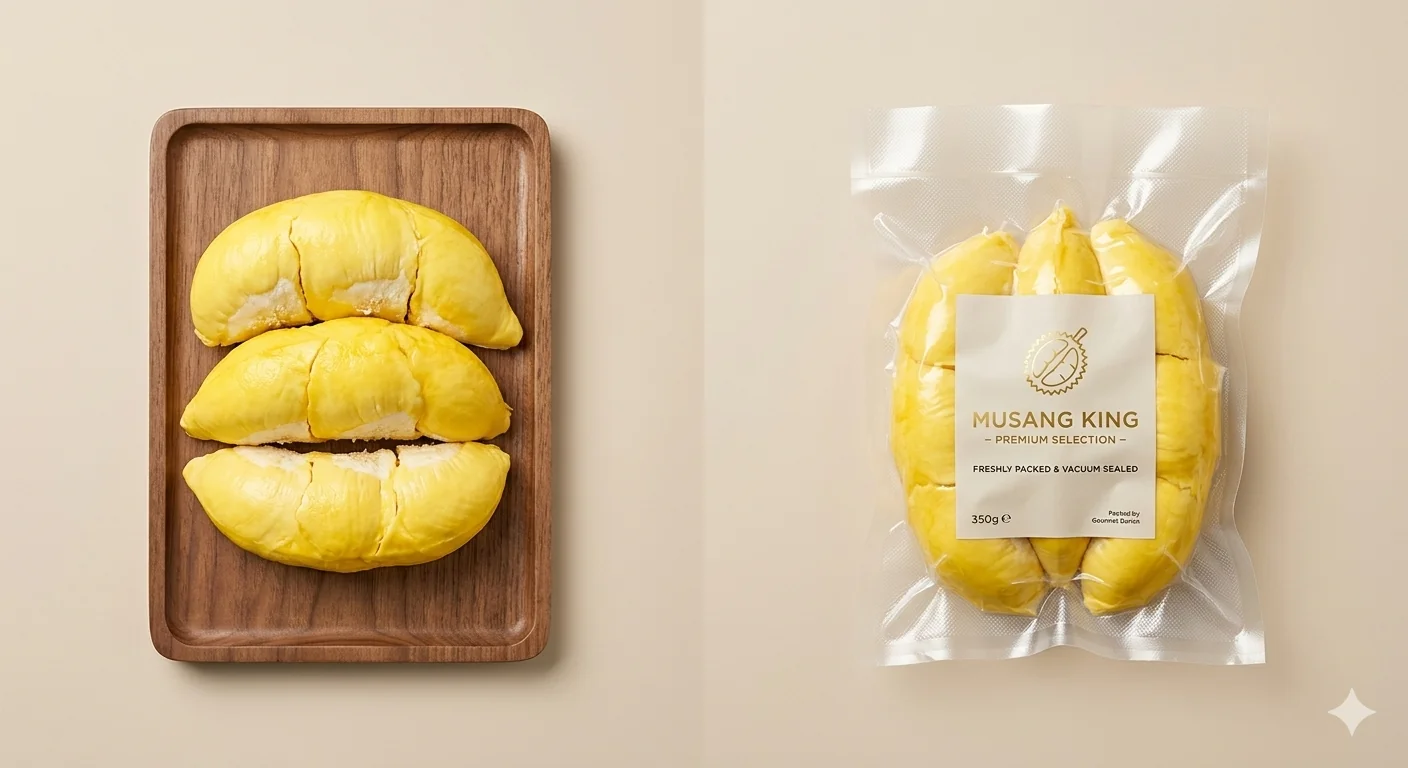
Short answer: Not necessarily. Most doctors don't ban it outright: keep to 2–3 small pods, eat them with a meal in place of rice or bread, and check your blood glucose 1–2 hours later. Skip it when your glucose control is poor or you're unwell.
The moment someone is diagnosed with diabetes, durian is often the first food to get cut. The logic seems straightforward — durian is sweet, therefore it is dangerous for blood sugar. But the full picture is more nuanced than a blanket ban. Understanding what durian actually does to blood glucose, and how portion and timing matter, gives diabetics a more honest framework than simply avoiding the fruit entirely.
What's in Durian That Affects Blood Sugar
A 100g serving of fresh durian flesh (about 2 to 3 small pods) contains roughly 27g of total carbohydrates, with fibre accounting for about 3.8g of that. The glycemic index (GI) of durian falls in the range of 44 to 54, which classifies it as a low-to-moderate GI food. For reference, white rice sits around 72, and watermelon around 72 to 76.
Durian also contains approximately 3 to 5g of dietary fat per 100g and about 3.8g of fibre. The fat and fibre slow gastric emptying, which blunts the speed at which sugar enters the bloodstream. This is a meaningful difference compared to drinking a sugary beverage, which spikes blood glucose rapidly.
What Happens When a Diabetic Eats Durian
The concern is not the fruit itself — it is the portion. A typical durian session involves consuming 100 to 200g of flesh, sometimes more. At 200g, a person is ingesting roughly 50g of carbohydrates in one sitting. For someone whose insulin response is impaired, this is a significant glucose load.
However, clinical observations and small studies from Southeast Asian medical journals suggest that moderate portions (50 to 80g) of durian do not produce dramatically different glucose spikes compared to equivalent carbohydrate loads from other fruits like mango or banana, provided the person is on stable medication and the durian replaces — rather than adds to — other carbohydrate sources in the meal.
Three Factors That Matter More Than the Fruit Itself
1. Portion size. Eating half a durian (300g+ of flesh) is a significant sugar load regardless of GI. Eating 2 to 3 pods (50 to 80g) is a manageable carbohydrate serving.
2. Timing and food pairing. Eating durian on an empty stomach produces a faster spike. Eating it after a meal with protein and vegetables slows absorption.
3. Individual medication and glucose control. A diabetic with well-managed HbA1c on metformin will handle a small portion very differently from someone with poorly controlled Type 2 diabetes on multiple medications.
What Doctors Actually Say
Most endocrinologists in Malaysia, Thailand, and Singapore do not issue an absolute prohibition. The common advice is: limit to 2 to 3 pods (roughly 50 to 80g), eat it as part of a meal rather than a standalone snack, and monitor blood glucose 1 to 2 hours afterward to understand personal response. Avoid entirely during periods of poor glucose control or illness.
The danger of an absolute "never eat durian" rule is that it is unrealistic in Southeast Asian cultures where durian is deeply social. Patients told "never" often eat it secretly without adjusting other carbs, which causes more harm than a planned, measured portion.
Practical Guidelines for Diabetics
- Limit to 2 to 3 pods (50–80g of flesh) per sitting
- Replace other carbohydrate sources in that meal — eat less rice, skip the bread
- Eat it after a meal, not on an empty stomach
- Check blood glucose at 1 and 2 hours after eating to understand your personal response
- Avoid entirely if glucose control is currently poor or during illness
Sources
- Robert SD, Ismail AA, Winn T, Wolever TMS (2008). Glycemic index of common Malaysian fruits. Asia Pacific Journal of Clinical Nutrition 17(1): 35–39. Link
- U.S. Department of Agriculture. Durian, raw or frozen (FDC 168192). FoodData Central. Link
Durian Khakha is a durian grower, not a medical provider. For personal health advice, speak to your doctor.
Fresh durian, farm-direct. Stock changes daily — WhatsApp us before you visit.
Check Today's Stock