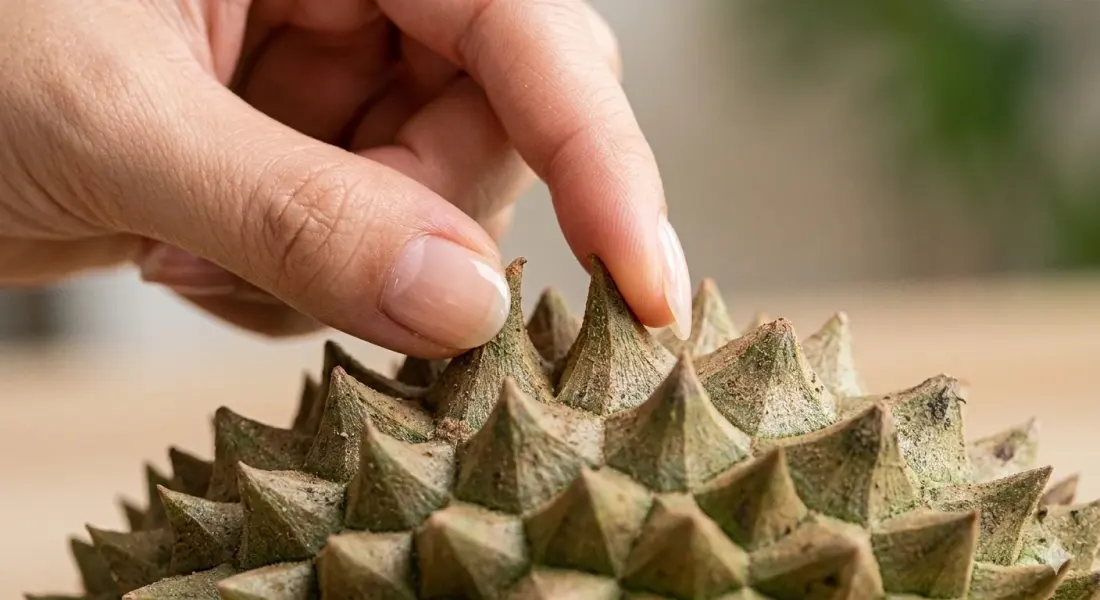
A durian hitting the ground at 2 a.m. is worth money — but only if someone picks it up within the next few hours. In Malaysian tropical conditions, with ambient temperatures running between 28 and 35°C, natural-drop durian begins fermenting soon after it falls. The window is roughly 2–4 hours before quality starts declining. Miss that window and the fruit that was worth RM 80–150/kg this morning is either degraded or worthless by sunrise.
For most growers running orchards larger than a few acres, this collection window is the central challenge of peak season. Traditional approaches involve night watchmen patrolling every few hours — expensive, physically demanding, and still imperfect for orchards spread over uneven terrain. Automated drop detection and anti-theft net systems exist to solve this problem directly. This article explains how the technologies work, what they cost, and what realistic expectations look like.
Why the Collection Window Is So Tight
Durian ferments differently from most fruits. Once the husk separates from the stem and the fruit hits the ground, the internal enzymes activating fermentation are not paused by the intact husk — heat accelerates the process. In field conditions at 30–35°C, a Musang King fruit left on the ground for 4–6 hours can develop off-flavours at the core even if the exterior looks undamaged. After 6–8 hours, the change becomes detectable in taste. After 10–12 hours in heat, the fruit is typically unsellable as fresh premium product.
This is not unique to Musang King — D24, Black Thorn, and other varieties follow similar patterns, though the tolerance window varies slightly by variety.
The practical implication: during heavy-drop nights, when 30–60 fruits might fall across a 15-acre orchard over 6 hours, a single watchman cannot physically patrol the full area and collect in time. Fruits fall in scattered locations. Some trees drop simultaneously. Without a notification system, the watchman is guessing where to walk next.
The Traditional Approach and Its Limits
The standard solution for decades has been night patrol workers stationed in the orchard during peak drop season. A typical arrangement:
- 1–2 watchmen per 10–15 acres during peak season
- Patrol circuit every 2–4 hours through the night
- Cost: RM 50–100 per night per watchman, or RM 1,500–3,000/month per person during the 6–8 week peak
This adds up to RM 6,000–12,000 per season in direct labour costs just for night collection. And it still misses drops. A watchman completing a 2-hour circuit may find a fruit that fell 90 minutes ago — borderline timing. A fruit that fell 5 minutes after the last patrol pass will sit for nearly 2 hours before discovery.
Safety is an additional concern. Working alone at night in orchard terrain — uneven ground, active wildlife, poor visibility — carries real injury risk.
Theft is a separate problem that watchmen address incompletely. A determined thief who has observed the watchman's patrol pattern knows exactly when to move. Musang King at RM 80–150/kg farm-gate price creates a strong financial incentive — a bag of 10–15 fruits represents RM 1,200–2,250 taken in minutes.
Automated Drop Detection: Three Technologies
1. Ground Impact Sensors (Vibration Detection)
Vibration sensors placed on the orchard floor detect the impact signature of a falling durian. The signal profile of a 2–4 kg fruit hitting soil or leaf litter at terminal velocity is distinctive — the sensor's firmware filters out other vibration sources (rain, animals, wind movement) and triggers an alert when a durian-match event is logged. GPS coordinates of the sensor node are sent along with the alert, so the farmer or worker knows exactly which area to check. Alert delivery to smartphone: within 30–60 seconds of the drop event.
Practical note: heavy rain is the main source of false positives — sustained rainfall generates continuous vibration that can saturate the sensor's detection logic. Most systems go into a "rain suppression" mode during precipitation events, reducing alert generation but also reducing detection sensitivity during those periods.
2. Net + Load Cell / Strain Gauge Systems
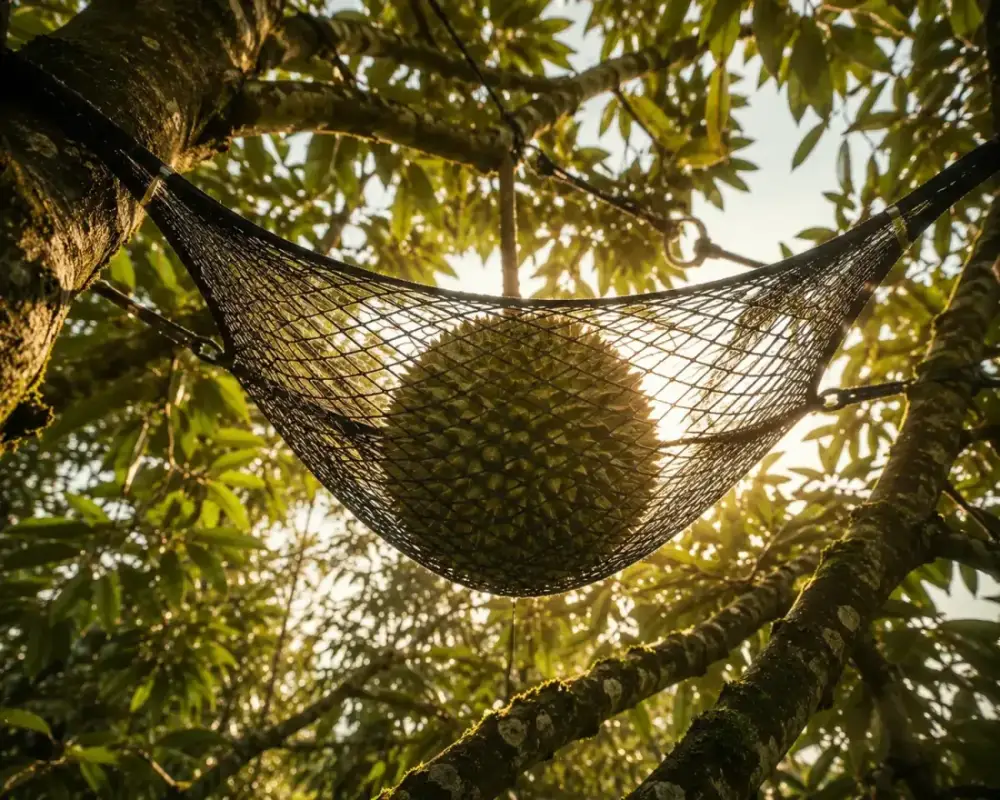
This approach suspends an HDPE mesh net around each tree at 1.5–2 metres height with a radius of 4–5 metres. When fruit falls and lands in the net, the additional weight triggers a load cell or strain gauge mounted at the net support point. The weight change — calibrated to the typical mass range of ripe durian (1.5–4 kg) — triggers an alert with tree identifier and timestamp.
This system solves two problems simultaneously: it detects the drop AND prevents the fruit from reaching the ground where it can roll away, be damaged, or be accessed by thieves. The net material needs to be appropriately tensioned — too loose and the fruit bounces or bruises on impact; properly tensioned, the net cushions the fall and holds the fruit in place until collection.
The physical net barrier also serves as the primary anti-theft mechanism. A fruit suspended in a net 1.5 metres off the ground with a tamper-evident locking mechanism at the net access points cannot be removed quietly or quickly.
3. Infrared Camera + AI Detection
IR cameras mounted on tree trunks or orchard poles continuously monitor the drop zone. An AI model running on the edge device (or in the cloud) processes the footage and distinguishes between fruit-drop events, animal movement, blowing branches, and rain. When a fruit-drop signature is detected, an alert fires with a video clip attached.
This is the highest-cost option and the most technically complex, but it provides a visual record of every drop event — useful for harvest logs, insurance purposes, and later for training the AI model further. Detection accuracy in well-deployed systems: 88–95% for fruit drop events; false positive rate 5–12% depending on orchard conditions.
The Anti-Theft Function
The net system deserves specific attention on theft protection, because the economics here are straightforward.
Musang King at RM 80–150/kg farm-gate price is among the most theft-attractive agricultural products in Malaysia. Documented theft from orchards typically occurs in the pre-dawn window when drop is heavy and supervision is minimal. A thief who knows the orchard layout can remove 10–20 fruits before being detected under traditional watchman arrangements.
Net systems reduce theft by 70–90% compared to unprotected orchards. The mechanism is physical: the net is suspended at height, requires tools or deliberate time to bypass, and the tamper-evident access lock generates an alert if interfered with. Theft is not impossible, but the time required and the alert generated mean opportunistic theft — the dominant form — becomes far less viable.
The alert system adds a second layer. A theft attempt on a net at 3 a.m. generates an immediate phone notification. Even if the farm owner is 20 minutes away, the psychological deterrent of a known alert system reduces opportunistic attempts significantly.
Cost Breakdown
Per-tree costs:
- Basic HDPE net installation (materials + installation): RM 200–500 per tree
- Vibration sensor node: RM 300–800 per node (one node covers 2–4 trees depending on placement)
- Full sensor + net system per tree: RM 500–1,300 per tree
Whole-orchard projection: For a 100-tree orchard:
- Net-only installation: RM 20,000–50,000
- Net + sensor system: RM 50,000–130,000
Ongoing costs:
- Cloud connectivity and alert platform: RM 80–200/month
- Net inspection and maintenance: 1–2 days/year of labour
ROI argument: At Musang King prices of RM 80–150/kg, a single fruit weighing 2.5 kg is worth RM 200–375. Recovering 2–3 fruits per night that would otherwise have been missed or stolen — conservatively 4–6 weeks of peak season, 50–80 nights — represents RM 20,000–90,000 in additional captured revenue over a season. Even on a pessimistic estimate, a RM 80,000 system pays back in 2–3 seasons on theft and quality recovery alone. The labour savings compound the return further.
Limitations to Know Before You Buy
False triggers from rain: This is the most common operational complaint. Heavy tropical rainfall generates net vibration and ground impact signals that overlap with the fruit-drop signature. Most modern systems apply rain-suppression logic, but during heavy rain, detection reliability drops noticeably. Some farms simply accept reduced alert sensitivity during storm nights and rely on manual patrol during heavy rain events.
Wind-blown branches: Large canopy movement during wind events causes net movement and occasional false alerts. Properly tensioned nets reduce this, and AI-based systems (cameras + models) are better at filtering this noise than pure vibration sensors.
Connectivity gaps: Remote orchards with poor cellular coverage may experience delayed alert delivery. A LoRaWAN gateway with local alarm capability (audible buzzer at a central station even without cloud connectivity) addresses the worst case — the alert still fires locally even if the phone notification is delayed.
Human collection still required: The system detects and protects the fruit. A person still needs to walk to the tree, retrieve the fruit from the net, grade it, and move it to post-harvest processing. Automation reduces labour demand by an estimated 40–60% compared to manual patrol — it does not eliminate the need for a night collection worker entirely.
Integration with Farm Management
The most useful configurations connect the drop detection system to the farm's orchard management app. When a drop alert fires, the system logs:
- GPS coordinates or tree identifier
- Timestamp (used to calculate time-since-drop, a freshness proxy)
- Alert type (drop detection vs. tamper/theft alert)
This data feeds directly into the harvest log. At end of season, you can see which trees dropped consistently, at what times of night, and what the collection latency was — data that informs staffing decisions for the following season, and that can be shared with buyers as a quality traceability record.
Some systems allow the worker to log a quality grade at collection (external husk condition, estimated firmness) which adds a grade-at-collection data point to each fruit's record.
Practical Takeaway
The ROI case for drop detection and anti-theft nets is clearest for orchards growing Musang King or other high-value varieties where per-fruit value justifies the infrastructure cost. For lower-value varieties at RM 8–15/kg, the numbers are tighter and basic net-only systems (without sensors) may be the better starting point — the physical barrier alone recovers meaningful value even without the alert system.
The practical sequence:
- Start with nets on your highest-value trees — the trees with the most consistent drop history.
- Add vibration sensor nodes at the net anchor points on those same trees.
- Connect to a mobile alert platform.
- Evaluate false trigger rate and detection reliability in your specific orchard conditions before expanding to full coverage.
Do not buy a 100-tree system based on vendor promises. Install on 10–15 trees, run it through one peak season, and measure actual collection improvement and false alert frequency in your orchard. The per-tree cost makes phased rollout entirely practical.
Common Questions
The two work best together, not as either/or. The sensor system tells the watchman exactly where to go and when — instead of walking a circuit and hoping, they respond to specific location alerts. This reduces the number of watchmen needed (often from 2 to 1) and improves collection timing. A watchman without sensor support still misses drops in a large orchard; sensors without anyone to collect are just data.
UV-stabilized HDPE mesh rated for agricultural use is designed to handle durian contact. The spines puncture individual mesh cells but do not propagate tears through the material the way they would in a fabric net. Standard replacement cycle is 3–5 years depending on UV exposure and how often the nets are walked through. Inspect nets at the end of each season for accumulated puncture damage and replace panels before they develop structural weakness.
For vibration-only systems without AI filtering: 20–35% false positive rate is typical during normal conditions, rising significantly during rain. For AI camera systems with trained fruit-drop models: 5–12% false positive rate under normal conditions. If your farm has frequent afternoon thunderstorms, budget time for dealing with false alerts and consider a system with a rain suppression mode or camera-based discrimination.
Most sensor nodes run on solar-charged lithium battery packs. A small panel (5–10W) mounted at canopy height provides sufficient charging even under partial shade. Battery backup sustains the node through 3–5 consecutive cloudy days. If your orchard has significant shade (high-density planting or hilly terrain limiting sun exposure), check with the vendor on battery autonomy and solar panel sizing for your specific canopy conditions.
The detection systems are calibrated by weight range and impact signature. For small varieties with fruit under 1.5 kg, load cell sensitivity and vibration detection thresholds may need adjustment. Tell your vendor the variety mix and expected fruit weight range before system design — this affects sensor node configuration and net load cell calibration.
Properly tensioned HDPE mesh provides enough give to cushion impact for a 2–4 kg fruit from 5–8 metres. Bruising risk is primarily from improper net tension (too tight creates a hard surface) or from fruits that land and then roll against the net support structure. Good installation with uniform tension across the net and padded support poles at contact points essentially eliminates bruising as a concern in practice.
Yes — mobile alert delivery with GPS tree coordinates means you receive notifications on your phone regardless of where you are. The practical question is who acts on the alert at 2 a.m. if you are not on site. Most farms with remote monitoring also maintain a live-in caretaker or have an on-call arrangement with a nearby worker. The system generates the alert; someone local still needs to physically collect.
Want to try fresh durian from our farm? We grow it at our own Bukit Serampang orchard in Tangkak, Johor, and sell it at our Melaka Mall stall. Stock varies daily — WhatsApp to confirm availability before you visit.
Ask About Today's Fruit