If you've been growing durian long enough, you already know the feeling: you walk the orchard one morning and something looks off. A branch is yellowing. The bark near the base looks darker than usual. By the time most farmers act, they've already lost the window.
This article covers the three threats that cause the most economic damage in Malaysian durian orchards — Phytophthora bark rot, Fusarium wilt, and the durian borer. Each one follows a pattern. Once you know the pattern, early detection becomes a habit rather than a guessing game.
Phytophthora palmivora — Bark Rot and Root Rot
This is the single most economically damaging disease in Malaysian durian cultivation. Left untreated, it can kill a mature tree within weeks. The speed is what catches farmers off guard.
What It Does to the Tree
Phytophthora palmivora is a water mould — not a true fungus, but it behaves like one. It attacks the trunk base, root collar, and feeder roots. The first visible sign is usually a dark, water-soaked lesion on the lower trunk or near the soil line. Within a few days, a brownish gum exudate starts weeping from the bark surface. This gum is a diagnostic signal — if you see it, the disease is already inside the tissue.
As the lesion spreads around the trunk, the crown above begins to yellow and drop leaves. By the time the crown shows visible stress, the cambium beneath the bark is already dead or dying in that zone. If the lesion girdles the trunk completely, the tree dies.
The early detection window is narrow: roughly 5–7 days from when the bark first discolours to when the lesion becomes lethal in spread. Every day of delay tightens the outcome.
What Triggers It
Three conditions drive most outbreaks:
- Waterlogged soil or poor drainage (the pathogen thrives in oxygen-depleted, wet conditions)
- Mechanical wounds on the trunk — from brushcutters, equipment, improper pruning
- Dense canopy with poor air circulation extending wet bark periods after rain
High-risk periods are prolonged wet seasons, particularly when consecutive rainy days prevent soil from drying between events.
Treatment
The standard protocol is metalaxyl-M combined with mancozeb — sold under formulations like Ridomil Gold. Apply as both a soil drench around the root zone and a trunk spray covering the affected area and 30–50 cm above and below the lesion.
Steps:
- Scrape off the dead bark at the lesion site to expose healthy tissue — this improves chemical penetration
- Drench the root zone with Ridomil Gold at label rate, repeated 2–3 times at 2-week intervals
- Spray or paint the trunk with the same product
- Remove and bag the scraped bark material — do not leave it on the orchard floor
Prevention
Between outbreaks, apply copper oxychloride as a protective spray on the lower trunk every 60 days during the wet season. This does not cure active infections but creates a chemical barrier that slows new entry points. Improve drainage before the wet season — raised beds, cleared drains, and sloped planting rows all reduce soil waterlogging significantly. Wrap tree guards around trunks in areas where brushcutter contact is common.
Fusarium oxysporum — Fusarium Wilt
Fusarium wilt is slower-moving than Phytophthora and harder to manage because the pathogen lives in soil, not just on the plant surface. Once it is in your orchard soil, it does not leave.
How It Progresses
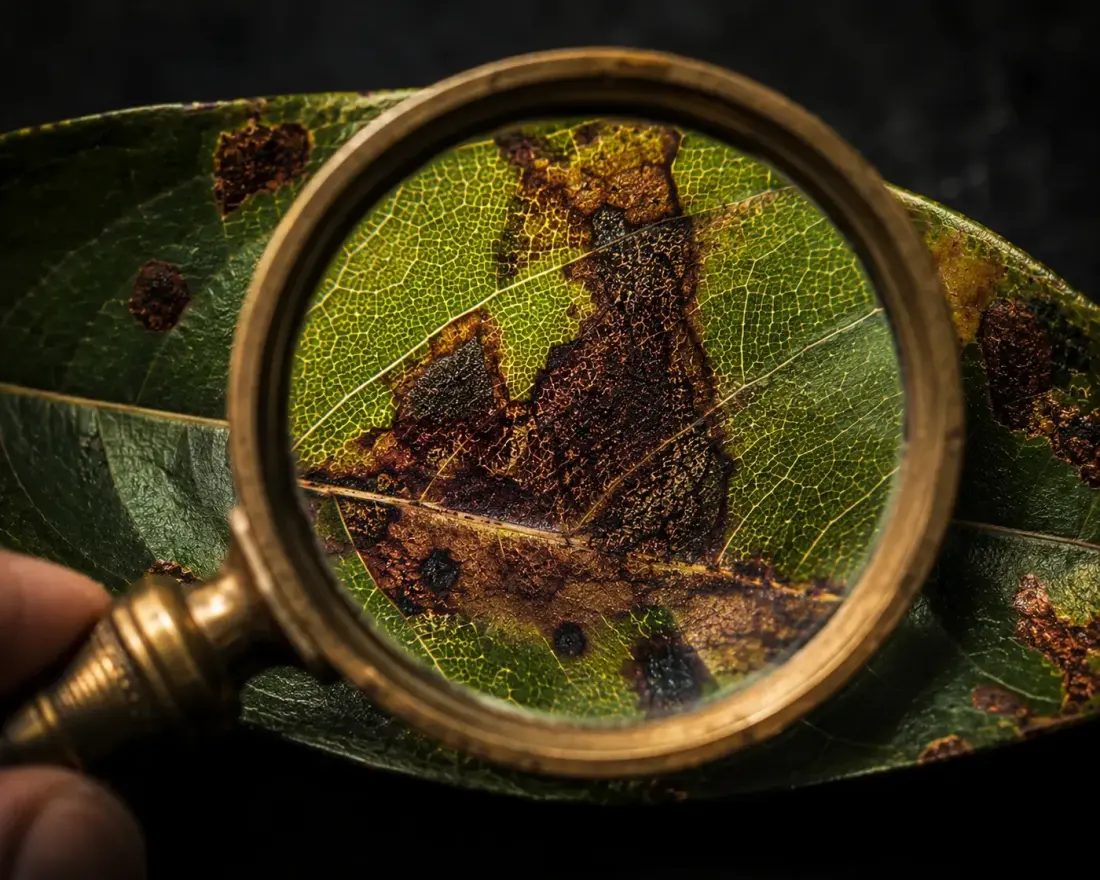
Unlike Phytophthora which attacks the base, Fusarium enters through roots and moves up through the vascular system. The classic presentation is progressive: one branch begins to yellow and wilt while the rest of the tree looks healthy. Farmers sometimes mistake this for nutrient deficiency or water stress. The tell is the asymmetry — it affects one limb at a time, progressing over weeks to months rather than all at once.
Cut a cross-section of an affected branch, and you'll see brown discolouration in the vascular tissue — the xylem vessels have been blocked by the pathogen's growth.
The pathogen survives in soil for years, even in the absence of a host plant. This means rotation or replanting in the same area does not solve the problem without targeted soil management.
Management Options
There is no complete cure. Management focuses on slowing progression and preserving tree vigour:
- Carbendazim or thiophanate-methyl root drenches, applied when early symptoms appear — these do not eradicate the pathogen but can slow colonization
- Remove and burn all infected branches; never compost diseased wood
- Sterilize cutting tools between trees (70% ethanol or diluted sodium hypochlorite)
Prevention
Healthy, stress-free trees are more resistant to Fusarium colonization. Avoid soil compaction around root zones — compacted soil damages feeder roots and creates entry points. Where available, plant on resistant or tolerant rootstocks. Some nurseries in Malaysia offer Fusarium-tolerant rootstock options, though availability varies by region. Maintain consistent fertilisation and irrigation schedules — trees under drought or nutrient stress are significantly more vulnerable.
Durian Borer — Tirathaba mundella
The durian borer moth is a different category of problem — it doesn't kill trees, but it destroys your harvest. The larvae bore into fruit stems and young shoots, causing fruit to detach from the tree before ripening.
What to Look For
The most reliable indicator is frass — the sawdust-like excrement that the larvae push out of their entry holes. Look for small entry holes with granular, fibrous material around the attachment point of the fruit to the stem. In early infestations, the holes are easy to miss. Check fruit stems and peduncles during every inspection pass, not just when you notice something wrong.
Fruits attacked by borers often drop between weeks 4–6 after fruit set — this is the highest-vulnerability window. Any premature fruit drop during this period should trigger a visual inspection of the fruit peduncles.
Treatment
Two insecticide approaches work for active infestations:
- Chlorpyrifos or cypermethrin sprayed onto fruit stems, repeat applications every 10–14 days during the vulnerable period
- Targeted injection of insecticide directly into entry holes using a syringe — more precise and uses less chemical volume
IPM Approach
Blanket spraying the entire canopy is inefficient and increases chemical residue on fruit surfaces. The IPM (Integrated Pest Management) approach is more precise:
- Set up pheromone traps to monitor adult moth population density — trap counts tell you when pressure is rising before visible damage appears
- Time targeted sprays to correspond with egg-hatching periods based on trap data
- Spray fruit stems and peduncles specifically, rather than the whole tree
Pheromone traps are available through DOA-licensed suppliers and some agri-input retailers. Replace lures according to manufacturer recommendations, typically every 4–6 weeks.
IPM Framework — Pulling It Together
Managing these three threats separately is less effective than running them as part of an integrated system. Keep a spray diary: record every application — chemical name, concentration, date, area covered, weather conditions. This is not just good practice; it is a requirement for MyGAP certification and GACC export registration.
Map your disease incidence. When Phytophthora appears, mark the location. Over seasons, you'll see whether outbreaks cluster around drainage bottlenecks, low spots, or mechanical damage zones. That pattern tells you where your preventive effort should be concentrated.
When to Call DOA or MARDI
If you encounter:
- A new disease presentation you cannot identify
- A rapid tree death pattern spreading across multiple trees in a short time
- Suspected pesticide resistance (treatments that worked before are no longer controlling the pest)
Contact your state DOA extension office or MARDI research station. They offer free on-site assessment and can send samples for lab identification. Do not delay — rapid spread situations need accurate diagnosis before you commit to a treatment that may be targeting the wrong pathogen.
Practical Takeaway
The pattern across all three threats is the same: early detection beats response. Phytophthora gives you 5–7 days. Fusarium gives you early branch symptoms before the tree is lost. Borers leave frass before fruit drop happens. None of these problems arrive silently — they leave signals. The farmer who walks the orchard every 3–4 days and knows what to look for is in a fundamentally different position from the one who waits until the damage is obvious.
Common Questions
Brushcutter wounds are usually clean cuts with no staining around them. Phytophthora lesions show dark, water-soaked discolouration in the bark tissue, often accompanied by a brownish gum weeping from the wound margin. Scrape a small section of the discoloured bark — if the inner tissue is dark and decayed rather than white-tan and moist, Phytophthora is the likely cause. When in doubt, photograph and send to your state DOA extension officer.
If the lesion has fully girdled the trunk, the prognosis is very poor. The vascular tissue connecting roots to crown is severed. You can attempt surgery — scraping and chemical treatment — but the tree rarely recovers. Prevention and early detection are what you have; late-stage intervention seldom succeeds.
Because the pathogen is soil-borne. Removing branches removes the infected plant tissue, but the Fusarium oxysporum spores remain in the soil indefinitely. Root drenches and maintaining tree health slow the progression, but there is no field-level soil treatment that eradicates it completely. Your goal is to slow the disease pace, not cure it.
Poor pollination fruit drop tends to happen very early — within 2 weeks of fruit set — and the dropped fruits are small and undeveloped with no entry holes. Borer-related drop happens later, at weeks 4–6, and the dropped fruits are larger with visible entry holes and frass near the peduncle attachment point. Check the peduncle on dropped fruits — if you see a small hole with fibrous excrement, it's borers.
No. Chlorpyrifos has a pre-harvest interval (PHI) of at least 14–21 days depending on the specific formulation and crop. Check the product label for the exact PHI. Spraying too close to harvest risks residue exceedances, which is a serious problem for export markets — China's GB2763 standard sets strict maximum residue limits. Switch to lower-residue alternatives or stop applications well before the PHI window.
A general guideline is 1–2 traps per acre, placed at canopy level near fruit-bearing trees. The goal is to detect population trends, not to trap all adults. Replace the lure every 4–6 weeks or per manufacturer instructions. Keep a weekly record of trap counts — rising numbers signal an incoming egg-laying event, which gives you roughly 7–10 days to prepare a targeted spray.
Yes, through contaminated soil, water runoff, and movement of infected plant material. If you share drainage channels or access paths, the risk is real. Disinfect footwear before entering your orchard from an affected property. Do not accept cuttings or soil from an affected farm. Increase protective copper oxychloride applications on your lower trunks during high-risk periods.
DOA extension officers handle most day-to-day diagnosis and certification matters. Contact MARDI when you're dealing with a disease or pest pattern you cannot identify, a resistance situation where treatments have stopped working, or if you want to trial new chemical or biological control options on your farm. MARDI has research stations across Malaysia and field teams that can assist.
Want to try fresh durian from our farm? We grow it at our own Bukit Serampang orchard in Tangkak, Johor, and sell it at our Melaka Mall stall. Stock varies daily — WhatsApp to confirm availability before you visit.
Ask About Today's Fruit