Land is where every durian orchard either succeeds or fails quietly over the first few years. You can buy the best clonal seedlings, follow every fertiliser schedule, and still end up with stunted trees and persistent root disease — if the soil was wrong from the start.
The good news is that most soil problems are diagnosable before you plant. Some are fixable. A few are deal-breakers that no amount of amendment will overcome. Knowing which is which saves you years of frustration.
This article covers what durian roots actually need from the ground, how to read your land before committing to it, and what soil preparation looks like in practice on a real smallholding.
What Durian Roots Are Looking For
Durian is not a forgiving tree when it comes to soil. It has a deep taproot that can push 1.5–2 metres down, plus a wide network of lateral feeder roots that do most of the nutrient and water uptake. Both systems need very specific conditions.
pH Range: 5.5 to 6.5
This is non-negotiable. Below pH 5.0, aluminium and manganese become soluble in the soil water at toxic concentrations — durian roots absorb them, and growth stalls. Above pH 6.5, iron and manganese become less available, and you start seeing micronutrient deficiencies even in otherwise healthy soil.
Most of Malaysia's natural soils sit between pH 4.5 and 5.5 — slightly too acidic. This is fixable with agricultural lime, but it takes planning.
Drainage: The Single Biggest Factor
Durian roots die within 48 hours of waterlogging. Even a single flooding event during a heavy monsoon can trigger Phytophthora root rot in a previously healthy tree. The soil does not need to be dry — it needs to drain freely after rain.
The field test is simple: dig a hole 30cm deep, fill it with water, and time how long it takes to drain. If it empties within one hour, drainage is adequate. If water is still sitting there after two hours, you have a problem that needs addressing — either through raised beds, drainage channels, or, in some cases, abandoning the site.
Soil Depth: Minimum One Metre
Durian taproots reach 1.5–2 metres under good conditions. If there's a hardpan layer, rock, or compacted clay at 60–70cm depth, root development is physically blocked. Trees will survive but never thrive. Before committing to a site, probe the soil — a metal rod pushed into the ground gives you a quick read on where resistance starts.
Organic Matter: Aim for 4–6%
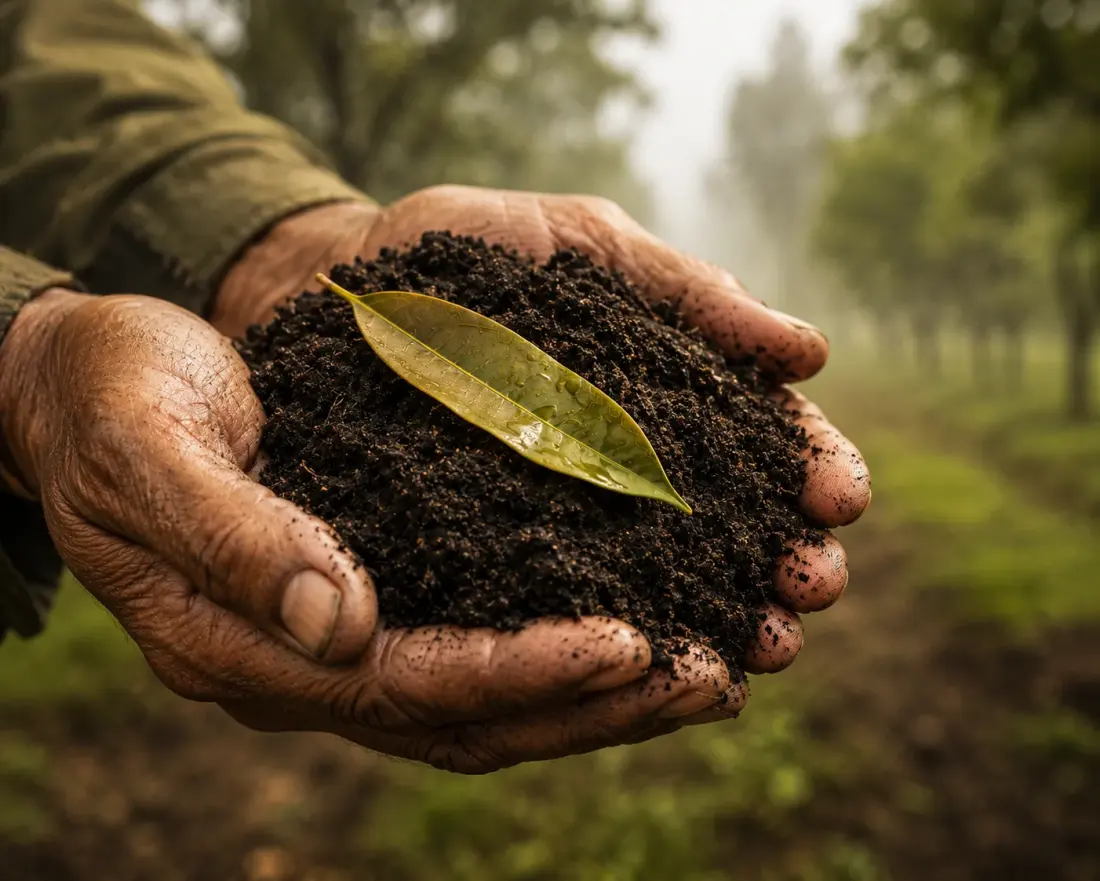
Organic matter does several things at once: it feeds soil microbes, improves water retention in sandy soils, improves drainage in clay soils, and holds nutrients in a form roots can access. Most Malaysian agricultural soils start at 1–2% organic matter. A healthy durian orchard should target 4–6%.
Building organic matter takes time — two to three years of consistent compost application and cover cropping. There's no shortcut, but starting early matters.
Reading the Landscape Before You Plant
Soil Type
Laterite soils — the red-orange clayey soils common on Malaysia's undulating hills — are actually quite good for durian when managed correctly. They drain well on slopes, retain enough moisture between rains, and respond predictably to amendment. Their main weakness is low pH and low phosphorus availability.
Heavy clay (like lowland river basin soils) retains too much water. Root rot risk is high without major drainage infrastructure investment. Not impossible, but costly to manage.
Pure sandy soils drain too fast and hold almost no nutrients. Fertilisers leach through before roots can capture them. Very high management cost.
Slope
A slope of 15–30 degrees is ideal for natural drainage while still being workable. Steeper than 30 degrees increases erosion risk significantly — you'll lose topsoil every monsoon season without aggressive erosion management.
Flat land is workable but requires deliberate drainage infrastructure — raised beds at 30–40cm height, or drainage channels every 15–20 metres running perpendicular to any slight natural grade.
Disease History
If the land previously grew crops that suffered from Phytophthora cinnamomi — avocado, black pepper, some vegetable crops — the pathogen may already be in the soil. Durian is highly susceptible. Ask about the land's history, and if there's any doubt, send a soil sample for pathogen screening through a private lab or the Department of Agriculture (Jabatan Pertanian).
Saline Subsoil
This is common near coastlines and in reclaimed peatland areas. Salt accumulation in the subsoil draws water osmotically out of roots, causing drought-like symptoms even when surface moisture is adequate. Test electrical conductivity (EC) if you're near coastal zones — EC should be below 1.5 dS/m in the root zone.
Soil Testing: Don't Skip It
Soil testing is the cheapest insurance you can buy before investing in planting.
Send samples to the Department of Agriculture (Jabatan Pertanian, DOA) or a private lab. Cost ranges from RM 50 to RM 150 per sample depending on the package. A standard test covers pH, NPK levels, and organic matter. A comprehensive test adds calcium, magnesium, micronutrients (boron, zinc, manganese), and sometimes cation exchange capacity.
Take multiple samples per site — soils vary within a single field. A useful practice is to take 10–15 core samples from across the planting area, mix them, and submit one composite sample per soil type or slope zone.
The report tells you exactly what needs correcting before planting and in what quantities.
Soil Preparation: The 6-Month Runway
Good soil preparation begins at least 6 months before planting — not 2 weeks. Here's a practical sequence:
Step 1: Clear and Subsoil (6 months out) Remove existing vegetation, old stumps, and debris. If a hardpan layer is detected below 40–50cm, subsoil ploughing or deep ripping breaks it up, allowing root penetration later. This is mechanised work on any meaningful scale.
Step 2: Lime Application (5–6 months out) For acidic soils below pH 5.5, apply agricultural lime (dolomite is preferred — it supplies both calcium and magnesium). Typical rate: 1–3 tonnes per hectare depending on how far below target pH the soil is. Lime needs 3–6 months to react with soil and raise pH — applying it the week before planting achieves nothing useful.
Step 3: Organic Matter Incorporation (2–3 months out) Spread compost, chicken manure, or green manure crop residue and incorporate into the top 30cm of soil. Target rates: 10–20 tonnes of compost per hectare, or equivalent. Chicken manure is higher in nutrients but should be composted first to avoid burning young roots. Green manure crops like Mucuna pruriens are another option — grow them on-site for a season, then slash and incorporate.
Step 4: Cover Cropping Between Rows On slopes, plant vetiver grass along contour lines to control erosion — its deep roots hold the soil bank without competing aggressively with durian. In the rows between trees, Mucuna (velvet bean) fixes atmospheric nitrogen and suppresses weeds, reducing fertiliser cost over time.
Step 5: Final Bed Preparation (planting time) Prepare planting holes or raised beds, apply base fertiliser (phosphate, slow-release compound), and ensure drainage channels are functional before the first seedling goes in.
What to Avoid
Phytophthora-prone land: Any history of root rot in previous crops should be treated as a red flag. Soil fumigation or biological control (Trichoderma application) can reduce but not eliminate the risk.
Waterlogged areas: Even seasonal waterlogging — land that floods for 1–2 weeks during monsoon — is damaging. Chronic waterlogging is fatal to durian.
Saline subsoil: Near coastal areas, test before committing.
Overly steep slopes without erosion management: Erosion removes topsoil, exposes roots, and washes away soil amendments. Terracing or vetiver grass contour lines are necessary above 25 degrees.
Practical Takeaway
If you get the soil right before planting, you solve a significant number of problems for the next 20 years. If you rush into the ground without testing and preparation, you spend years fighting symptoms — yellowing trees, persistent disease, poor flowering — without ever addressing the actual cause.
The sequence is straightforward: test the soil, correct the pH, build organic matter, manage drainage. None of this is complicated. It just requires time and doing it in the right order.
Common Questions
Peat soil is generally not suitable. It's highly acidic (pH 3.5–4.5), has low mineral nutrient content, and can become either waterlogged or shrink and crack depending on water levels. Some farmers have attempted it with significant liming and drainage infrastructure, but it remains a high-risk, high-cost choice.
Push a metal rod or long screwdriver into the soil. If you hit solid resistance within 60–70cm depth, there's likely a hardpan. Alternatively, dig a 1-metre test pit and look at the soil profile directly. You'll see the colour and texture change at the hardpan depth.
It's workable, not naturally ideal. Laterite tends to be acidic and low in phosphorus. But it drains well on slopes and responds well to liming and organic matter addition. Many of Malaysia's productive durian areas are on laterite hills — the key is proper amendment before planting.
Every 2–3 years is a reasonable schedule for an established orchard. If you notice tree health issues, test more specifically — both soil and leaf tissue analysis can help identify deficiencies.
pH 5.2 is marginal. Durian will grow, but aluminium toxicity is a risk, and phosphorus availability is reduced. A light lime application (0.5–1 tonne/hectare) to push pH toward 5.8–6.0 is worth doing. It's cheap insurance relative to the cost of the trees.
Both raise pH. Agricultural lime (calcium carbonate) supplies calcium only. Dolomite (calcium magnesium carbonate) supplies both calcium and magnesium. Since Malaysian laterite soils are often deficient in magnesium, dolomite is the more practical choice for durian orchards.
Yes, in two specific ways. Vetiver grass on slopes holds the soil through heavy rain — without it, you lose centimetres of topsoil per monsoon season. Mucuna between rows fixes nitrogen from the air (up to 100–150 kg N/hectare/year in ideal conditions), reducing your fertiliser cost and building soil organic matter simultaneously.
The concern is specifically about shared soil or waterways, not just proximity. If water from his land drains onto yours, or if you're purchasing land that previously grew his crops, the risk is higher. Phytophthora can move through soil water. Test the soil before purchasing or planting.
Want to try fresh durian from our farm? We grow it at our own Bukit Serampang orchard in Tangkak, Johor, and sell it at our Melaka Mall stall. Stock varies daily — WhatsApp to confirm availability before you visit.
Ask About Today's Fruit