Durian farming has historically been labour-intensive, experiential, and difficult to systematize. A skilled orchardist learns through decades of observation: when to fertilise, how to read tree health from foliage colour, when fruit has reached the right point in development for harvest timing. This tacit knowledge is hard to transfer, hard to scale, and highly vulnerable to labour shortages.
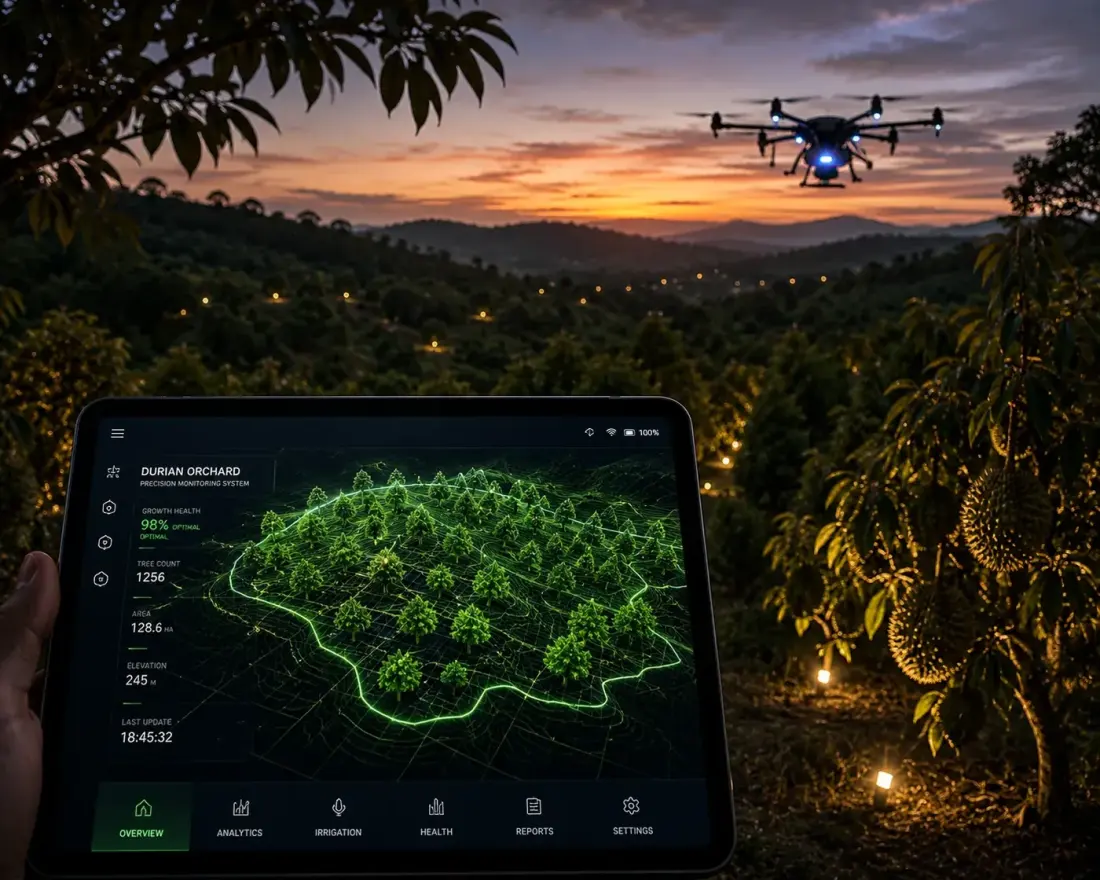
Precision agriculture technology — NDVI drone imaging, IoT soil sensors, AI-based disease detection, and automated irrigation systems — is being adopted by a growing number of Malaysian and Thai durian orchards. The adoption is uneven and the technology is not yet widespread among small growers, but the direction is clear.
Here is what the technology actually does and what it has demonstrated so far.
NDVI Drone Imaging
What it is: NDVI (Normalized Difference Vegetation Index) is a measurement calculated from near-infrared and visible-light imagery captured by drone. Healthy, photosynthetically active vegetation reflects near-infrared light strongly and absorbs visible red light. Stressed, diseased, or nutrient-deficient vegetation shows a different near-infrared/red ratio, which NDVI quantifies.
In durian orchards: NDVI imaging from drones identifies:
- Leaf chlorophyll concentration (proxy for nitrogen nutrition status)
- Water stress (moisture deficit shows in leaf reflectance before visible wilting)
- Early disease symptoms — Phytophthora infection and Fusarium wilt typically show altered leaf reflectance 5–10 days before visible symptoms appear
- Spatial heterogeneity within the orchard — which zones are thriving vs. underperforming
Practical outcome: Targeted fertiliser and intervention application. Instead of applying uniform fertiliser rates across an entire orchard, NDVI maps guide variable-rate application — more inputs to underperforming zones, reduced inputs where the canopy is already saturated. This reduces fertiliser waste and input cost by an estimated 15–25%.
Flight frequency: Monthly NDVI surveys during active growing season; bi-weekly during flowering and fruit development. A drone survey of 10–20 acres takes approximately 45–90 minutes with current fixed-wing or multirotor platforms.
IoT Soil and Environmental Sensors
What they are: Wireless sensor nodes installed at soil depths of 10–20cm and 30–50cm, measuring:
- Soil moisture (volumetric water content)
- Soil temperature
- Electrical conductivity (proxy for nutrient concentration and salinity)
- pH (some systems)
- Ambient temperature and humidity at canopy level
In durian orchards: Real-time soil moisture monitoring enables precision irrigation — water is delivered only when and where the soil moisture drops below a set threshold. This replaces schedule-based irrigation (watering every 3 days regardless of actual need) with demand-based irrigation.
Demonstrated water savings: Studies at precision agriculture trial sites in Malaysia and Thailand show 30–40% reduction in irrigation water use compared to conventional schedule-based irrigation, with equivalent or improved yield. Durian trees are sensitive to both water deficit (reduces fruit set and fruit quality) and waterlogging (increases Phytophthora risk) — IoT monitoring enables the narrow optimal window to be maintained consistently.
Alert systems: Sensors connected to SMS or app alerts notify the farmer when readings exceed defined thresholds — soil moisture below minimum, excessive rainfall accumulation (flooding alert), or soil temperature anomalies. Response time to adverse conditions improves significantly.
AI-Based Disease Detection
What it does: Computer vision systems trained on datasets of durian leaf and stem imagery learn to recognize the visual signatures of common diseases — Phytophthora symptoms (bark darkening, water-soaked lesions), Fusarium wilt (yellowing progression patterns), and nutrient deficiency (specific chlorosis patterns).
Deployment options:
- Drone image analysis: Images captured during routine NDVI flights are processed by AI classifiers that flag areas showing disease signatures for ground inspection.
- Mobile app identification: Field workers photograph suspicious symptoms with a smartphone; the app returns a diagnosis and management recommendation within seconds. MARDI and several Malaysian agri-tech companies have developed durian-specific disease identification apps.
Accuracy status: Published accuracy rates for AI-based durian disease detection in research settings reach 85–95% for Phytophthora and Fusarium identification under controlled conditions. Field conditions (variable lighting, partial occlusion, early-stage symptoms) reduce accuracy. Current tools are best used as screening aids that flag potential issues for experienced human confirmation, not autonomous diagnostic systems.
Economic case: Early Phytophthora detection is economically significant. A tree killed by advanced Phytophthora represents approximately RM 1,500–3,000 in lost future revenue (mature tree, 10–15 year production horizon). If AI detection identifies infection 7–10 days before visual symptoms allow human detection, fungicide intervention can save trees that would otherwise be lost — potential ROI of several hundred percent for the AI system cost.
Automated Irrigation and Fertigation
What fertigation is: Delivering dissolved fertiliser directly through the irrigation system — nutrients reach roots at precise concentrations without separate application. In durian orchards, precision fertigation delivers nitrogen, phosphorus, potassium, calcium, magnesium, and micronutrients (boron, zinc) at the specific ratios required at each growth stage (vegetative growth vs. flowering vs. fruit development).
Automation: IoT sensor data triggers automated fertigation schedules. Soil moisture data determines when irrigation runs; pre-programmed nutrient formulations deliver the correct nutrient ratio for the current phenological stage. This replaces manual fertiliser broadcasting with automated precision delivery.
Documented outcomes in Malaysian trials:
- 20–35% reduction in fertiliser input quantity (same or better yield, reduced excess)
- 8–15% yield improvement from optimized nutrition timing
- Improved fruit quality metrics (Brix, seed-to-flesh ratio) in some trials
Yield Prediction
What it is: Machine learning models trained on historical yield data, weather patterns, NDVI measurements, and flowering observations produce yield forecasts per orchard and per tree.
In durian production: Accurate yield prediction 60–90 days before harvest allows:
- Advance logistics booking (cold chain capacity, transport, storage)
- Price negotiation with buyers before harvest
- Labour planning for harvest season
- Export quota allocation (particularly relevant for GACC-registered farms with China commitments)
Current accuracy: Research-stage models show 70–85% accuracy in yield prediction 60 days out under Malaysian orchard conditions. This is substantially better than traditional expert estimation (often ±30–50% accuracy at the same horizon) but still not precise enough for tight contract commitments.
Who Is Adopting This Technology
Large commercial orchards (20+ acres, organized export operations): Most active adopters. The capital cost of IoT infrastructure (RM 5,000–25,000 per 5 acres depending on sensor density) and drone surveys (RM 500–2,000 per survey for commercial operators) is justified at this scale.
Government-linked programs: MARDI and state agricultural departments have deployed precision agriculture pilot programs in selected durian orchards. Results from these pilots are being used to develop adoption subsidies and technical assistance programs.
Small growers (under 5 acres): Adoption is limited by capital cost, technical literacy, and access to service providers. Cooperative models — where multiple small farms share sensor infrastructure and drone survey costs — are being developed in some regions.
What This Costs
Full integrated system: RM 30,000–120,000 per 10 acres. The wide range reflects sensor density and automation level. A minimalist setup — basic soil moisture nodes, a simple fertigation controller, no drones — sits at the lower end. A dense sensor network with NDVI drone surveys, AI cameras, and full fertigation automation sits at the upper end.
Individual component costs:
- Soil sensor node (LoRaWAN, multi-parameter): RM 1,500–4,000 per node
- Drone NDVI survey (contracted service): RM 300–800 per flight per 10 acres
- AI disease detection app (subscription): RM 50–150/month
- Cloud platform subscription (FarmAs, AgriConnect, or similar): RM 100–300/month
- Automated fertigation controller (per zone): RM 2,000–6,000
Data platforms: Malaysian agri-tech companies like FarmAs and AgriConnect offer managed platforms where sensor data feeds into a pre-built dashboard with alerts and basic analytics. An alternative is a DIY LoRaWAN network — you buy sensors, set up a gateway, and manage data storage yourself, which reduces ongoing subscription costs but requires technical ability to configure and maintain.
Does the Investment Pay Back?
The ROI calculation has two sides: input savings and yield improvement.
Input savings:
- Water use: automated fertigation based on real soil moisture readings typically reduces irrigation water consumption by 30–40% compared to schedule-based irrigation.
- Fertiliser: precision application guided by EC readings and soil analysis reduces fertiliser spend by 20–35%.
For a 15-acre Musang King orchard spending RM 60,000–90,000 per year on water and fertiliser inputs, a 25% average reduction saves RM 15,000–22,500 annually.
Yield improvement:
- Early disease detection and faster response reduces crop losses.
- More consistent soil moisture during fruit development reduces premature drop and improves fruit fill.
- Reported yield improvements from precision management: 8–15% above baseline.
At Musang King farm-gate prices of RM 25–45/kg, a 10% yield improvement on a 15-acre orchard producing 15,000–20,000 kg per season adds RM 37,500–90,000 in gross revenue.
Payback period: For a 10-acre orchard investing RM 50,000–80,000 in a mid-range precision agriculture setup, the payback period is typically 3–5 years, assuming both input savings and yield improvement materialize. Smaller orchards under 5 acres will find the payback period stretches to 7–10 years for a full system, which is why small orchards are better off starting with one or two devices and expanding later.
Government Support Available
Several programs currently support precision agriculture adoption for registered durian farms:
- MARDI precision agriculture grants: Research collaboration and pilot program funding for farms willing to share yield data.
- DOA (Department of Agriculture) digital farming incentives: Equipment subsidies for registered farmers, covering up to 50% of approved equipment costs.
- MDEC agri-tech programs: Support for technology adoption including connectivity infrastructure (relevant for farms in areas without cellular coverage needing LoRaWAN gateways).
Subsidies can cover up to 50% of system cost for farms with active Farm Registration (Pendaftaran Ladang). The application process requires farm registration documentation, a basic farm management plan, and quotes from approved technology vendors. Processing time is typically 3–6 months, so plan for this before committing to vendor contracts. Programmes and subsidy rates change, so confirm the current terms with MARDI or DOA before you budget around them.
Practical Takeaway
Precision agriculture technology in durian orchards is real and working — not vaporware. NDVI drone imaging and IoT soil sensors have demonstrated measurable outcomes in Malaysian and Thai trial sites. The primary barriers to adoption are capital cost and technical support infrastructure, not technology efficacy.
For new orchards being established now (2024–2025): basic IoT soil monitoring and app-based disease detection are accessible, practical, and cost-justified at reasonable scale. Full precision agriculture integration (NDVI + IoT + automated fertigation + AI disease detection) becomes economical at 10+ acres with professional management.
Common Questions
Commercial drone survey services in Malaysia charge approximately RM 100–300 per acre for NDVI imaging including processed maps. For a 10-acre orchard, a monthly NDVI survey costs RM 1,000–3,000. For operations that justify a dedicated drone, a consumer-grade multispectral drone suitable for NDVI imaging costs RM 15,000–50,000+.
Published research says yes — NDVI changes in leaf reflectance and specific spectral signatures precede visible symptoms by 5–14 days in controlled studies. Field performance varies with disease stage and lighting conditions. Current tools work best as screening aids that direct human attention to suspicious areas.
Basic IoT soil moisture monitoring: RM 1,500–4,000 per sensor node (hardware, installation, and first year connectivity). At 3–5 nodes per acre for adequate spatial coverage, the infrastructure cost is RM 4,500–20,000 per acre. Some government programs subsidize up to 50% of the cost for registered commercial farms.
Indirectly — optimized irrigation and nutrition timing can improve Brix and flesh quality metrics. Consistent soil moisture management during fruit development (particularly during the 30–60 days before harvest) produces more consistent Brix and flavour profile compared to rain-dependent irrigation. Precision fertigation with correct calcium and boron at the right stage reduces physiological disorders.
Want to try fresh durian from our farm? We grow it at our own Bukit Serampang orchard in Tangkak, Johor, and sell it at our Melaka Mall stall. Stock varies daily — WhatsApp to confirm availability before you visit.
Ask About Today's Fruit