Water management in a durian orchard is counterintuitive in one crucial way: the tree needs deliberate drought at the right moment to flower. This catches new growers off guard. In most fruit cultivation, consistent watering equals consistent production. Durian works differently — too much water at the wrong time keeps the tree in a vegetative state, producing leaves instead of flowers.
Getting irrigation right means understanding not just how much water the tree needs, but when water should be withheld, and why.
Annual Water Requirements
Durian trees need 1,500–2,000mm of rainfall distributed across the year. Malaysia's annual average is 2,000–2,500mm, which generally covers the baseline requirement — on paper. The issue is distribution.
Most Malaysian states have two main rainfall patterns, and the wet seasons can deliver too much water while dry spells in between can leave orchards genuinely stressed for 6–8 weeks at a time. It's during those dry spells — managed carefully — that durian flowering is triggered.
The Drought Signal: Why Dry Stress Is a Tool, Not a Problem
This is the part of durian irrigation that surprises most people.
Durian requires 3–4 weeks of dry stress before flowering occurs. This is not a flaw or a survival mechanism to be worked around — it's a deliberate management tool. When roots experience water deficit, the tree interprets it as a signal to shift from vegetative growth to reproductive mode. Flower panicles initiate on branches, not new growth flushes.
In practice, growers who achieve consistent annual crops do so by timing irrigation suppression to coincide with natural dry periods, or by intentionally reducing irrigation in the pre-flowering window. Once panicles (flower buds) are visibly developing on the branches, irrigation resumes.
Irrigating steadily throughout the year — especially with high-nitrogen fertiliser at the same time — keeps trees pushing out leaves instead of flowering. This is a common reason for low production in otherwise healthy-looking orchards.
Stage-by-Stage Water Needs
Young Trees (Years 0–3)
Young trees have small root systems and can't access deep soil moisture reserves. In dry season, they need:
- Daily watering in the first 6–12 months
- 10–20 litres per tree per day depending on size and temperature
- Gradual reduction as the canopy expands and root depth increases
The goal is establishment, not stress tolerance. Young trees should not be allowed to wilt.
Pre-Flowering (Dry Stress Period)
For mature trees on a production schedule:
- Reduce or stop irrigation for 3–4 weeks
- Allow the root zone to dry — not completely parched, but significantly below normal moisture levels
- Monitor for leaf wilt as a stress indicator, but brief afternoon wilt that recovers overnight is acceptable
- Resume irrigation once panicles are visibly forming
Fruit Set to Development (Days 60–90 After Flowering)
This is the most water-sensitive stage after establishment. Inconsistent moisture during fruit development causes:
- Premature fruit drop — the tree sheds fruit when stressed
- Small fruit size at harvest
- Uneven pulp development
Mature trees need 50–100 litres per day during active fruit development. This is not the time to economise on irrigation. A uniform supply of moisture, combined with adequate potassium, supports fruit sizing and pulp quality.
Post-Harvest Recovery
After harvest, trees can tolerate slightly drier conditions as they rest before the next flush. This is when you do soil improvements, compost applications, and wait for the next dry cycle.
What Overwatering Looks Like
Overwatering is as damaging as drought in durian. Signs to watch for:
Yellowing leaves, starting with older foliage — this looks exactly like nitrogen deficiency, which is why people often add more fertiliser and make the problem worse. Check drainage first.
Root rot — the smell from around the root zone is a reliable indicator. Dig a small hole near the drip line and examine feeder roots; healthy roots are firm and white, rotting roots are brown, slimy, and collapse when touched.
Phytophthora outbreak — the most serious consequence of sustained waterlogging. Dark brown lesions at the collar (base of trunk), oozing gum, and canopy dieback are the visible signs. Prevention is far easier than treatment.
Even 48 hours of standing water around the root zone after a heavy rain event is enough to initiate root damage in an otherwise healthy tree.
Irrigation Methods: What Works in Malaysian Orchards
Flood Irrigation Water is directed along channels between rows. Low cost, easy to set up, but highly inefficient — most water runs off or evaporates before reaching the root zone. Not recommended for sloped terrain where it accelerates erosion.
Microjet Sprinklers The most common method in Malaysian durian orchards. Sprinkler heads on short risers spray a 1–2m radius around the tree. More efficient than flooding, practical for orchards of most sizes. The main weakness is evaporation loss — on hot afternoons, 20–30% of water evaporates before reaching the soil. Run sprinklers in the early morning when evaporation is lowest.
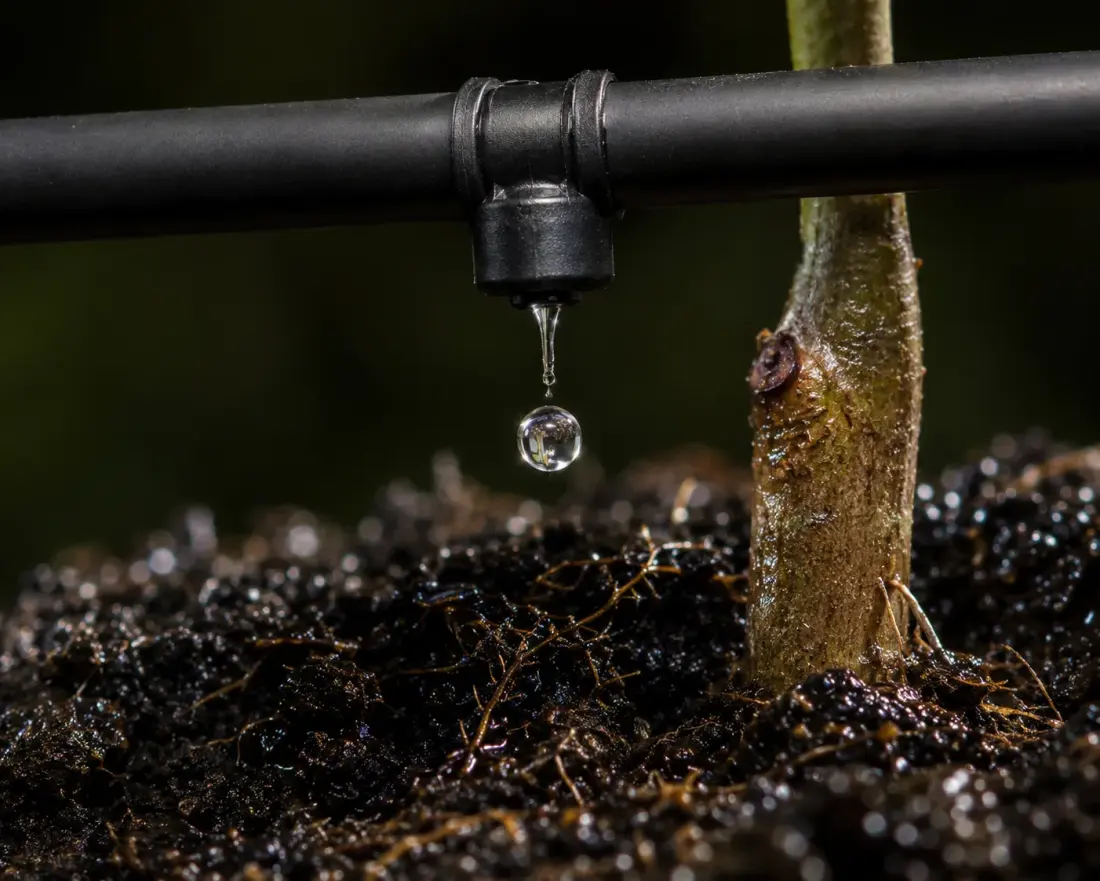
Drip Irrigation The most efficient system. Water is delivered directly to the root zone through emitters at low pressure, typically 2–4 emitters per mature tree placed at the drip line. Achieves roughly 40% water savings compared to sprinkler systems.
Drip systems allow fertigation — the simultaneous delivery of dissolved fertilisers through the irrigation water. This reduces fertiliser waste, improves uptake efficiency, and allows precise control over nutrient delivery at each growth stage.
The upfront cost is higher (approximately RM 3,000–6,000 per hectare for installation), but the long-term savings in water and fertiliser often justify the investment in orchards of 2 hectares or more.
Mulching: Simple and Underused
Regardless of irrigation method, applying a 10–15cm layer of mulch (rice straw, wood chips, or dry grass) in a 1-metre radius around each trunk reduces evaporation significantly — studies show 30–50% reduction in soil moisture loss on hot days.
Mulch also moderates soil temperature, suppresses weeds, and breaks down over time to add organic matter. It's one of the highest return-on-effort practices in durian management, especially during dry season.
IoT Soil Sensors: Optional But Useful
In larger commercial operations, soil moisture sensors (volumetric water content sensors) placed at 10–30cm depth in the root zone allow continuous monitoring without needing to check individual trees.
The target range is 25–35% volumetric water content during active fruit development. Below 20% indicates stress. Above 40% on heavy clay soils indicates drainage risk.
Sensors are available from agricultural suppliers at RM 200–500 per unit and can be connected to simple data loggers or smartphone apps. For orchards above 3–4 hectares, the reduction in water waste and early warning of stress events makes the cost reasonable.
Smart Controller Integration
Sensor data alone is information. Combined with automated valve control, it becomes action.
The system works like this: sensors transmit moisture readings to a cloud processing platform. The platform compares readings against the programmed thresholds. When the root zone drops below the trigger point (or rises above the drainage alert), the controller sends a signal to open or close irrigation valves on the drip or microjet system.
In multi-zone orchards — which most commercial operations should use, since soil conditions vary across any meaningful acreage — each zone has its own sensor network and independent valve control. A zone with heavier clay soil that retains moisture longer gets less frequent irrigation than a zone with sandier soil on the same farm.
Water savings demonstrated in Malaysian trial sites: 30–40% reduction compared to schedule-based irrigation. Fertiliser cost reduction from EC sensor data that prevents over-application: 15–25%. These are real savings on recurring costs.
Connectivity: LoRaWAN, WiFi or Cellular
The sensor network needs to transmit data somehow. Three main options:
LoRaWAN is the preferred choice for orchard scale. It supports 2–5 km range on low power, which means sensor nodes can run on batteries for months without replacement, and a single gateway covers most farm sizes. Cost is low per node. The limitation: you need LoRaWAN infrastructure in the area, or you need to set up your own gateway.
WiFi works for small, compact orchards where all sensors are within range of an access point. Not practical for large operations or irregular terrain.
Cellular (4G/LTE) is the fallback for remote farms without LoRaWAN infrastructure. Works anywhere there's a mobile signal, but recurring SIM card data costs add up, and power consumption is higher.
What It Costs
Sensor node: RM 800–2,500 per node, depending on sensors included (moisture only vs. full suite with EC and temperature).
Gateway: RM 1,500–5,000 depending on connectivity type and range.
Cloud subscription: RM 100–300 per month for data processing, storage, and the dashboard interface.
A 10-hectare orchard with nodes every 2 hectares per management zone, plus a gateway and one year of cloud subscription, runs roughly RM 12,000–30,000 total first-year cost. Water and fertiliser savings at the demonstrated rates would typically recover this in 2–4 growing seasons, depending on current water and fertiliser costs.
Practical Takeaway
The simplest irrigation framework for Malaysian durian:
- Dry period (3–4 weeks before expected flowering): reduce or stop irrigation
- Panicles visible: resume irrigation at standard rate
- Fruit development phase (next 60–90 days): maintain consistent moisture, 50–100L/tree/day for mature trees
- Post-harvest: taper back, allow normal dry cycle
- Year-round: mulch the root zone, monitor for drainage issues after heavy rain
The single most common irrigation mistake is irrigating too consistently without ever allowing a dry period. The tree never gets the signal to flower.
Common Questions
There's no single answer — it depends on the variety and local climate. The reliable indicator is visible panicle development on branches. Most farmers in Peninsula Malaysia work from the natural dry season calendar (typically January–February and June–July depending on state) and supplement with reduced irrigation timing.
For young trees in the first 3 years, yes — they can't access deep water reserves yet. For mature trees, natural rainfall often covers the need, but the key is managing the dry period. If rain is falling regularly, you may need to physically block water from reaching trees for 3–4 weeks to induce the stress response — some farmers use plastic sheet mulch or divert irrigation intentionally.
Yes, if the source is not contaminated and the EC (salt content) is low (below 1.0 dS/m). Some river sources in intensive agricultural areas carry pesticide or fertiliser runoff — worth testing if you're near upstream farms.
Yellowing leaves can appear within 2–3 weeks of sustained overwatering. Root rot visible symptoms at the collar (gum ooze, dark lesions) may take 4–8 weeks. By the time collar rot is visible, significant root damage has usually already occurred.
For 1 acre specifically, the ROI is borderline. The water savings are real, but the irrigation time savings on a small farm are modest. The fertigation capability — feeding through the drip system — is the stronger argument for small farms, as it reduces fertiliser waste significantly.
Volumetric water content of 25–35% in the 10–30cm depth range is the target. If you don't have sensors, a practical check is to take a handful of soil from the root zone — it should hold together when squeezed but not release water when pressed firmly.
If the rainfall is heavy (>30mm in one event), watering before it can push the root zone above field capacity and cause waterlogging. Better to skip scheduled irrigation when the forecast shows significant rain.
Rice straw is cheapest and widely available. Wood chips break down more slowly and last longer between applications. Dry grass works but compacts over time. Avoid fresh green material that hasn't composted — it ties up nitrogen during decomposition, competing temporarily with the tree. Any dry organic material is better than bare soil.
Want to try fresh durian from our farm? We grow it at our own Bukit Serampang orchard in Tangkak, Johor, and sell it at our Melaka Mall stall. Stock varies daily — WhatsApp to confirm availability before you visit.
Ask About Today's Fruit