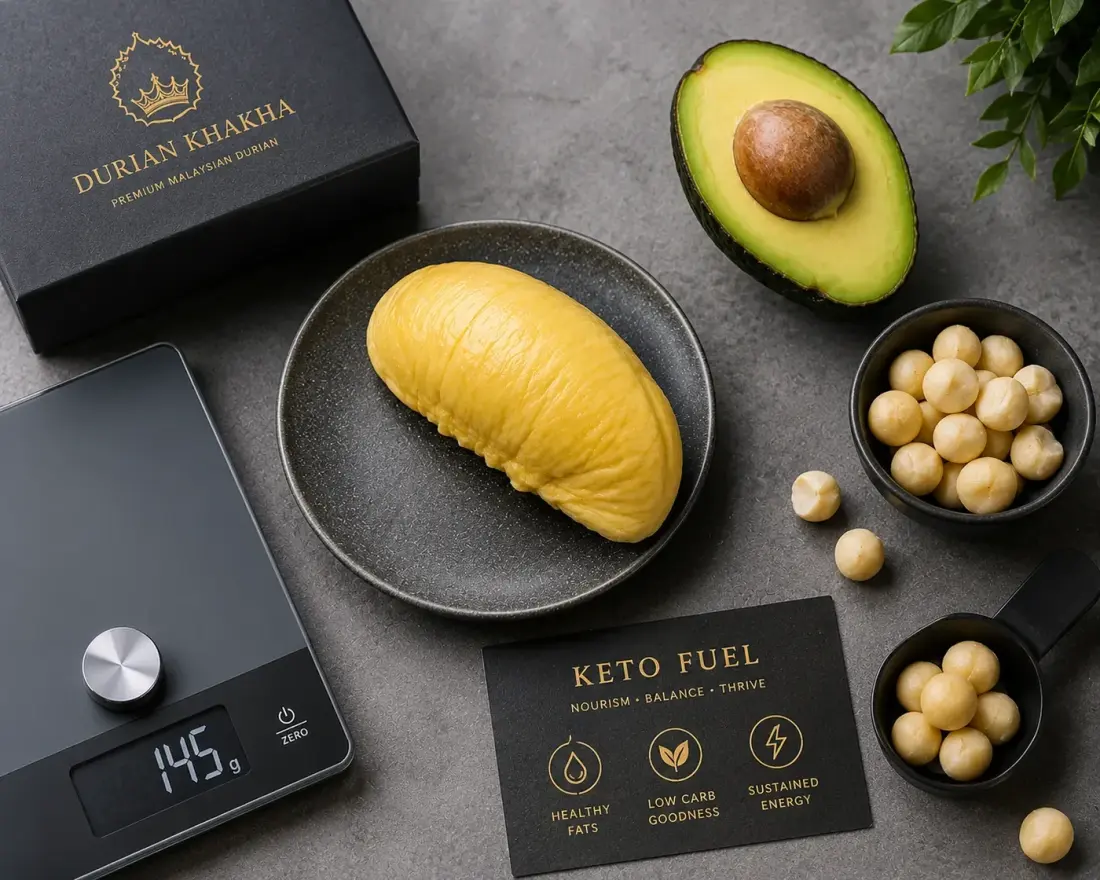
Short answer: Not on strict keto. Durian has about 23g of net carbs per 100g, so three or four pods can use up a whole day's allowance. On a cyclical or moderate low-carb plan, a 50–80g portion may fit if you track it.
Durian and the ketogenic diet occupy opposite ends of the macronutrient spectrum when it comes to carbohydrate content. Standard ketogenic diets limit total daily carbohydrate intake to 20–50g net carbs. A 200g serving of fresh durian — a reasonable amount for a casual eating session — contains approximately 46.4g net carbohydrates.
The short answer is: durian is not keto-friendly in normal portion sizes. For strict keto adherents, eating durian in standard quantities will break ketosis.
The longer answer has nuance: very small portions (30–50g), consumed strategically, may fit within modified or cyclical ketogenic diet frameworks. But this requires precise tracking and realistic expectations about what "eating durian" means at that scale.
The Numbers
Per 100g fresh durian pulp:
- Total carbohydrates: 27g
- Dietary fibre: 3.8g
- Net carbohydrates: 27g – 3.8g = 23.2g net carbs
- Total fat: 5g (primarily monounsaturated and polyunsaturated fatty acids)
- Protein: 1.47g
- Calories: 147 kcal
At 23.2g net carbs per 100g, durian is one of the highest-carbohydrate fruits by weight — comparable to dates (which are typically excluded from even flexible diets due to their density) and bananas. For reference:
- Avocado: ~1.8g net carbs per 100g (keto-friendly)
- Strawberries: ~5.5g net carbs per 100g (moderate, used in small amounts on keto)
- Durian: 23.2g net carbs per 100g (not keto-compatible in standard portions)
What Happens if You Eat Durian on Keto
For strict keto (under 20g net carbs/day): Even 80g of durian (less than one medium segment) provides 18.6g net carbs — nearly the entire daily allowance. A typical durian eating session of 3–4 segments (~200–300g) provides 46–70g net carbs, which definitively breaks ketosis.
For moderate keto (20–50g net carbs/day): One small portion (30–50g pulp, approximately 7–12g net carbs) leaves room for other carbohydrates in the day. This is a theoretical allowance. In practice, 30–50g of durian is a very small amount — one half of a small segment — which may create more dissatisfaction than satisfaction for someone who enjoys durian.
Insulin response: Beyond net carb count, durian has a glycemic index estimated at 44–49 — classified as low to moderate. The GI is relatively favourable compared to other high-carbohydrate foods (white rice GI ~73, table sugar GI ~65). However, glycemic load (which accounts for the actual amount consumed) escalates quickly with portion size. At 200g, the glycemic load from durian is substantial.
Durian's Fat Content Is Not Enough to Offset Carbs
A common misconception: durian's 5g fat per 100g makes it "more keto-friendly than other fruits." This reasoning is flawed. On a ketogenic diet, the fat content of food is not what makes it compatible — the net carbohydrate count is the binding constraint. Durian's moderate fat content does not compensate for its high net carbohydrates. Compare durian (5g fat, 23.2g net carbs) with avocado (15g fat, 1.8g net carbs) — the latter is the appropriate keto-compatible fruit, not durian.
Who This Matters For
Strict ketogenic dieters (medical or epilepsy-specific protocols): No durian in any meaningful quantity. The carbohydrate disruption is medically significant in this context.
Fat adaptation / performance keto: The daily carb limit is typically 20–50g. One small durian portion may technically fit, but it consumes most of the day's carb allowance.
Cyclical keto (CKD): CKD involves periodic high-carbohydrate refeed days (typically 1–2 days per week of 100–150g+ carbs). Durian eaten on a refeed day is compatible with this protocol. This is probably the framework under which most keto-adjacent durian fans actually consume it.
Low-carb (not strict keto, 50–100g carbs/day): Small durian portions (50–100g, ~12–23g net carbs) fit within a moderate low-carb approach, especially if other carbohydrate sources are controlled that day.
Practical Takeaway
If you are on a strict ketogenic diet: durian is not keto-friendly. A normal eating session breaks ketosis.
If you are on a cyclical or moderate low-carb approach: a 50–80g portion on a lower-carb day may fit, if you track carefully. That is about two pods, not a durian eating session by any normal definition.
The honest framing: if you love durian and follow strict keto, you face a genuine trade-off. Durian is not nutritionally reformulatable into a keto food — the carbohydrates are intrinsic to the fruit, not additive.
Common Questions
A typical Musang King pod (aril) holds about 25–50g of flesh. At 23.2g net carbs per 100g, one pod provides roughly 6–12g net carbs, so three or four pods can use up a whole strict-keto day.
No. Freezing preserves the carbohydrate content essentially unchanged. Cooking may reduce some sugars through caramelization (Maillard reaction) but does not significantly change net carbohydrate content. There is no preparation method that meaningfully reduces durian's carbohydrate content.
Avocado (1.8g net carbs/100g), raspberries (5.4g net carbs/100g), blackberries (4.9g net carbs/100g), and strawberries (5.5g net carbs/100g) are the standard keto-compatible fruits. None replicates the durian flavour profile. The flavour trade-off is real and there is no keto substitute for durian as a sensory experience.
Durian's actual sugar content (fructose, glucose, sucrose) is approximately 6.75g per 100g — which is relatively modest compared to grapes (~16g/100g) or mangoes (~13g/100g). However, keto restricts total net carbohydrates, not just sugar. Durian's total carbohydrate content (27g/100g) — including more complex carbohydrates — is the relevant figure for keto compatibility, not the sugar fraction alone.
People with diabetes on a medically supervised low-carb or ketogenic diet should consult their healthcare provider before eating durian. The glycemic index (44–49) is moderate-to-low, but the glycemic load at typical portion sizes is significant. Individual glycemic response varies substantially. Blood glucose monitoring before and 2 hours after eating is the practical approach.
No — a keto athlete avoids carbohydrate loading by definition. Pre-workout carbohydrates that break ketosis may support performance in high-intensity exercise, but that is a cyclical keto or carb-cycling approach, not strict keto. For a keto athlete who wants carbohydrates strategically before a high-intensity training session, durian is a high-quality carbohydrate source with moderate GI (44–49). But this is not keto; it's carb-cycling.
Sources
- U.S. Department of Agriculture. Durian, raw or frozen (FDC 168192). FoodData Central. Link
Durian Khakha is a durian grower, not a medical provider. For personal health advice, speak to your doctor.
Want to try fresh durian from our farm? We grow it at our own Bukit Serampang orchard in Tangkak, Johor, and sell it at our Melaka Mall stall. Stock varies daily — WhatsApp to confirm availability before you visit.
Ask About Today's Fruit