Fresh durian has a narrow window of peak quality — typically 2–4 days after natural drop before deterioration becomes significant. Processing extends that window dramatically, from months to over a year. But different processing methods preserve different aspects of the original fruit.
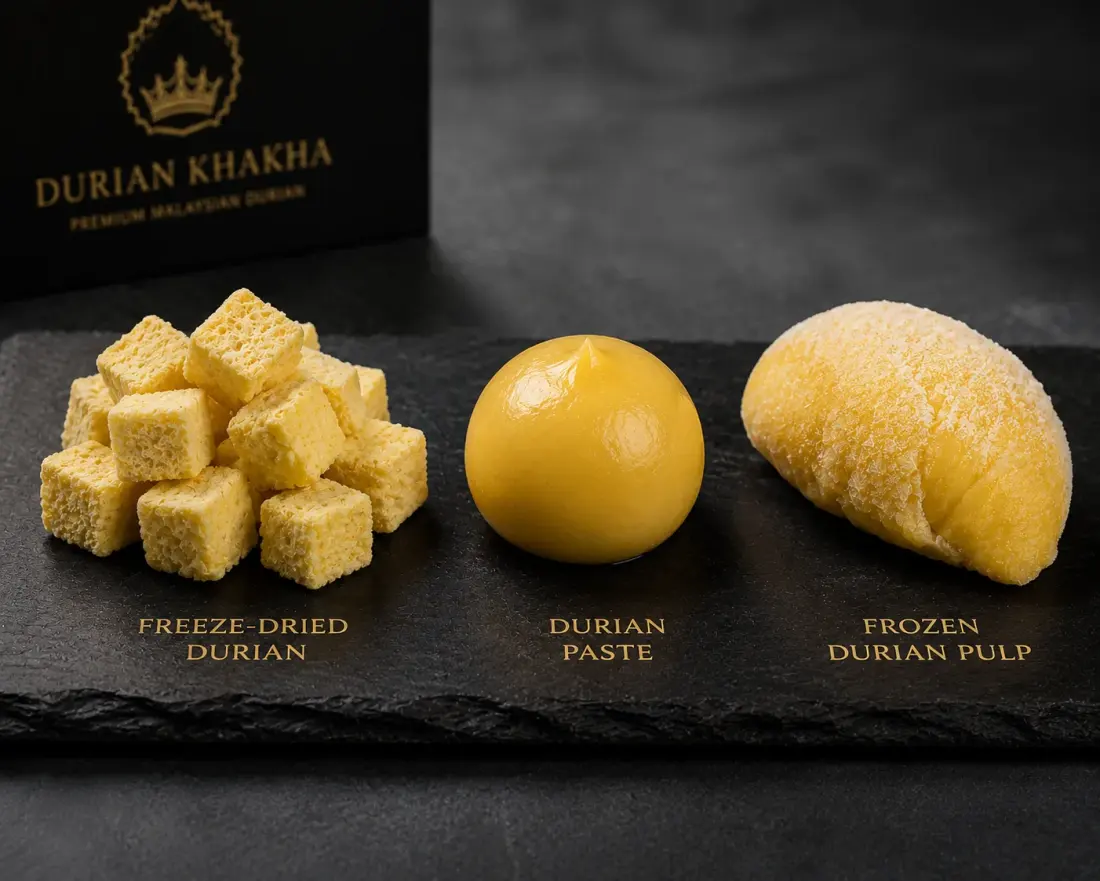
Freeze-dried, flash-frozen, paste, and canned durian are not interchangeable. Each method involves specific trade-offs between flavour preservation, texture, shelf life, moisture content, and cost. This guide explains what each method does to the fruit and which applications each is best suited for.
Flash Freezing
The process: Durian pulp (or whole fruit) is quickly frozen at -35°C to -40°C. The speed is critical — rapid freezing creates very small ice crystals within the cells of the fruit flesh. Small crystals cause minimal cell membrane damage. Slow freezing (in a regular home freezer at -18°C to -20°C) creates large ice crystals that rupture cell membranes, causing significant texture degradation on thawing.
Commercial flash freezing uses blast chillers or nitrogen tunnels. Home freezers cannot achieve the same crystal size and therefore produce an inferior result — the thawed product from a home-frozen durian is noticeably softer and more watery than commercially flash-frozen pulp.
Storage: After flash freezing, product is stored at -18°C. At this temperature, enzymatic and microbial activity is essentially stopped.
Shelf life: 12–24 months at -18°C continuous cold storage. Quality begins to degrade after this period due to oxidative changes (freezer burn) even at consistent temperature.
Flavour preservation: Very high — flash-frozen durian retains approximately 85–90% of volatile sulfur compound content compared to fresh. The characteristic Musang King bitter-sweet profile is well-preserved. This is the gold standard for maintaining durian flavour outside of fresh consumption.
Texture on thawing: Even with flash freezing, some textural change occurs. The thawed pulp is slightly softer than fresh and releases more liquid. For direct eating, this is noticeable but acceptable. For cooking and baking, it is often not an issue.
Best applications: Direct consumption (thaw and eat), smoothies and drinks, ice cream base, filling for pastries and mochi, export to China (requires -18°C cold chain throughout).
Freeze Drying
The process: Freeze drying (lyophilization) first freezes the fruit, then places it in a vacuum chamber and applies low heat. Under vacuum, ice converts directly to water vapour (sublimation) without passing through liquid state. This removes approximately 97–99% of the fruit's moisture content without subjecting it to the high temperatures that would degrade volatile flavour compounds.
The result is a crisp, lightweight product that retains most of the original flavour profile — including sulfur compounds that would be destroyed by conventional oven drying.
Shelf life: 18–36 months at room temperature in sealed, moisture-proof packaging. This is significantly longer than frozen (which requires continuous cold chain) and dramatically longer than fresh.
Flavour preservation: High for non-volatile flavour components (sweetness, esters). Moderate for volatile sulfur compounds — some are lost during the freeze-drying process as the vacuum chamber removes vapour, but significantly more are retained than with conventional drying. Freeze-dried durian still has the characteristic durian aroma, though less intense than fresh or frozen.
Texture: Crisp, lightweight, porous structure. Rehydrates slowly when in contact with moisture. The texture is completely different from fresh or frozen — it is a snack food in its own right, not a substitute for fresh durian in most applications.
Cost: Highest processing cost of all durian products. Freeze-drying equipment is expensive, the process is slow (24–72 hours per batch), and the energy consumption is high. This is reflected in retail pricing — freeze-dried Musang King chips can sell for RM 80–150 per 100g (dried weight).
Best applications: Snack chips (durian chips, durian candy), durian powder for flavouring, travel and export (no cold chain required), incorporation into dry mixes, granola, chocolate.
Durian Paste (Puree)
The process: Fresh durian pulp is blended smooth, optionally heated to inactivate enzymes, then packaged — typically in vacuum-sealed portions of 100–500g, then frozen for distribution. Some commercial pastes are heat-treated (pasteurized) and shelf-stable; others are frozen raw puree.
Flavour preservation: Varies significantly by product. Heat-pasteurized paste has lower volatile compound content (the heat treatment degrades thiols just as baking does — above 60°C). Raw frozen paste has similar flavour characteristics to flash-frozen pulp. Read the product description carefully — "durian paste" is not a standardized term.
Texture: Smooth, homogeneous — no fibre or seed remnants. This makes it directly usable in recipes that require smooth durian flavour without sieving. Consistency is highly product-dependent.
Shelf life: Frozen paste: 12–18 months at -18°C. Heat-pasteurized shelf-stable paste: 12 months at room temperature.
Best applications: Baking (cakes, pastries, ice cream bases where smooth texture is required), industrial food manufacturing, flavouring for beverages.
Conventional Drying (Hot Air Dried)
The process: Durian flesh is dried using hot air at 60–80°C until moisture content drops to approximately 5–15%. The high temperatures destroy virtually all volatile sulfur compounds — the product has essentially none of the fresh durian aroma. What remains is primarily sugar concentration and a dried, chewy texture.
Flavour preservation: Low. The characteristic durian aroma is largely absent. The product tastes primarily of concentrated sweetness with faint durian undertones. This is why hot-air-dried durian products (common in some markets as "dried durian chips" at low price points) are considered significantly inferior by durian enthusiasts compared to freeze-dried.
Shelf life: 6–12 months at room temperature in sealed packaging.
Best applications: Budget confectionery, durian candy with added flavour compounds, mass-market dried fruit mixes. Not suitable for applications requiring authentic durian flavour.
Canned Durian
The process: Durian pulp is packed into cans with sugar syrup, then heat-sterilized (autoclaved at approximately 121°C). The high sterilization temperature completely destroys volatile sulfur compounds and significantly alters the fresh durian flavour profile.
Flavour preservation: Very low for authentic durian character. Canned durian is sweet and fruit-forward but has very little of the complex, sulfurous notes that define fresh durian. It is a different eating experience.
Shelf life: 2–3 years at room temperature, making it the longest shelf life of any durian product.
Best applications: Cooking applications where the heat of cooking would destroy volatile compounds anyway (durian rice, durian curry components), situations where shelf stability and logistics are more important than flavour fidelity, markets with no cold chain access.
Comparison Table
| Product type | Shelf life | Flavour retention | Cold chain needed | Cost index |
|---|---|---|---|---|
| Flash-frozen pulp | 12–24 months | ★★★★★ | Yes (-18°C) | Medium |
| Freeze-dried chips/powder | 18–36 months | ★★★★☆ | No | High |
| Raw frozen paste | 12–18 months | ★★★★☆ | Yes (-18°C) | Medium |
| Heat-pasteurized paste | 12 months | ★★★☆☆ | No | Medium-Low |
| Hot air dried | 6–12 months | ★★☆☆☆ | No | Low |
| Canned | 24–36 months | ★★☆☆☆ | No | Low |
Practical Takeaway
For direct eating with maximum flavour: flash-frozen pulp, thawed. For snacking and export without cold chain: freeze-dried. For baking and cooking requiring smooth texture: raw frozen paste. For maximum shelf life with no cold chain: canned (accept lower flavour quality).
"Freeze-dried" and "frozen" are not interchangeable terms — freeze-dried removes moisture while frozen preserves it. Both preserve flavour better than conventional drying or canning.
Common Questions
Flash freezing uses blast chillers or liquid nitrogen to drop product temperature to -35°C or below within minutes. The speed creates microscopic ice crystals that cause minimal cell damage compared to slow freezing. The result: better texture and higher volatile compound retention after thawing.
The freeze-drying process is slow (24–72 hours per batch), energy-intensive, and requires specialized equipment. Removing 97–99% of moisture concentrates the product significantly — a 100g bag of freeze-dried chips represents approximately 400–600g of fresh durian. Input cost alone justifies most of the price premium.
No. Home freezers operate at -18°C to -20°C and freeze slowly, creating large ice crystals that damage cell structure. Thawed home-frozen durian is noticeably mushier and more watery than commercially flash-frozen product. The flavour is preserved reasonably well, but texture is compromised. Acceptable for personal consumption; not comparable to commercial quality.
Yes. Flash-frozen durian at -18°C retains volatile sulfur compounds including the disulfides responsible for ALDH inhibition. The alcohol interaction warning applies to frozen durian just as it does to fresh.
Look for: (1) product from a named variety (Musang King, D24) rather than generic "durian pulp" — variety affects quality significantly; (2) "flash frozen" or "IQF" (Individually Quick Frozen) in the description; (3) packaging integrity — no visible ice crystals on the outside suggesting temperature break; (4) MESTI (Malaysian food safety) certification on Malaysian-produced products.
Both exist in the market. Freeze-dried durian powder retains a stronger flavour profile. Hot-air-dried durian powder has significantly weaker flavour and is used primarily in mass-market flavouring applications. For baking or cooking where authentic durian flavour matters, use freeze-dried powder. Check the ingredient list — some products labelled "durian powder" contain added flavour compounds to compensate for low-quality drying methods.
Want to try fresh durian from our farm? We grow it at our own Bukit Serampang orchard in Tangkak, Johor, and sell it at our Melaka Mall stall. Stock varies daily — WhatsApp to confirm availability before you visit.
Ask About Today's Fruit