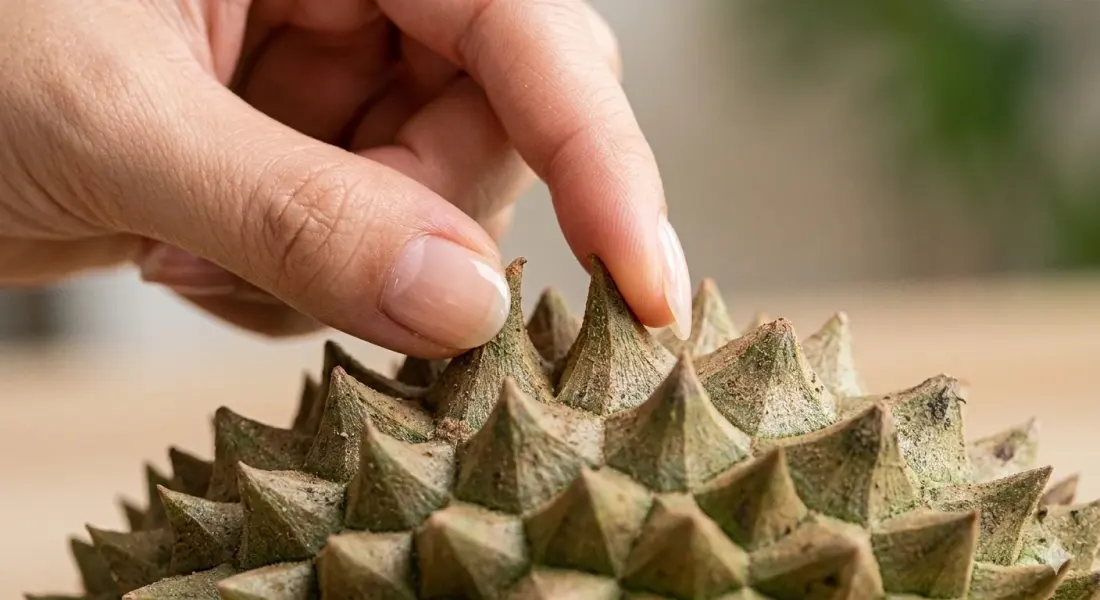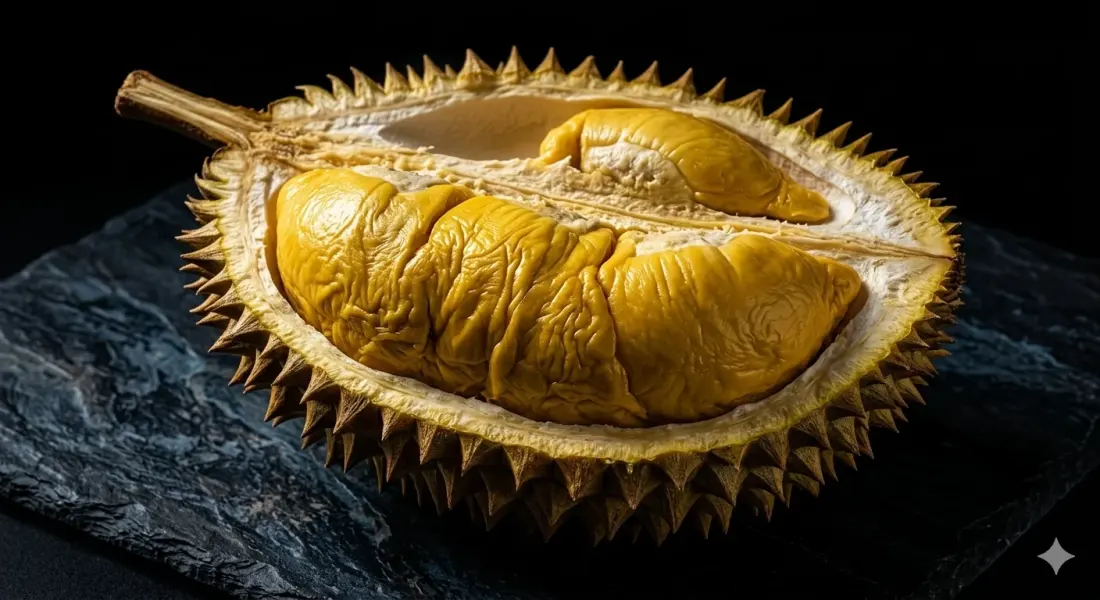
Durian did not evolve for humans. The fruit's extraordinary chemical complexity, enormous size, thick armoured husk, and powerful odour evolved over millions of years as a survival strategy — specifically, to attract the large forest mammals and nocturnal bats that disperse its seeds and pollinate its flowers.
The human appreciation of durian is, in evolutionary terms, accidental. The intended audience was always the wildlife of tropical Southeast Asian forests.
The Pollinator: Cave Fruit Bat (Eonycteris spelaea)
Durian flowers open at night, produce nectar rich in sucrose, and emit a faintly musty, sour odour that bats detect readily. This is not coincidence — it is co-evolution between the durian tree and its primary pollinator.
The cave fruit bat (Eonycteris spelaea, also known as the lesser dawn bat) is the primary pollinator of durian across much of its range in Malaysia, Thailand, and Indonesia. These bats are nectarivorous — they feed primarily on flower nectar and pollen. When a bat visits a durian flower to drink nectar, pollen adheres to its face and fur. When it visits the next flower, cross-pollination occurs.
Why bats and not insects? Durian flowers are large, robust, and open briefly at night. The nectar reward is substantial. Bat pollination (chiropterophily) is associated with flowers that open at night, are dull-colored (bats navigate by echolocation, not vision), are strongly scented, and produce large volumes of nectar. Durian fits all criteria precisely.
The conservation concern: Eonycteris spelaea roosts in large colonies in limestone caves across Southeast Asia. Cave destruction (for limestone quarrying), disturbance of roost sites, and hunting all reduce bat populations. Reduced bat populations have been linked to reduced durian fruit set in areas where bat colonies have declined. This is an under-discussed agricultural dependency — durian orchards in many regions depend on wild bat populations for pollination. Some orchards near areas of bat population decline have installed bat houses to attract and support local roost colonies.
Sun Bears (Helarctos malayanus)
The Malayan sun bear is the world's smallest bear species and one of the most enthusiastic consumers of durian in the wild. Sun bears are omnivores with powerful forelegs and long claws evolved for climbing trees and breaking open food sources.
A sun bear encountering a fallen durian will tear the husk open with its claws and consume the flesh, often leaving the seeds intact — which is exactly what a plant wants from a seed disperser. Seeds that pass through a sun bear's digestive system are deposited away from the parent tree in a ready-fertilized package (dung), giving them a competitive germination advantage.
Sun bears in Borneo have been documented travelling specific routes during durian season, apparently able to detect ripe fallen fruit from significant distances. Their diet shifts noticeably during durian season, with studies finding durian composing a large fraction of gut contents in sun bears during peak fruiting months.
Conservation status: Vulnerable (IUCN). Sun bear populations are declining due to deforestation, palm oil expansion, and poaching. Their role as durian seed dispersers — and the seed dispersal services they provide for other large-seeded forest fruits — is functionally irreplaceable. No domesticated animal performs the same ecological role.
Orangutans (Pongo pygmaeus, Pongo abelii)
Orangutans are probably the most cognitively sophisticated durian consumers. They have been documented:
- Detecting ripe durians from a distance and travelling directly to known fruiting trees
- Using sticks or other tools to access fruit in some contexts
- Sharing unusually large amounts of food (by orangutan standards) during durian abundance seasons
Orangutans prefer durian fruit that has just fallen or is nearly ripe, timing their consumption precisely. They consume the flesh entirely and typically drop or scatter seeds, contributing to seed dispersal — though their dispersal range is less than elephants.
Research on wild orangutan behaviour has found that durian availability correlates with increased social interaction (typically solitary animals come together during fruiting seasons when food is abundant), elevated energy reserves, and in some cases, reproductive activity in females in the months following durian abundance.
Conservation status: Bornean orangutan: Critically Endangered. Sumatran orangutan: Critically Endangered. Tapanuli orangutan: Critically Endangered. All three species are threatened by habitat loss driven by palm oil and logging.
Asian Elephants (Elephas maximus)
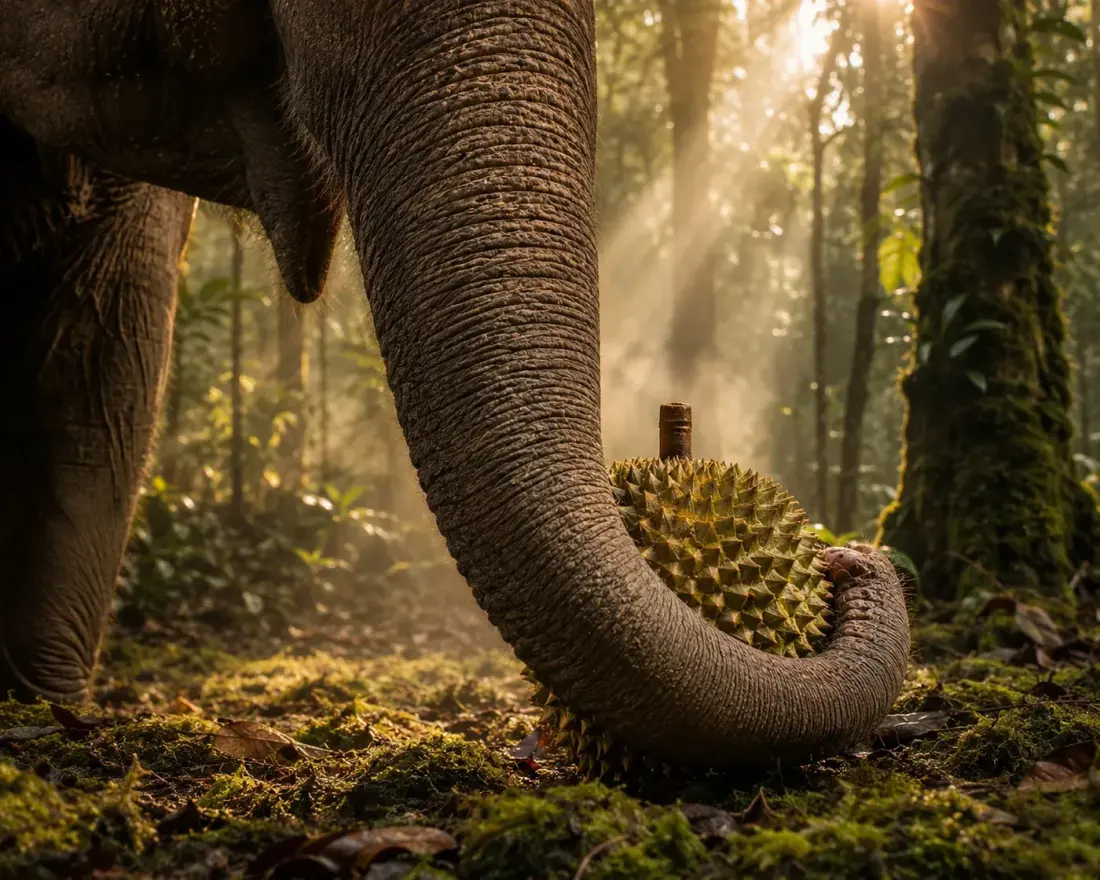
Elephants are the most effective seed dispersers for durian. A single Asian elephant can consume large numbers of fallen durian fruits in a single feeding event, transport seeds over distances of 10–50 km, and deposit them in dung deposits that provide immediate fertilisation.
The relationship between elephants and large-seeded forest fruits (a syndrome called "megafaunal dispersal") is well-documented. Many tropical tree species with large, heavy fruits — including durian — evolved seed characteristics specifically suited to dispersal by large mammals. The thick husk protects seeds from digestive damage; the nutrient-rich flesh rewards the animal sufficiently to travel far from the parent tree before depositing seeds.
Elephants in Malaysia's Sabah (Borneo) are documented consuming durian regularly during fruiting seasons. Human-elephant conflict in durian-growing areas is a recurring issue — elephants enter orchards and consume commercial fruit crops, causing significant damage. This conflict has no easy resolution: the elephants are behaving exactly as they evolved to behave, in landscapes where their traditional forest range has been replaced with durian orchards.
Civets (Viverra tangalunga, Paradoxurus hermaphroditus)
Civets are nocturnal, omnivorous mammals distributed widely across Southeast Asia. They are opportunistic durian consumers — they access fallen fruit and consume flesh, scattering seeds in the process.
The common palm civet (Paradoxurus hermaphroditus) — better known in the context of kopi luwak (civet coffee) — is also documented consuming durian. Their digestive systems process some seeds effectively while leaving others intact for dispersal.
Civets are not the primary dispersers of durian (their size limits how far they carry seeds), but they contribute to secondary dispersal of seeds scattered by larger animals.
Squirrels and Rodents
Squirrels and various rodents consume durian flesh opportunistically. In orchard settings, squirrels are significant pests — they gnaw through the husk before fruit fully ripens, causing substantial harvest losses. Orchard owners in Malaysia and Thailand frequently cite squirrels as a major agricultural problem during durian season, particularly in orchards adjacent to forest.
The ecological role of squirrels in wild durian seed dispersal is minimal — they typically consume seeds rather than disperse them, and their range of movement is limited.
Tigers
Tigers do not consume durian. The inclusion of tigers in the title requires clarification: tigers are apex predators in durian-growing forest ecosystems, and their presence shapes the behaviour of the prey species (deer, wild pigs, sun bears) that do interact with durian. Fewer tigers mean more herbivores and omnivores, which affects fruiting tree pressures. The durian-tiger ecological connection is indirect, mediated through the food web.
Why This Matters for Conservation
The wild animals that pollinate and disperse durian have been declining for decades due to habitat loss, hunting, and forest conversion. This creates an underappreciated agricultural dependency:
- Bat population declines reduce pollination services in areas without managed hives or hand-pollination programs. Durian orchards have documented reduced fruit set in regions where cave bat colonies have been disturbed.
- Elephant conflict increases as forest corridors shrink — elephants that historically moved between forests now encounter orchards in their path.
- Sun bear and orangutan habitat loss is functionally irreversible on agricultural timescales — a cleared forest does not regenerate into wildlife habitat within a farming generation.
Durian's relationship with wildlife is not merely interesting natural history. It is an active, functioning ecological system that continues to affect commercial durian production, and its degradation has real agricultural consequences.
Common Questions
The cave fruit bat (Eonycteris spelaea), also called the lesser dawn bat. These nectarivorous bats visit durian flowers at night, consume nectar, and transfer pollen between trees during feeding. Other bats and insects contribute to pollination, but Eonycteris spelaea is the primary documented pollinator across most of durian's natural range.
Studies of wild sun bear diet in Borneo document a marked shift toward durian consumption during fruiting seasons. Sun bears have been observed travelling toward known fruiting areas and consuming substantial quantities of fallen durian. Durian's high caloric density (147 kcal/100g) makes it a high-value food source for a bear that needs to maintain body weight.
Elephants have historically foraged for fallen durian (and other large fruits) as part of their natural diet. As forest habitat has been converted to orchards, elephants encounter commercial durian crops in what were formerly their foraging routes. They are not "raiding" — they are foraging in a landscape that has changed around them. Orchard damage from elephant incursion is a significant problem in parts of Sabah (Malaysian Borneo).
Yes, negatively. Durian orchard expansion typically involves clearing existing forest — which is orangutan habitat. In Borneo and Sumatra, where all orangutan species are Critically Endangered, any additional habitat conversion for agriculture (including durian farming) reduces viable range and fragments populations. Some conservation organizations have documented orangutans being displaced from areas converted to durian orchards.
Wild durian populations would decline in diversity and eventually in numbers without effective pollination and seed dispersal. Commercial durian orchards manage this by planting at high density (minimizing the need for long-range dispersal) and in some areas practicing hand pollination (manually transferring pollen between flowers). But wild durian forest diversity depends on bat pollination and large mammal seed dispersal — losing these would reduce genetic diversity in wild populations over generations.
Durian flowers are structurally self-incompatible — pollen from a flower cannot successfully fertilise the same flower, and in most cases cannot fertilise flowers on the same tree. Cross-pollination from a different tree (and ideally a different genetic individual) is required for fruit set. This is why bat pollinators and wind are both important, and why orchard planting typically includes multiple varieties or individuals.
Want to try fresh durian from our farm? We grow it at our own Bukit Serampang orchard in Tangkak, Johor, and sell it at our Melaka Mall stall. Stock varies daily — WhatsApp to confirm availability before you visit.
Ask About Today's Fruit