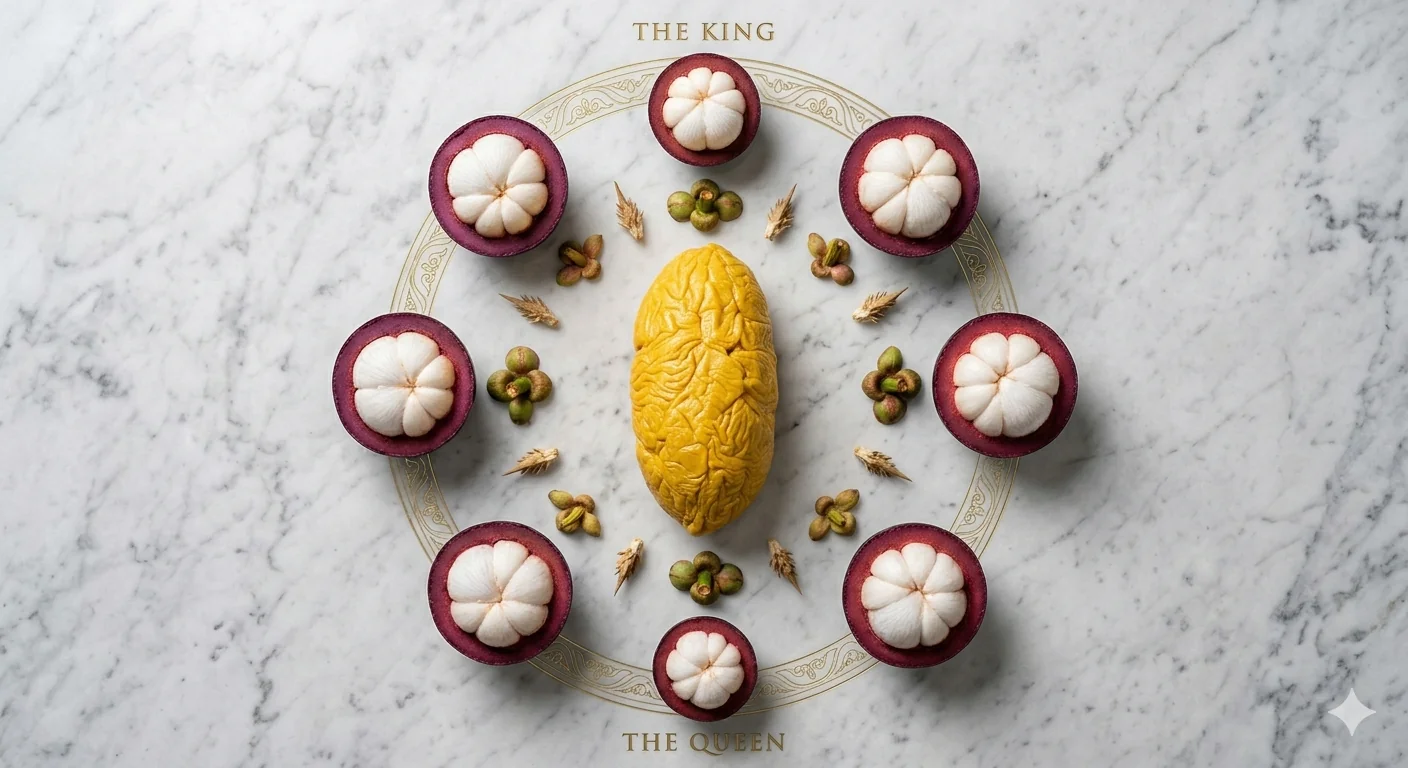
Short answer: Not really. Mangosteen hydrates and refreshes your palate after durian, and it's a lovely pairing, but it doesn't cancel the heat. Smaller portions (2–3 pods), plenty of water and no alcohol help far more.
Walk through any durian stall in Malaysia or Thailand between May and August, and you will see the same scene: a pile of spiky durians on one side, a basket of deep purple mangosteens on the other. The seller tells you, "Durian is heaty, mangosteen is cooling. Eat them together, balance." This advice has been passed down for generations across Southeast Asia. But does it actually hold up, or is it just a convenient sales pitch?
Let us look at what is really going on.
The "Heat" Concept in Traditional Frameworks
The idea of "heat" (heatiness) comes from Traditional Chinese Medicine (TCM) and Malay traditional medicine. In these systems, foods are classified as "heaty" (panas) or "cooling" (sejuk). Durian is considered extremely heaty. Symptoms of excess "heat" include sore throat, mouth ulcers, constipation, and acne breakouts.
Mangosteen, on the other hand, is classified as cooling. The logic is straightforward: pair a heaty food with a cooling one, and the body stays balanced.
This classification system is not scientific in the Western sense. It is observational, built over centuries of noticing how people feel after eating certain foods. But it does not mean it is entirely without basis.
What Science Says About Durian
Durian is calorie-dense. One kilogram of durian flesh contains roughly 1,470 kcal, with a carbohydrate content of about 27g per 100g and significant fat (about 5g per 100g). It is also rich in sulfur compounds, particularly volatile thioacetals and esters, which give it the strong odour.
When you eat a large amount of durian, your body processes a heavy load of carbohydrates, fat, and sulfur-containing compounds. This increases metabolic activity. Your body temperature may rise slightly. You may sweat. Your digestive system works harder. These physiological responses are real, and they likely contributed to the traditional classification of durian as "heaty."
There is also the alcohol angle. Durian contains compounds that inhibit aldehyde dehydrogenase (ALDH), the enzyme that breaks down alcohol metabolites. This is why combining durian with alcohol is traditionally warned against. A study from the University of Tsukuba (Japan) found that durian extract suppressed ALDH activity in laboratory tests. The effect in humans at normal consumption levels is still debated, but the mechanism is plausible.
What Science Says About Mangosteen
Mangosteen (Garcinia mangostana) is rich in xanthones, particularly alpha-mangostin, which has demonstrated anti-inflammatory and antioxidant properties in laboratory studies. Scientific reviews have found that xanthones from mangosteen show anti-inflammatory activity in cell and animal models.
Mangosteen is also high in water content (about 81% of the fruit) and contains vitamin C, folate, and fibre. It is low in calories compared to durian — roughly 73 kcal per 100g.
The cooling sensation people report after eating mangosteen is partly physical: the high water content and the act of eating a cold, juicy fruit genuinely lowers the sensation of internal warmth. The anti-inflammatory compounds may also play a subtle role, though you would need to eat a very large quantity to achieve therapeutic levels of xanthones from fruit alone.
So, Does Mangosteen Cancel Durian Heat?
Here is the honest answer: partially, but not in the way most people think.
What mangosteen does well:
1. Hydration. The high water content helps your body process the heavy carbohydrate and fat load from durian. Staying hydrated genuinely reduces the discomfort associated with eating rich, dense foods.
2. Anti-inflammatory compounds. The xanthones in mangosteen rind and flesh have real anti-inflammatory properties. While the amount you get from eating a few fruits is modest, it is not zero.
3. Psychological and sensory effect. Eating a cold, sweet, juicy fruit after a rich, heavy one creates a genuine sensation of relief. Your palate resets. Your body feels lighter. This is real, even if it is not "cancelling heat" in a biochemical equation.
What mangosteen does NOT do:
1. It does not neutralise the metabolic load of durian. Your liver and digestive system still have to process all that carbohydrate, fat, and sulfur regardless of what else you eat.
2. It does not prevent the ALDH inhibition that durian causes. If you are drinking alcohol, mangosteen will not protect you.
3. It is not a medicine. The anti-inflammatory effects observed in lab studies use concentrated extracts, not the amount present in a few fruits.
Practical Takeaway
Eat mangosteen after durian if you enjoy it. It is a pleasant combination, and the hydration and mild anti-inflammatory benefits are real, even if modest. But do not rely on it as a shield. If you are prone to sore throats or acne after eating durian, the best strategies are:
- Limit your durian intake to 2–3 pods (about 100–150g of flesh) per sitting
- Drink plenty of water
- Avoid combining durian with alcohol or very spicy food
- Eat mangosteen or drink mangosteen rind tea as a complementary measure, not a cure
The king and queen pairing works as a cultural practice and a sensory experience. Just do not treat it as medical fact.
There is no established scientific ratio. Eating 2–3 mangosteens after a moderate durian meal is common practice and provides hydration and some anti-inflammatory compounds. More is not necessarily better, as mangosteen also contains sugar.
You can, but eating it after is more effective for the sensory reset. The cooling, hydrating effect is most noticeable when your palate is already heavy from durian.
No. The traditional concept of "heatiness" refers to a cluster of symptoms (sore throat, mouth ulcers, constipation) rather than a measurable rise in body temperature. It is a pattern of discomfort, not a clinical fever.
Mangosteen rind contains higher concentrations of xanthones than the flesh. A tea made from boiled rind may deliver more anti-inflammatory compounds. However, scientific evidence for its effectiveness specifically against durian-related discomfort is still limited to traditional use.
Children can eat both fruits in moderation. Durian is very calorie-dense and high in carbohydrates, so portion control is important. A small amount of durian (1–2 pods) with a mangosteen is reasonable for older children. Avoid giving durian to infants.
Individual metabolism plays a big role. People with faster metabolisms, better hydration, and no underlying digestive sensitivities may process durian without noticeable discomfort. Those with slower digestion, existing inflammation, or sensitivity to sulfur compounds are more likely to experience symptoms.
No single food can fully neutralise the metabolic effects of durian. The closest things that help are water (hydration), coconut water (electrolytes), and foods with genuine anti-inflammatory properties like mangosteen. But moderation with durian itself remains the most effective strategy.
Durian is high in carbohydrates and calories, so pregnant women with gestational diabetes should be cautious. Mangosteen in normal food amounts is generally considered safe. However, pregnant women should consult their doctor, especially regarding mangosteen supplements or concentrated extracts, as high-dose xanthone safety in pregnancy has not been well studied.
Sources
- Maninang JS, Lizada MCC, Gemma H (2009). Inhibition of aldehyde dehydrogenase enzyme by durian (Durio zibethinus Murray) fruit extract. Food Chemistry 117(2): 352–355. Link
- U.S. Department of Agriculture. Durian, raw or frozen (FDC 168192). FoodData Central. Link
Fresh durian, farm-direct. Stock changes daily — WhatsApp us before you visit.
Check Today's Stock