Phytophthora root rot and bark rot are among the most damaging diseases in Malaysian durian orchards. By the time a farmer notices the characteristic brown weeping cankers on bark, the infection has usually been active for weeks. Trees at that stage are difficult to save and often spread the pathogen to neighbours.
The core problem isn't knowledge — experienced durian farmers know what Phytophthora looks like. The problem is scale and timing. Walking every tree in a 50-acre orchard every two weeks to spot early symptoms is not practically possible with the labour available on most farms.
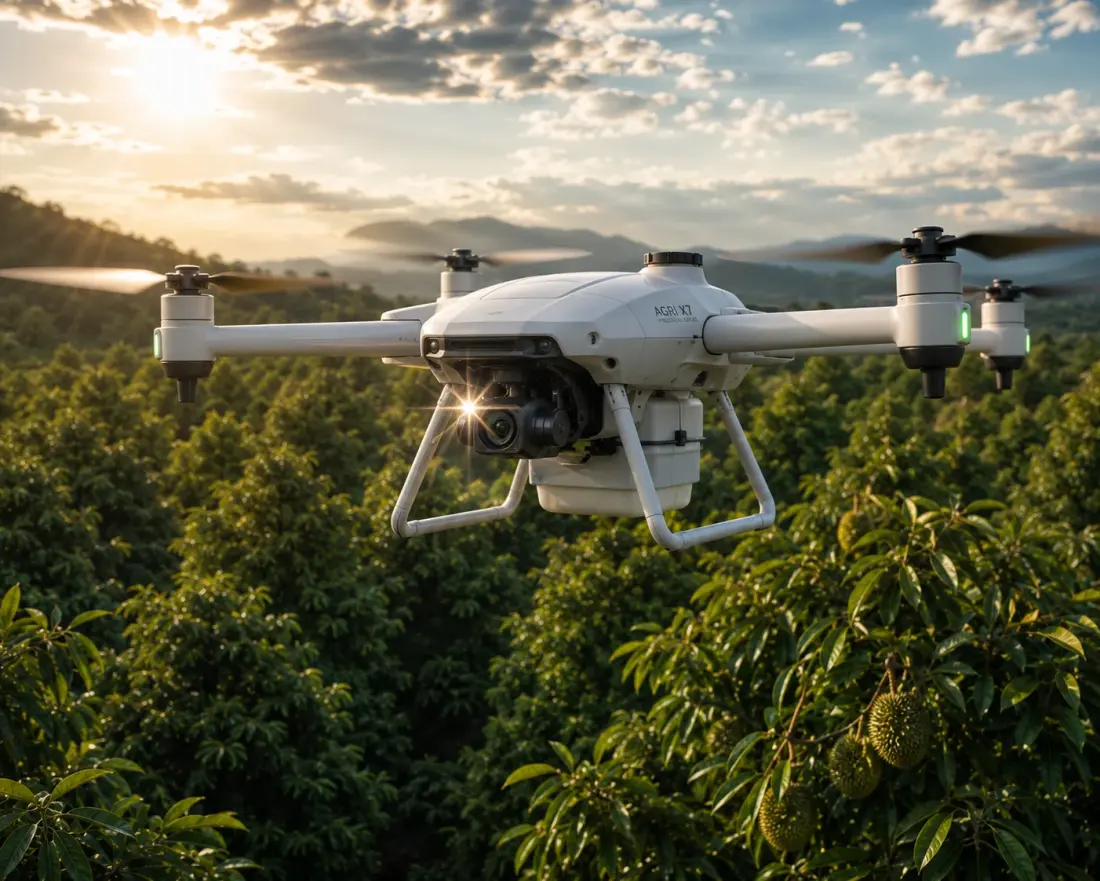
Autonomous drone patrols change the scale equation. A pre-programmed drone covering the full orchard on a regular schedule, feeding imagery into an AI disease detection pipeline, can flag reflectance anomalies that indicate stress — potentially 5–14 days before any visible symptoms appear on the bark. Ground inspection then targets specific flagged trees rather than the entire orchard.
Here's how the system works, what it costs, and what the real limitations are.
How Autonomous Patrols Work
"Autonomous" in this context means the drone follows a pre-programmed flight path without a pilot actively controlling it per flight. The path is set up once, covering the orchard in a systematic grid or corridor pattern at a set altitude. After that, the farmer triggers the flight — or it runs on a schedule — without hands-on piloting.
The sensors matter more than the drone itself. Standard RGB cameras capture visible-light imagery useful for detecting gross symptoms and fruit development. Multispectral cameras capture wavelengths beyond visible light, including near-infrared, which is where the real disease detection happens.
The key metric is NDVI — Normalized Difference Vegetation Index. Healthy green plant tissue has a characteristic reflectance signature in the near-infrared band that declines measurably when the plant is under stress, before the stress is visible to the human eye. Phytophthora infection reduces this reflectance in the affected zones of the tree's canopy 5–14 days before bark symptoms appear.
The Processing Pipeline
Images from a drone survey don't become actionable information on their own. The pipeline:
Images upload to a cloud platform (automatically, via drone docking station or manual transfer). The AI classifier analyzes NDVI and reflectance patterns across the orchard imagery. Anomalous zones — areas where reflectance is outside the healthy range for that variety and season — get flagged. The farmer receives a GPS-tagged alert on their phone, showing which trees or zones triggered the flag. Ground inspection at flagged locations confirms or rules out actual disease.
The map output is typically a colour-coded NDVI overlay on a satellite image of the orchard. Red zones mean investigate immediately. Yellow means monitor. Green means normal.
False positive rate with current systems runs at 10–15%. That is, roughly 1 in 7 to 1 in 10 alerts requires a ground check that finds nothing wrong — the flag was triggered by non-disease stress, nutrient deficiency, or sensor noise. Ground checks are always required before treatment decisions.
Flight Frequency And Drone Type
Recommended flight frequency: bi-weekly during the wet season when disease pressure is highest; monthly during the dry season as a routine check.
Two main drone types serve different farm sizes:
Fixed-wing drones cover more area faster — over 100 acres per hour of flight time. They're better suited for large operations (100+ acres) where coverage speed is the priority. They require a landing strip or catapult launch and can't hover in place.
Multirotor drones (the more common quadcopter style) fly slower but manoeuvre better around complex canopy and irregular terrain. They're more practical for orchards under 50 acres. They can take off and land vertically, hover to inspect a specific tree, and operate from small clearings.
The Pahang Case
A concrete example of this working: a Pahang orchard operating a bi-weekly drone patrol program detected unusual reflectance anomalies in a cluster of 15 trees during the wet season. Ground inspection confirmed early-stage Phytophthora bark infection in 12 of those trees — before any visible symptoms. Spot fungicide treatment (phosphonate-based, applied directly to affected bark) plus improved drainage in that zone arrested the infection. All 12 trees survived and continued producing. Without early detection, the standard outcome would have been symptomatic trees discovered too late for high-confidence treatment, likely resulting in loss of several trees.
Cost And Regulatory Context
Commercial drone survey service: RM 100–300 per acre per survey. For a 50-acre orchard at bi-weekly frequency during a 4-month wet season, that's roughly RM 40,000–120,000 per season in survey costs — expensive, but compare it against tree replacement and lost production.
Owning a drone: RM 15,000–80,000 for the drone plus multispectral sensor payload. Processing software subscription adds RM 500–2,000 per month depending on platform. Ownership makes sense for operations doing frequent surveys over multiple seasons.
Regulatory note: Malaysia's Civil Aviation Authority (CAAM) requires drone operator certification for commercial operations. Farm owners can operate drones on their own land under recreational rules without commercial certification — but this has altitude and operational restrictions. Check current CAAM guidelines before operating.
Integration With Disease Management
The direct operational benefit beyond early detection: AI-flagged zones enable spot treatment rather than blanket application. Chemical applied only to flagged areas rather than the entire orchard reduces fungicide usage 20–40% compared to calendar-based blanket spraying. This is both a cost saving and a resistance management benefit — reducing selection pressure for fungicide-resistant Phytophthora strains.
Practical Takeaway
Autonomous drone patrols don't eliminate disease — they compress the detection window. That compression has real value because Phytophthora at early stage responds to treatment reliably; Phytophthora at symptomatic stage does not. The 10–15% false positive rate means ground inspection is always part of the workflow. But targeted ground inspection of 5–10 flagged trees is far more manageable than walking every tree every two weeks.
The economics work most clearly for medium to large orchards where tree replacement costs and lost production make early intervention worthwhile. For small family orchards, the cost per survey is harder to justify unless pooled with neighbouring farms for a shared drone patrol service.
Common Questions
Research shows reflectance anomalies in NDVI imagery appearing 5–14 days before bark rot symptoms are visible to human observation. The window varies with infection stage and tree health.
NDVI measures the difference between near-infrared and red light reflectance from plant tissue. Healthy green tissue has a high NDVI signature. Stressed, infected, or dying tissue has a lower signature. Disease reduces NDVI before the tree looks visibly sick.
Current systems show 10–15% false positive rates. Every flagged zone requires ground inspection before treatment. The system identifies areas to check — a human still makes the treatment decision.
In Malaysia, commercial drone operations require CAAM certification. Farm owners operating on their own land under recreational rules have more flexibility. Check current CAAM regulations for your specific situation.
Yes, but accuracy varies by disease. Phytophthora has a strong NDVI signature. Nutrient deficiencies, Ganoderma, and other stressors also appear in multispectral imagery, though distinguishing between them requires more sophisticated models or ground confirmation.
Fixed-wing covers more area faster (100+ acres/hour) but needs space to land and can't hover. Multirotor is slower but more maneuverable and can operate in tight spaces. Fixed-wing for large orchards, multirotor for under 50 acres.
Hiring is lower upfront risk and makes sense for occasional surveys. Owning makes sense for frequent (bi-weekly) surveys over multiple seasons. At 8+ surveys per year, ownership typically becomes more economical.
A standard RGB drone can detect advanced visible symptoms but cannot detect the pre-symptomatic NDVI anomalies that make early detection valuable. For meaningful early disease detection, multispectral is necessary.
Want to try fresh durian from our farm? We grow it at our own Bukit Serampang orchard in Tangkak, Johor, and sell it at our Melaka Mall stall. Stock varies daily — WhatsApp to confirm availability before you visit.
Ask About Today's Fruit