Every durian farmer knows the headache of yield estimation. You walk the orchard, count what you can see, guess at what's hidden in the canopy, scribble numbers on paper, and end up with a figure you're maybe 60% confident in. Then the logistics calls start — how many workers, how many trucks, how many cold chain slots do you book?
There's a different way to do this now. Computer vision systems mounted on drones or handheld cameras can count fruit in a canopy image in 5–10 seconds per frame. An entire orchard survey that used to take two full person-days can be done in 45–90 minutes. The numbers aren't perfect, but they're consistently better than a farmer eyeballing rows in afternoon heat.
Here's how it actually works, what the limitations are, and whether it's worth considering for your operation.
How Computer Vision Fruit Counting Works
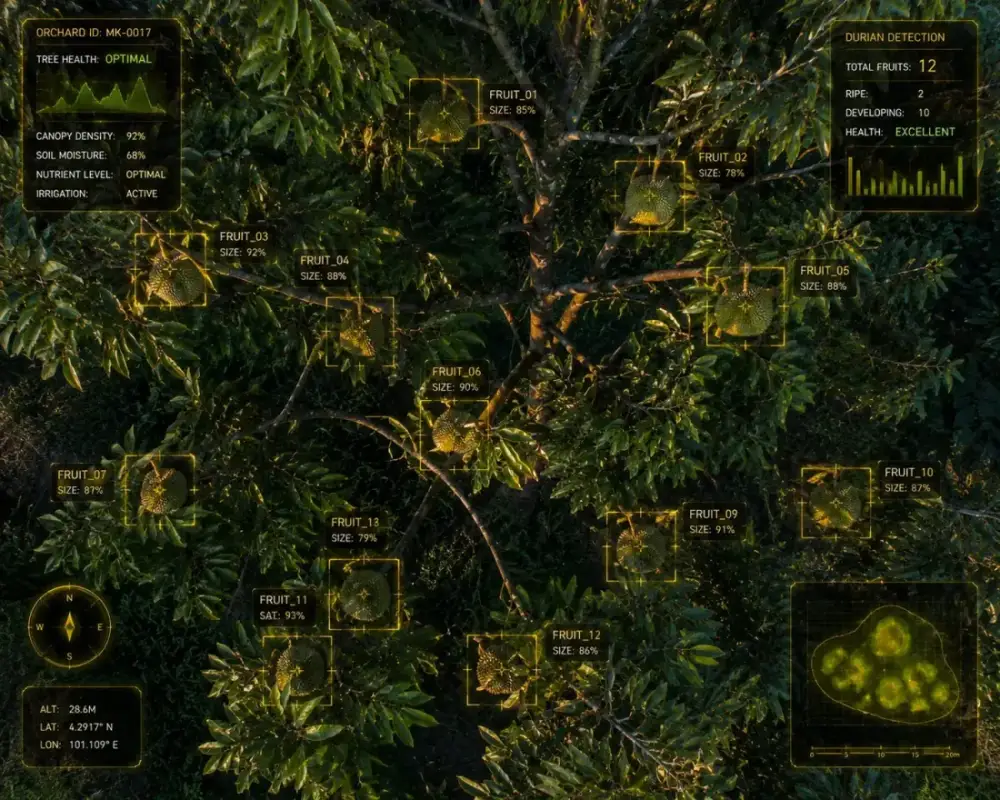
The core technology is object detection — specifically, AI models (many built on YOLO architecture) trained to recognize durian fruit in photographic imagery. You feed the system images from a drone survey or a person walking the orchard with a smartphone, and the model draws bounding boxes around each fruit it identifies, counting as it goes.
The output isn't just a number. Well-designed systems return a GPS-tagged count per tree or per orchard zone, giving you a spatial map of where fruit density is high or low.
Accuracy under good canopy conditions — good lighting, not fully closed canopy — runs at 85–92% in well-trained models. When the canopy is dense and fruits overlap or hide behind leaves, that drops to 70–80%. The honest limitation: a drone flying overhead simply cannot see fruit tucked deep inside the tree. Ground-truth sampling (manually counting a representative subset of trees) is still recommended to calibrate the AI's output.
Turning A Count Into A Yield Prediction
A fruit count alone is useful. A yield prediction is more useful. The gap between them is fruit weight estimation.
This is where historical variety data matters. Musang King fruit average 1.5–3.5 kg per fruit depending on season and growing conditions. Thai Monthong runs heavier at 2–4 kg per fruit. The AI system can also estimate relative fruit size from image geometry — a fruit occupying a larger area in the frame, at a known camera distance, is estimated as heavier.
The yield prediction formula is straightforward:
Estimated yield = fruit count × estimated average fruit weight
Research models using this approach achieve 70–85% accuracy at 60-day harvest prediction horizons. That's substantially better than experienced-farmer eyeball estimates, which tend to be 50–65% accurate at the same timeframe. It's not a guarantee, but it's a usable planning number.
Why This Matters For Logistics
The commercial value of yield prediction isn't in the number itself — it's in what you can do with the number early enough to act on it.
With a reliable 60-day estimate, a farm operation can:
- Pre-book cold chain capacity (cold rooms, refrigerated transport) at better rates than last-minute booking
- Confirm or adjust export quota commitments before the harvest window
- Schedule the correct number of harvest workers with enough lead time
- Negotiate forward pricing with buyers rather than accepting spot prices during glut periods
These are real cost differences. Cold chain booked two months out costs less per slot than cold chain booked at harvest time during peak season.
Tools And Approaches Available
Commercial applications: AgriEye and FruitCount AI are among the specialized platforms built for agricultural fruit counting. These typically offer subscription-based drone data processing.
Custom models: Some larger operations work with agrtech developers to build custom YOLO-based models trained specifically on their variety and canopy conditions. More accurate for that specific context, higher upfront cost.
DIY approach: Smartphone camera plus open-source counting apps (several exist in the agricultural AI space) gives a free option with meaningfully lower accuracy — suitable for rough estimates on small plots, not for logistics pre-booking on commercial volumes.
Drone types matter: Fixed-wing drones cover more area faster (useful for orchards over 100 acres) while multirotor drones fly slower but can manoeuvre into more complex canopy angles.
Practical Takeaway
Computer vision fruit counting is not a magic solution, and the accuracy ranges should be read honestly — 70–92% depending on conditions means there's real variance. But it solves a specific, real problem: turning a two-day manual counting exercise into a 90-minute automated survey, and turning a gut-feel yield estimate into a data-backed number you can actually build logistics plans around.
For orchards large enough that yield prediction errors cost real money in cold chain, labour, or export commitments, the technology cost is likely worth evaluating. For small family orchards where the farmer knows each tree personally, the value proposition is less clear.
Common Questions
Well-trained models hit 85–92% accuracy in good canopy conditions. Dense canopy drops this to 70–80%. Manual counting by a careful worker is more accurate per tree but takes dramatically longer across a full orchard.
No. Fruits hidden deep in the canopy, obscured by leaves or branches from the drone's angle, will be missed. This is the main reason ground-truth sampling on a subset of trees is still recommended alongside drone surveys.
Research models report 70–85% accuracy at 60-day prediction horizons — noticeably better than experienced-farmer estimates, which typically run 50–65% accurate at that timeframe.
Field average is 1.5–3.5 kg per fruit, with significant variation by season, soil, and tree age. Monthong runs 2–4 kg per fruit on average.
45–90 minutes for a full survey, compared to 1–2 person-days for manual counting per hectare. Processing time per image is 5–10 seconds.
Commercial options include AgriEye and FruitCount AI. Open-source smartphone apps exist for DIY use with lower accuracy. Large operations sometimes commission custom YOLO-based models.
Drone survey services can be hired rather than bought. The DIY smartphone approach is free but less accurate. The cost justification depends on whether yield prediction errors currently cost you money in logistics, labour, or pricing decisions.
Not yet. Current recommendation is to use drone counting as the primary method, calibrated by manual ground-truth counting on a sample of trees. The combination is faster than pure manual and more reliable than pure AI.
Want to try fresh durian from our farm? We grow it at our own Bukit Serampang orchard in Tangkak, Johor, and sell it at our Melaka Mall stall. Stock varies daily — WhatsApp to confirm availability before you visit.
Ask About Today's Fruit